

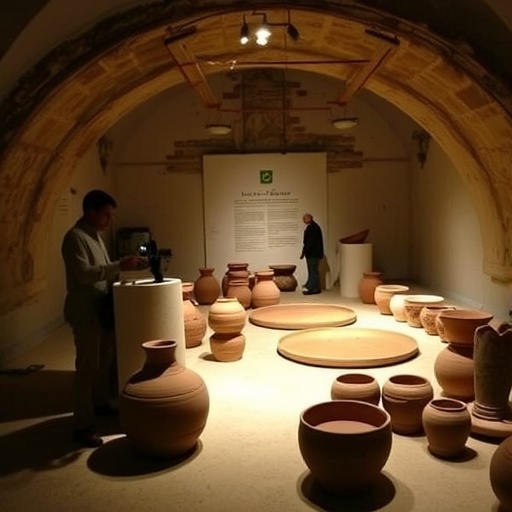
Revolutionizing Archaeology: Unveiling Pottery’s Chrono-Cultural Significance in Cave Settings
In the complex tapestry of human history, pottery stands out as one of the most significant artifacts, offering profound insights into the cultural practices and daily lives of ancient societies. Deep within European archaeological sites, particularly in cave environments such as the Grotte di Sant’Angelo Cave Complex in Calabria, Italy, researchers are leveraging advanced techniques to analyze pottery in unprecedented detail. This research promises to redefine our understanding of prehistoric societies, revealing the intricate relationships between culture, time, and material production.
The innovative research spearheaded by a team of archaeologists, including Carloni, Larocca, and Attema, outlines a framework for conducting in-depth chrono-cultural and functional analysis of pottery. This approach is driven by the need to move beyond traditional archaeological methodologies, which often fail to capture the nuanced meanings associated with pottery production and use. The method integrates chronological, cultural, and functional dimensions, providing a multifaceted perspective on these artifacts that is crucial for comprehending their role in ancient societies.
One of the primary focuses of this research is the Grotte di Sant’Angelo Cave Complex, a site that offers a wealth of archaeological data. Situated in Cassano allo Ionio, this prehistoric cave system has yielded a rich trove of artifacts and organic remains, creating a unique opportunity for researchers to probe the socio-economic dynamics of ancient inhabitants. The researchers meticulously excavated pottery fragments, each offering a glimpse into the lives of the individuals who once occupied these caves, including their cooking practices, social interactions, and even trade relations with neighboring groups.
To achieve a comprehensive understanding of the pottery, the researchers employed cutting-edge techniques in chrono-cultural analysis. This method emphasizes the correlation between pottery styles and the time periods from which they originated. By cross-referencing ceramic typologies with stratigraphic data, the team established a clearer chronological framework for the artifacts. This process not only aids in dating the pottery but also uncovers the evolution of styles over time, reflecting shifts in cultural practices and interactions among different groups.
Functional analysis, another integral component of the team’s research methodology, focuses on the practical uses of pottery in everyday life. By examining surface residues and conducting use-wear analysis, the researchers could infer the specific functions these items served. For instance, the residue from food preparation or storage can reveal dietary habits and subsistence strategies, while the wear patterns can indicate the frequency and nature of their use. Such insights illuminate the complex interplay between people and their environment.
The researchers further enriched their findings by comparing the data from the Grotte di Sant’Angelo with other contemporaneous sites across Europe. This comparative analysis highlighted regional variations in pottery styles and functions, shedding light on broader cultural trends. It emphasizes that pottery is not merely functional but also a canvas for cultural expression, allowing for the transmission of identity and tradition across generations.
Moreover, the significance of this research extends beyond pottery itself; it offers a reflection on the interconnectivity of prehistoric cultures. The findings underscore how technological advancements in pottery production facilitated trade and communication among disparate groups, thus fostering the exchange of ideas and practices that shaped cultural evolution. It exemplifies how seemingly mundane artifacts carry stories of cooperation, competition, and innovation, illustrating the complexity of human societal development.
As the study unfolds, the researchers anticipate that their work will prompt further investigations into other archaeological sites across Europe. Each site presents its own unique context, challenges, and opportunities for understanding human history through material culture. There is great potential for this approach to contribute to a more nuanced understanding of the prehistoric world, as archaeologists align their findings to construct a more cohesive narrative of human development.
The implications of this research are particularly significant in the context of ongoing discussions surrounding archaeological practices and preservation. Pottery, often viewed merely as debris in excavation sites, is now recognized as a vital source of knowledge. This shift in perspective has the potential to change how future archaeological work is conducted, encouraging a focus on the careful analysis of artifacts rather than simple cataloging.
In conclusion, the investigation into the chrono-cultural and functional analysis of pottery in European cave archaeology, exemplified by the detailed study conducted at the Grotte di Sant’Angelo, brings forth a new paradigm in archaeological research. By merging various analytical techniques and drawing from a vast pool of data, researchers are revealing the profound stories embedded in pottery. As they delve deeper into the past, these archaeologists illuminate the rich tapestry of human existence, unveiling how materials can tell us not just about what people did, but who they were as social beings.
This groundbreaking research marks a significant stride in the field of archaeology, challenging traditional narratives and opening avenues for future explorations. As we strive to understand the multifaceted dimensions of human history, studies like this remind us that the remnants of the past—whether pots, tools, or art—serve as valuable connections to our shared heritage, reminding us of the complexity of the human experience across time and space.
Subject of Research: Pottery analysis in European cave archaeology
Article Title: Evaluating the potential of in-depth chrono-cultural and functional analysis of pottery in European cave archaeology: a case study from the prehistoric Grotte Di Sant’angelo Cave Complex (Cassano allo Ionio – Calabria, Italy).
Article References: Carloni, D., Larocca, F., Attema, P.A.J. et al. Evaluating the potential of in-depth chrono-cultural and functional analysis of pottery in European cave archaeology: a case study from the prehistoric Grotte Di Sant’angelo Cave Complex (Cassano allo Ionio – Calabria, Italy). Archaeol Anthropol Sci 18, 30 (2026). https://doi.org/10.1007/s12520-025-02332-1
Image Credits: AI Generated
DOI: https://doi.org/10.1007/s12520-025-02332-1
Keywords: Pottery, Archaeology, Grotte Di Sant’Angelo, Chrono-Cultural Analysis, Functional Analysis, Prehistoric Societies, Italy.


