


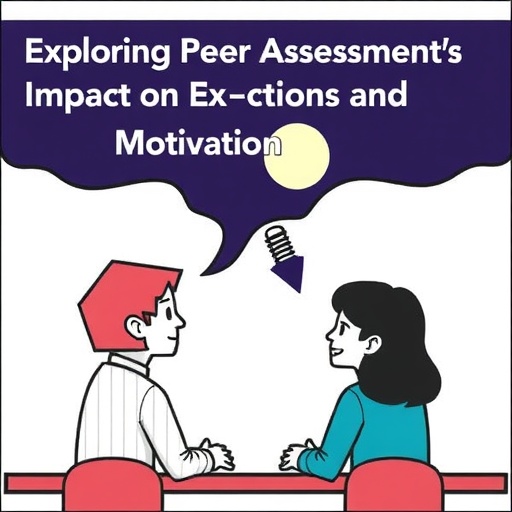
In an era where educational methodologies are continuously evolving, recent research sheds light on the intricacies of peer assessment and its impact on students’ affective outcomes, such as motivation, self-efficacy, and anxiety. The study, authored by Lu, Lei, Chiu, and others, systematically analyzes various data points, revealing that peer assessment is more than just a grading technique; it is a multifaceted approach that can influence students’ emotional and psychological landscapes significantly.
Peer assessment encourages students to take on the dual role of evaluator and participant, fostering a sense of community and collaboration in the learning environment. It requires learners to engage critically with their peers’ work, prompting them to reflect on their understanding of the material while gaining insights from alternative perspectives. This interaction often feeds into a collaborative ethos, enhancing emotional connection and reducing competitive anxieties common in traditional grading systems.
Furthermore, the meta-analysis indicates a positive correlation between peer assessment practices and students’ motivation. Motivation, often seen as a driving force behind learning, benefits when students perceive their assessments as meaningful. By engaging in peer evaluation, students come to understand the value of constructive feedback, making the learning process not only about personal achievement but also about supporting one another’s growth. This communal approach bridges emotional distances often found in education, creating a collaborative atmosphere where students feel more invested in their educational journeys.
The study delves deeper into self-efficacy, which refers to a learner’s belief in their ability to succeed in specific tasks. Engaging in peer assessment enables students to witness their peers’ strengths and weaknesses, which can either bolster or diminish their confidence in their abilities. The findings suggest that when peer feedback is framed positively and constructively, it can lead to an increase in self-efficacy. Students begin to realize that they are not alone in facing challenges and that they can provide valuable insights based on their own experiences.
Another intriguing aspect of this meta-analysis is its examination of anxiety levels among students participating in peer assessments. Traditional assessments often evoke anxiety as students feel immense pressure to perform well. However, the findings indicate that peer assessment can mitigate some of this anxiety by promoting a more relaxed atmosphere. The shift from competitive testing to collaborative evaluation allows students to express themselves without the fear of severe repercussions tied to grades alone.
This research underscores the importance of integrating peer assessment into educational practices. However, it also emphasizes that the success of such interventions hinges on proper implementation. Educators must provide clear guidelines and frameworks that lead students through the peer assessment process to maximize its potential benefits. This includes training on constructive feedback techniques and fostering a growth mindset among students.
Importantly, the findings are not only applicable in traditional classroom settings but extend to various educational environments, including online and hybrid models. As education increasingly moves into the digital domain, peer assessment tools can be implemented using technology, enhancing accessibility while maintaining effectiveness. This adaptability of peer assessment techniques ensures that diverse learner groups can benefit, regardless of the educational context.
As the research indicates, successful implementation of peer assessment can lead to transformative outcomes for students. It aligns well with the contemporary emphasis on personalized, student-centered learning experiences, fostering an educational landscape where students feel empowered and engaged. The insights gleaned from this meta-analysis serve as a call-to-action for educational stakeholders to reconsider assessment strategies and prioritize methods that genuinely contribute to learners’ affective and academic success.
Additionally, educational institutions must recognize the importance of feedback culture. Shifting from a punitive to a supportive milieu can significantly affect how students engage with their learning environments. The emphasis on peer assessment as a tool not only for grading but also for psychological well-being encourages a holistic approach to education that values emotional intelligence as much as academic proficiency.
In conclusion, the research conducted by Lu, Lei, Chiu, and their colleagues opens up new avenues for understanding how interpersonal dynamics can shape educational outcomes. Peer assessment is not merely a method of evaluation but a transformative educational practice that addresses crucial affective outcomes, fostering a more inclusive and supportive learning environment. As educational paradigms continue to shift, embracing such methodologies will be vital in preparing students for not just academic success but lifelong learning experiences.
Lu, Z., Lei, H., Chiu, M.M. et al. Meta-analyses of Peer Assessment and Affective Outcomes: Motivation, Self-efficacy, and Anxiety. Educ Psychol Rev 38, 14 (2026). https://doi.org/10.1007/s10648-025-10098-0
Cite Scienmag News
Courtney Benton. (January 27, 2026). Exploring Peer Assessment’s Impact on Emotions and Motivation. Scienmag. https://scienmag.com/exploring-peer-assessments-impact-on-emotions-and-motivation/
Courtney Benton. "Exploring Peer Assessment’s Impact on Emotions and Motivation." Scienmag, 27 January 2026, https://scienmag.com/exploring-peer-assessments-impact-on-emotions-and-motivation/. Accessed 4 September 2026.
Courtney Benton. "Exploring Peer Assessment’s Impact on Emotions and Motivation." Scienmag. January 27, 2026. https://scienmag.com/exploring-peer-assessments-impact-on-emotions-and-motivation/


