

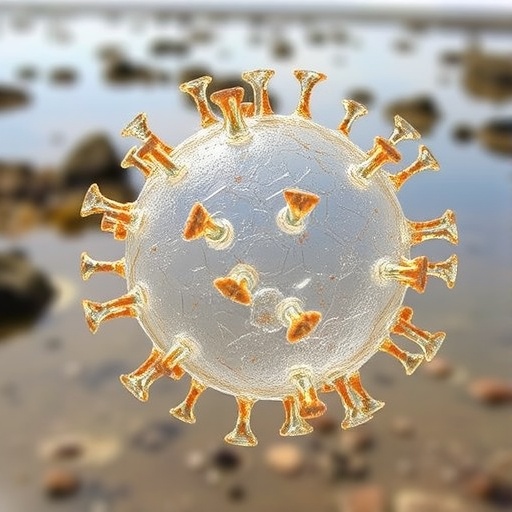
In a groundbreaking study published in Nature Communications, a team of researchers led by Ji, Li, and Wang have unveiled an astonishing diversity of large DNA viruses thriving in the seemingly inhospitable realm of intertidal mudflats. This pioneering metagenomic research sheds new light on the hidden viral world, revealing complex ecological dynamics where these giant viruses play critical roles in coastal ecosystems. The implications of these findings extend far beyond marine biology, offering fresh perspectives on viral evolution, environmental adaptations, and genomic complexity.
Intertidal mudflats—coastal wetlands frequently submerged and exposed by the tides—are among Earth’s most dynamic and productive ecosystems. Historically, these environments have been studied for their microbial communities, nutrient cycling, and their role as nurseries for marine life, but the viral populations inhabiting these zones remained largely enigmatic. By employing state-of-the-art metagenomic sequencing techniques, Ji and colleagues have now mapped an unprecedented breadth of viral diversity present within these sediments, profoundly shifting the spotlight onto the giant DNA viruses that dominate these ecosystems.
The researchers deployed high-throughput sequencing to extract and catalog DNA directly from sediment samples collected across multiple geographically distinct mudflats. Unlike traditional viral classification approaches limited by culturability, metagenomics allowed the team to reconstruct entire viral genomes without prior cultivation, facilitating the discovery of novel viral lineages. The utilization of advanced bioinformatic pipelines enabled the classification and phylogenetic analysis of these sequences, confirming that the majority of detected viruses belong to the nucleocytoplasmic large DNA viruses (NCLDVs) supergroup—colloquially known as giant viruses—some of which harbor genomes larger than many bacteria.
One of the most captivating revelations of the study is the sheer abundance and genomic complexity of these large DNA viruses. Their genomes encode a remarkable array of genes, including those traditionally associated with cellular life, such as DNA repair enzymes, metabolic genes, and even components involved in translation. This finding challenges the conventional understanding of viruses as mere genetic parasites, suggesting instead that giant viruses possess genetic versatility that may enable them to influence host physiology profoundly and manipulate ecological functions within these sedimentary habitats.
The presence of such genetically versatile giant viruses in intertidal mudflats highlights their potential role in modulating microbial communities and nutrient fluxes. By infecting and lysing key microbial populations, these viruses could drive biogeochemical cycles, impacting carbon and nitrogen turnover in these environments. Furthermore, their interactions may facilitate horizontal gene transfer, contributing to the genetic innovation of sediment-dwelling microbes, ultimately shaping ecosystem resilience and adaptability under environmental fluctuations such as tidal changes and salinity gradients.
Ji and colleagues’ methodological approach further emphasizes the move towards comprehensive viral ecology studies. Integrating metagenomics with metatranscriptomics allowed the researchers to discern not only the identity but also the activity profiles of these viruses in situ. This dual approach demonstrated that many large DNA viruses are actively transcribing genes in the mudflat sediments, confirming their functional relevance rather than representing dormant or relic DNA. This insight reinforces the concept that viral populations are dynamic and tightly interconnected with the ecosystem’s overall health and productivity.
This study also undertook phylogenomic comparisons that reposition some of the newly identified viral genomes within the existing giant virus taxonomy, expanding the known viral tree of life. Intriguingly, several newly discovered clades show unique adaptations potentially related to the fluctuating environmental stresses characteristic of intertidal zones, such as extreme changes in temperature, desiccation, and osmolarity. These adaptations may include specialized gene clusters enabling viral persistence during tide-induced dormancy phases or facilitating infection cycles synchronized with microbial host availability.
The metagenomic data also provided insights into viral-host interactions, revealing putative hosts among a diverse set of sedimentary protists, bacteria, and archaea. By leveraging CRISPR spacer matching and genome-resolved metagenomics, the team inferred viral predation networks crucial to understanding how viral infections cascade through microbial food webs. These networks underscore the integral role of giant viruses as ecosystem engineers, controlling microbial population dynamics and contributing to sediment ecosystem homeostasis.
From a broader evolutionary perspective, the findings open exciting questions regarding virus-host coevolution in extreme environments. The intertidal mudflats, subjected to constant environmental pressures, may act as crucibles for viral innovation, driving the emergence of novel genetic modules that could disseminate to other ecosystems via tidal connectivity. Such gene flow could have worldwide ecological significance, potentially influencing evolutionary trajectories of marine microbial communities at large.
Another profound contribution of this research lies in demonstrating the value of intertidal zones as biodiversity hotspots for viral populations, a fact previously underappreciated. This realization could reshape conservation priorities and environmental monitoring frameworks, emphasizing the need to preserve and study these transitional habitats, which harbor cryptic yet ecologically significant viral assemblages.
The researchers underscored the technical challenges they overcame, including overcoming inhibitors common in muddy sediment DNA extractions and differentiating viral DNA from host and microbial genomes in complex metagenomes. Their success in overcoming these obstacles paves the way for future investigations into other unexplored environmental reservoirs of viral biodiversity, such as deep-sea sediments or polar permafrost.
While the comprehensive viral catalog generated here represents a significant leap forward, Ji et al. acknowledge that much remains to be unraveled about the lifecycle strategies, host range specificity, and environmental triggers modulating these large DNA viruses’ dynamics. They advocate for integrating single-virus genomics, advanced imaging techniques, and cultivation strategies to deepen functional understanding and unlock biotechnological potentials inherent in viral gene repertoires.
Ultimately, this study by Ji and colleagues marks a critical step in viral ecology and environmental genomics, combining innovative metagenomics with ecological insights to reveal an invisible yet influential viral dimension within coastal sedimentary ecosystems. Through their meticulous work, they have not only uncovered viral diversity previously hidden deep in the mudflats but have also broadened the scientific horizon regarding the roles giant viruses play in the biosphere’s balance.
As climate change and anthropogenic pressures continue to impact coastal regions worldwide, understanding the complexities of these microbial and viral communities becomes increasingly urgent. This research equips scientists with foundational knowledge to assess how such ecosystems might respond to environmental perturbations and guides future explorations into harnessing viral functions for environmental and medical applications.
In the narrative of nature’s complexity, giant viruses emerging from the mudflats remind us that our understanding of biodiversity is ever-expanding and that often, the smallest entities wield immense ecological power. Ji et al.’s insights invite us to rethink the ecological significance of viruses—not just as pathogens but as vital components of Earth’s life-support systems.
Subject of Research:
The biodiversity and ecological roles of large DNA viruses in intertidal mudflats characterized via metagenomics.
Article Title:
Unveiling the biodiversity of large DNA viruses in intertidal mudflats via metagenomics.
Article References:
Ji, M., Li, Y., Wang, M. et al. Unveiling the biodiversity of large DNA viruses in intertidal mudflats via metagenomics. Nat Commun (2026). https://doi.org/10.1038/s41467-026-71095-7
Image Credits:
AI Generated


