


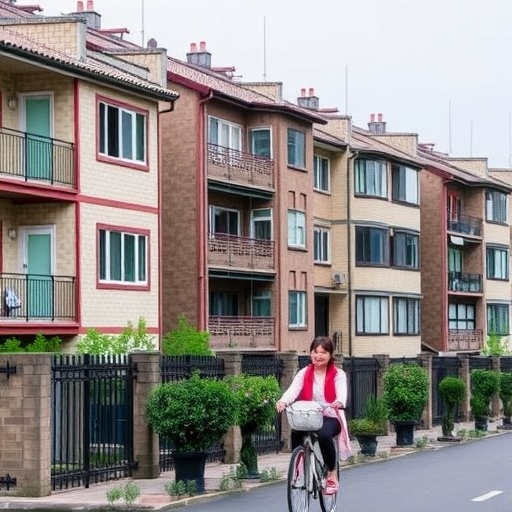
In an era where urbanization is rapidly reshaping global landscapes, the importance of residential environments on individual and collective well-being cannot be overstated. A recent study conducted by Chen, Yang, and Wang explores the intricate relationship between built environments and household life satisfaction, specifically contrasting public-led and private-led housing communities in Suzhou, China. This pioneering research brings to light the profound effects that design and planning principles have on the quality of life experienced by residents.
Through meticulous analysis, the researchers identify what they term the “5D” drivers of satisfaction: Density, Diversity, Design, Destination Accessibility, and Distance to Transit. Each of these dimensions plays a critical role in shaping not only the physical but also the psychological dimensions of living spaces. By employing a comprehensive approach, the study delves into how these factors interplay within varying contexts and cultural backdrops, revealing nuanced insights that are applicable to urban planners and policymakers alike.
Density, the first of the 5D drivers, refers to the amount of built space available in a given area and its relationship to the population residing there. In densely populated urban settings like Suzhou, the challenge often lies not just in the sheer number of residents but in ensuring that sufficient resources and amenities are distributed equitably. The study highlights that high-density housing can lead to increased social interactions, provided it is designed to encourage engagement among residents. Conversely, poorly designed high-density neighborhoods may foster isolation rather than community, illustrating the fine line between beneficial density and detrimental crowding.
The second driver, Diversity, emphasizes the variety of housing types, socio-economic groups, and services available within a community. This diversity opens the door for richer social interactions and experiences, contributing significantly to overall life satisfaction. The researchers assert that housing policies should foster mixed-use developments that offer varied housing options, as this can significantly enhance not just individual satisfaction but also community resilience. Through a diverse community structure, residents are exposed to different lifestyles and perspectives, enriching their social fabric.
Design, the third dimension, encapsulates the architectural and aesthetic facets of living spaces. Well-designed environments, which incorporate elements like natural light, green spaces, and thoughtful layouts, positively influence residents’ mental health and general well-being. The research findings suggest that when housing designs prioritize human experience and usability, they lead to a greater sense of belonging and satisfaction among residents. This aspect of design cannot be underestimated in urban planning, as it directly correlates with how individuals interact with their environments at both an emotional and functional level.
Destination Accessibility, the fourth driver, pertains to how easily residents can access amenities, services, and employment opportunities. It is crucial for urban environments to facilitate efficient transport links and pedestrian pathways that connect individuals to essential resources. The research reveals that communities with high destination accessibility foster higher life satisfaction because they minimize the barriers residents face in accessing daily necessities, thereby allowing for a seamless integration of work-life balance. Efficient transport systems not only enhance convenience but also reduce stress levels associated with commuting.
The final driver, Distance to Transit, highlights the importance of public transport availability in maintaining life satisfaction. Proximity to transit routes can significantly impact how residents experience their neighborhoods. The study emphasizes that easy access to reliable public transportation encourages residents to engage more with the broader urban area, promoting exploration and interaction beyond their immediate living spaces. This enhanced mobility can lead to a more dynamic social life and greater overall happiness.
The research findings are particularly relevant in the context of China, where urbanization continues at an unprecedented pace. Suzhou is emblematic of the rapid development seen across the nation, and the differences observed between public-led and private-led housing projects provide valuable insights into governance and community development. By analyzing these contrasting models, the study makes a compelling case for the need to incorporate community voices into planning processes, highlighting the potential pitfalls of top-down approaches that may overlook the nuances of local needs and aspirations.
The implications of these findings extend beyond Suzhou and resonate with global urban planning discussions. As cities worldwide grapple with similar challenges of density, diversity, and accessibility, the study serves as a critical reminder of the multidimensionality of residential satisfaction. Urban planners and policymakers are urged to rethink traditional approaches and embrace innovative strategies that prioritize quality living conditions based on the research’s 5D framework.
In conclusion, the comprehensive analysis conducted by Chen, Yang, and Wang not only sheds light on the factors influencing household satisfaction but also frames a broader conversation about urban living in an age of rapid change. Their work paves the way for future research on the intricate connections between environmental design and individual contentment. By focusing on how the built environment influences social interaction, accessibility, and overall life satisfaction, we can begin to envision cities that foster not only economic growth but also holistic well-being among their residents.
As urban areas continue to evolve, the insights from this study underscore the urgent need to prioritize thoughtful design and inclusive policies that enhance life satisfaction for all community members, ensuring that as we build our cities for the future, we are also building for the happiness and well-being of those who inhabit them.
Chen, J., Yang, Y., Wang, H. et al. Living Well by Design: Unpacking 5D Built‑Environment Drivers of Household Life Satisfaction in Public-led and Private-led Housing Communities in Suzhou, China.
Applied Research Quality Life (2025). https://doi.org/10.1007/s11482-025-10472-8
Cite Scienmag News
Courtney Benton. (September 11, 2025). Exploring Housing’s Impact on Life Satisfaction in Suzhou. Scienmag. https://scienmag.com/exploring-housings-impact-on-life-satisfaction-in-suzhou/
Courtney Benton. "Exploring Housing’s Impact on Life Satisfaction in Suzhou." Scienmag, 11 September 2025, https://scienmag.com/exploring-housings-impact-on-life-satisfaction-in-suzhou/. Accessed 4 September 2026.
Courtney Benton. "Exploring Housing’s Impact on Life Satisfaction in Suzhou." Scienmag. September 11, 2025. https://scienmag.com/exploring-housings-impact-on-life-satisfaction-in-suzhou/


