


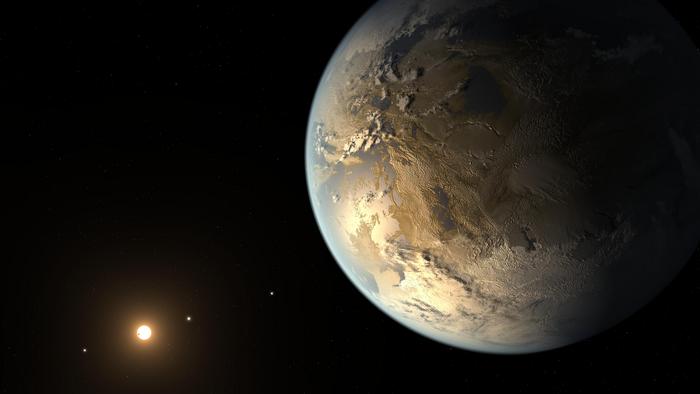
In a groundbreaking study published in The Astronomical Journal, researchers led by Dr. Daniel Angerhausen from ETH Zurich explore an intriguing yet unsettling question: What if humanity’s extensive search for extraterrestrial life yields no conclusive results? The research, conducted within the framework of the Swiss National Centre of Competence in Research, PlanetS, delves into statistical methods to articulate what could be learned about life beyond Earth in the event of a negative outcome from future surveys. The implications of their findings could reshape humanity’s understanding of its place in the universe.
The study hinges on a Bayesian statistical analysis to evaluate the minimum number of exoplanets that scientists need to observe to derive meaningful conclusions regarding the frequency of potentially habitable worlds. The researchers reveal that if observations of 40 to 80 exoplanets yield a definitive "null result," scientists could confidently ascertain that no more than 10 to 20 percent of similar planets possess life. This percentage translates to a staggering number—around 10 billion potentially habitable planets within our Milky Way galaxy. Such findings would provide a crucial insight into the prevalence of life throughout the cosmos, a question that has long eluded scientists.
However, the study introduces a critical caveat regarding the notion of a "perfect" null result. Every observation carries inherent uncertainties that significantly influence the validity of drawn conclusions. Researchers emphasize the need to grasp how these uncertainties affect the robustness of their findings. Various forms of uncertainty can affect individual exoplanet observations. For instance, interpretation uncertainty may lead to false negatives where a biosignature indicative of life is missed, erroneously categorizing what could be a habitable world as uninhabited. Additionally, sample uncertainty arises when the observed examples are not adequately representative of the sample space, failing to meet specific standards associated with the presence of life.
As Angerhausen aptly points out, it is not solely a matter of how many planets scientists analyze; it is equally about the quality of the questions being posed and the reliability with which they can extrapolate their findings. Overconfidence in the ability to identify signs of extraterrestrial life could skew results, even when based on a vast observational dataset. This insight serves as a cautionary note for upcoming missions, such as the Large Interferometer for Exoplanets (LIFE), which aims to investigate numerous exoplanets similar to Earth by scrutinizing their atmospheres for indicators of water, oxygen, and other complex biosignatures.
The research provides an optimistic outlook, indicating that the number of planned observations is substantial enough to derive significant conclusions about the prevalence of life in the galactic neighborhood of Earth. However, the authors stress that even with advanced technology, the quantification of uncertainties and biases is paramount for achieving statistically meaningful outcomes. This means that researchers must formulate precise questions such as, "What percentage of rocky planets in a solar system’s habitable zone show clear signs of water vapor, oxygen, and methane?" instead of the vague inquiry, “How many planets possess life?”
Moreover, the study delves into how existing knowledge—or priors—impact the outcomes of future surveys. By employing a Bayesian approach that incorporates this prior knowledge, Angerhausen and his colleagues determined how it influences interpretations of observation variables. When contrasted with the Frequentist statistical method, which operates without such priors, their findings reveal that within the sample sizes targeted by missions like LIFE, the influence of chosen priors appears limited. In essence, both statistical frameworks yield comparable results in this context.
Emily Garvin, a co-author of the study and a PhD student in Angerhausen’s group, elucidates this point by describing Bayesian and Frequentist statistics not as contradictory, but rather as complementary frameworks to interpret scientific data. Variations in a survey’s aims may necessitate the use of different statistical methodologies for obtaining reliable and precise insights. Consequently, the team’s work illustrates how diverse analytical approaches can deepen our understanding of the same dataset, providing a coherent pathway for adopting either framework based on the research’s objectives.
Ultimately, this research underscores the critical importance of defining the correct research questions and employing apt methodologies when investigating the cosmos. The ramifications of a single positive detection of extraterrestrial life would be monumental, fundamentally transforming our comprehension of biological existence beyond Earth. Even in the absence of such a discovery, the ability to quantify the rarity or prevalence of planets possessing detectable biosignatures could shape future explorations and theories regarding life’s existence in the wider universe.
In conclusion, this groundbreaking study invites the scientific community to engage in robust conversations about the future of exoplanet research and astrobiology. The quest to understand whether we are alone in the universe is fraught with uncertainty, but with rigorous statistical approaches, researchers may one day illuminate the enigmatic nature of life beyond Earth.
Keywords
Exoplanets, astrobiology, Bayesian statistics, extraterrestrial life, habitability zone, life detection, uncertainty analysis, statistical methods, Cosmic exploration, planetary science.
Cite Scienmag News
Grant Pearson. (April 7, 2025). Exploring Exoplanets: The Quest for Life Reveals Silence. Scienmag. https://scienmag.com/exploring-exoplanets-the-quest-for-life-reveals-silence/
Grant Pearson. "Exploring Exoplanets: The Quest for Life Reveals Silence." Scienmag, 7 April 2025, https://scienmag.com/exploring-exoplanets-the-quest-for-life-reveals-silence/. Accessed 4 September 2026.
Grant Pearson. "Exploring Exoplanets: The Quest for Life Reveals Silence." Scienmag. April 7, 2025. https://scienmag.com/exploring-exoplanets-the-quest-for-life-reveals-silence/


