


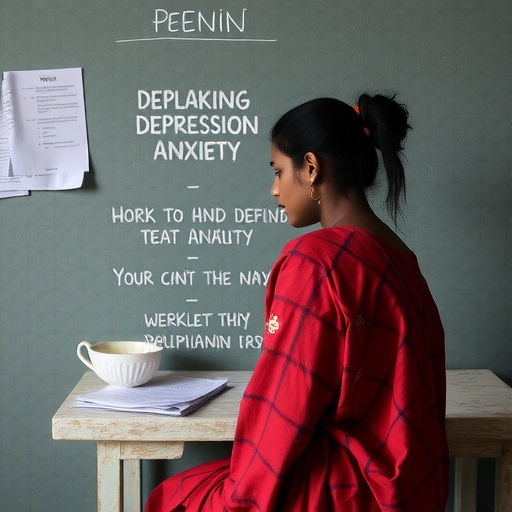
In recent years, there has been a growing focus on the mental health of women, particularly in regions where socio-economic challenges are prevalent. A landmark study spearheaded by researchers P. Suanrueang and K. Peltzer investigates the intricacies of major depressive disorders (MDD) and generalized anxiety disorders (GAD) among reproductive-age women in Bangladesh. This nationally representative study employs sophisticated statistical tools, specifically structural equation modeling, to unveil the interconnected factors influencing mental health in this demographic. The findings, which were published in the Annals of General Psychiatry, highlight significant regional variances and the social determinants contributing to these mental health issues.
The backdrop of this research is vital for understanding the societal context in which Bangladeshi women find themselves. With over 40% of the population affected by various mental health disorders, Bangladesh presents a unique setting for studying the interplay between economic factors, education, and mental health outcomes. The high prevalence rates of MDD and GAD raise alarming concerns about the quality of life and well-being of women. As caretakers and primary breadwinners in many households, their mental health status has far-reaching implications for families and communities.
In an effort to parse through these complex relationships, Suanrueang and Peltzer utilized a robust dataset that afforded them the ability to examine regional discrepancies in mental health prevalence. Their work reveals a stark contrast in mental health outcomes across different areas in Bangladesh. Regions with limited access to healthcare and educational resources exhibited higher rates of depression and anxiety. Such disparities underscore the importance of targeted interventions that consider regional dynamics in mental health programming.
In addition to regional variations, the study highlights the role of socio-economic status in shaping mental health. Women from lower socio-economic backgrounds reported heightened instances of MDD and GAD, suggesting that financial stress and economic vulnerability significantly contribute to mental health burdens. These findings align with existing literature that has documented the adverse effects of poverty on psychological wellness. By advocating for policies that alleviate economic disparities, the study calls for a broader societal commitment to enhancing women’s mental health.
Furthermore, the research delves into the influence of educational attainment on mental health. The authors noted a positive correlation between higher educational levels and improved mental health outcomes. Women who had access to education reported lower rates of depressive and anxiety symptoms. This finding is critical as it emphasizes the need for educational reforms and initiatives aimed at empowering women, which could lead to better mental health.
Suanrueang and Peltzer also explored the impact of familial and social support systems on mental health. Emotional support from family and friends emerged as a crucial protective factor against MDD and GAD. This underscores the necessity of fostering strong community ties and support networks to mitigate mental health challenges faced by women. Health programs that facilitate community bonding and support systems could play a significant role in alleviating mental health disorders.
Interestingly, the study also scrutinized cultural beliefs and their effects on mental health. Stigma surrounding mental health in many regions can prevent women from seeking the help they need. This cultural dimension complicates the treatment landscape, as many women may not disclose their struggles due to fear of social repercussions. Hence, public health initiatives must strive to destigmatize mental health to encourage more women to access necessary care.
Moreover, the research’s methodological robustness provides a strong foundation for the validity of its findings. Utilizing structural equation modeling allows for the analysis of complex relationships between variables while considering the potential for mediating and moderating influences. This approach enhances the reliability of the results and offers a clearer understanding of the factors at play, making it an exemplar study for future research.
As the discourse around mental health continues to evolve, the study offers critical insights into the need for tailored mental health interventions. Policymakers and health practitioners are urged to consider the multidimensional factors that influence mental health when designing programs. A comprehensive approach that addresses economic, educational, social, and cultural factors will be essential for effective mental health care.
In conclusion, the work of Suanrueang and Peltzer marks a significant step forward in understanding the mental health challenges faced by Bangladeshi women. By illuminating the interconnectedness of various factors and demonstrating regional variations, the study sets the stage for further research and action. It serves as a clarion call for enhanced mental health services that are attuned to the unique needs of women in Bangladesh, ultimately working towards a future in which every woman has the opportunity to attain optimal mental wellness.
Cite Scienmag News
Glenn Wilkins. (January 20, 2026). Exploring Depression and Anxiety in Bangladeshi Women. Scienmag. https://scienmag.com/exploring-depression-and-anxiety-in-bangladeshi-women/
Glenn Wilkins. "Exploring Depression and Anxiety in Bangladeshi Women." Scienmag, 20 January 2026, https://scienmag.com/exploring-depression-and-anxiety-in-bangladeshi-women/. Accessed 3 September 2026.
Glenn Wilkins. "Exploring Depression and Anxiety in Bangladeshi Women." Scienmag. January 20, 2026. https://scienmag.com/exploring-depression-and-anxiety-in-bangladeshi-women/


