


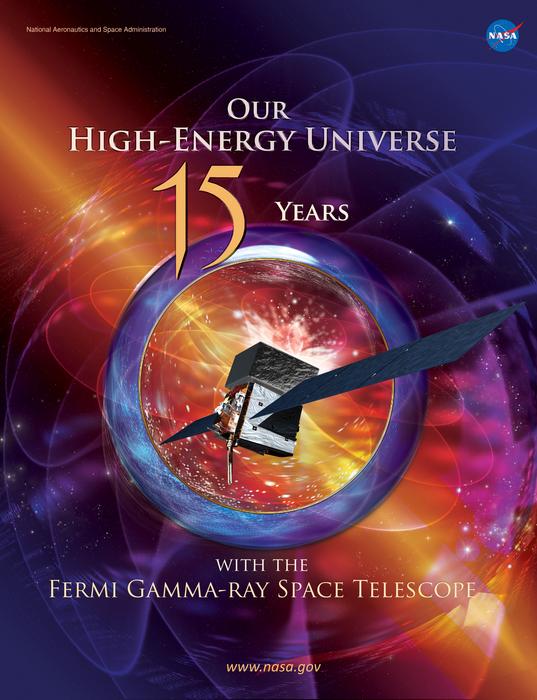
To commemorate a milestone anniversary for NASA’s Fermi spacecraft, the mission team has published an e-book called “Our High-Energy Universe: 15 Years with the Fermi Gamma-ray Space Telescope.”

Credit: NASA
To commemorate a milestone anniversary for NASA’s Fermi spacecraft, the mission team has published an e-book called “Our High-Energy Universe: 15 Years with the Fermi Gamma-ray Space Telescope.”
Readers can download the e-book in PDF and EPUB formats. The e-book is aimed at general audiences with an interest in space.
Launched on June 11, 2008, Fermi detects gamma rays, the highest-energy form of light, from Earth’s atmosphere to far-flung galaxies and cosmic phenomena in between. Its research has uncovered details on topics ranging from solar flares to star formation and the mysteries at the center of our Milky Way.
Through images, fun facts, and launch-day memories, the e-book tells Fermi’s story from conceptualization to launch and recounts some of the mission’s groundbreaking discoveries. By delving into high-energy astrophysics topics like gamma-ray bursts and blazars, readers can explore Fermi’s universe and what questions remain open for investigation in its next chapter.
Fermi was originally called the Gamma-ray Large Area Space Telescope but was renamed after Italian physicist Enrico Fermi in August 2008.
“Enrico Fermi’s science has been important for understanding the sources that the Fermi telescope sees,” said Elizabeth Hays, the mission’s project scientist at NASA’s Goddard Space Flight Center in Greenbelt, Maryland. “The gamma-ray sky is powered by particle acceleration mechanisms he theorized about.”
The satellite has two gamma-ray detectors: the Large Area Telescope (LAT) and the Gamma-ray Burst Monitor (GBM).
The LAT observes a fifth of the gamma-ray sky at any time, detecting high-energy light with energies ranging from 20 million to over 300 billion electron volts. (The energy of visible light is 2 to 3 electron volts.) The GBM views about 70% of the sky at a time at lower energies, searching for brief flashes of gamma-ray light.
The result of this carefully crafted duo is the most sensitive gamma-ray observatory in orbit, equipped to study the universe’s highest-energy phenomena near and far.
By peering through Fermi’s gamma-ray eyes, we can better understand our solar system. Within its first eight years of operation, Fermi detected gamma-ray emissions from 40 solar flares — bursts of energy from the Sun. Some even originated on the Sun’s far side, allowing scientists to analyze how charged particles fired by solar flares can arc from one side of the Sun to produce gamma rays on the other.
In studying our Milky Way, Fermi found two lobes of high-energy gamma rays — called the Fermi Bubbles — extending above and below the galaxy’s center. Each bubble stands 25,000 light-years tall. Astronomers think the bubbles formed following an ancient burst of activity from the Milky Way’s central supermassive black hole.
Fermi helps scientists understand black holes in other galaxies, too.
“As a black hole forms, either from the death of a massive star or the collision of two neutron stars, it creates a brief flash of light called a gamma-ray burst,” said Judith Racusin, Fermi’s deputy project scientist at Goddard. “Fermi detects about one burst a day and has helped revolutionize our understanding of these phenomena.”
Even after 15 years of accomplishments, however, many mysteries remain for Fermi to tackle. One of the telescope’s ongoing objectives is to study the composition of dark matter — the mysterious substance that makes up about 25% of the universe.
Because dark matter doesn’t reflect, absorb, or emit light, scientists remain unsure of its composition. One popular theory suggests, though, that dark matter particles create gamma rays when they interact. If Fermi can spot this high-energy signature, it might help scientists learn more about dark matter’s makeup.
If there’s one thing Fermi has taught us, it’s to expect the unexpected. Gamma-ray research has yielded unprecedented breakthroughs in our understanding of the Milky Way’s central black hole, our flaring Sun, and merging neutron stars. As much as we anticipate the next gamma-ray revelation, only time will tell what exactly Fermi has in store.
Fermi is an astrophysics and particle physics partnership managed by Goddard. Fermi was developed in collaboration with the U.S. Department of Energy, with important contributions from academic institutions and partners in France, Germany, Italy, Japan, Sweden, and the United States.
Cite Scienmag News
Grant Pearson. (April 23, 2024). Explore the universe with the first e-book from NASA’s Fermi. Scienmag. https://scienmag.com/explore-the-universe-with-the-first-e-book-from-nasas-fermi/
Grant Pearson. "Explore the universe with the first e-book from NASA’s Fermi." Scienmag, 23 April 2024, https://scienmag.com/explore-the-universe-with-the-first-e-book-from-nasas-fermi/. Accessed 4 September 2026.
Grant Pearson. "Explore the universe with the first e-book from NASA’s Fermi." Scienmag. April 23, 2024. https://scienmag.com/explore-the-universe-with-the-first-e-book-from-nasas-fermi/

