


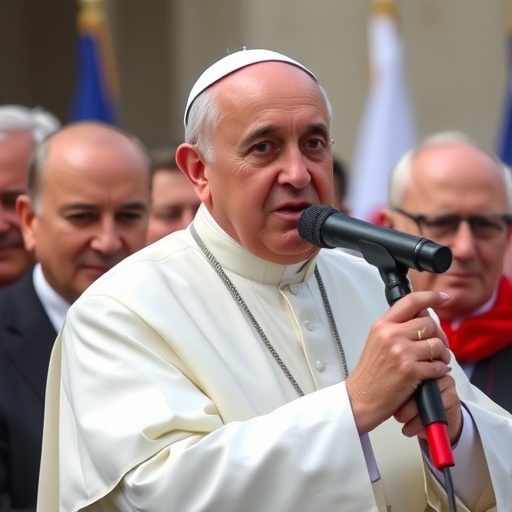
Pope Francis, the leader of the Roman Catholic Church, has emerged as a significant global voice against war and violence. His anti-war discourse has resonated deeply in a world increasingly fraught with conflict. Recent analyses have delved into the instrumentalization of this discourse, particularly how it has been utilized in the context of the geopolitical tensions associated with the Russian Federation. The evolving landscape of cognitive warfare raises critical questions about the intersection of religion, politics, and communication strategies in the modern era.
From the outset of his papacy, Pope Francis has consistently highlighted themes of peace, compassion, and the sanctity of life. His messages, often delivered in passionate speeches or encyclicals, reflect a profound commitment to addressing the devastating impacts of war on individuals and communities. This humanitarian approach is not merely a moral standpoint; it serves as a profound statement on the nature of humanity itself, urging leaders and citizens to reconsider their roles in the perpetuation of violence.
As tensions between nations have escalated, particularly in the wake of conflicts that seem unending, the relevance of the Pope’s messages has intensified. The Russian Federation, with its historical legacy of military engagement, has found itself at the center of this complex dialogue. Scholars have begun to explore how Francis’s teachings may be co-opted by various actors within the cognitive warfare landscape, wherein information and ideology are utilized as weapons in psychological and social arenas.
This instrumentalization of the Pope’s anti-war rhetoric raises critical questions about authenticity and intent. When religious leaders are drawn into the mechanisms of political strategy, the ramifications can be profound. The use of such discourse may serve to manipulate public perception, frame narratives, or even justify actions that contradict the very ideals being espoused. This paradox stretches into the realms of ethics, communication, and societal values, making it a rich area for academic exploration.
Cognitive warfare is not simply about traditional military engagement; it involves the deliberate shaping of beliefs and perspectives through the strategic use of information. The unique position of the papacy affords Pope Francis a platform that can influence millions globally. Yet, as research indicates, this influence is not always benign. Politicians and states may find ways to align their agendas superficially with his messages to gain legitimacy or support, while diverging from the core principles of peace and reconciliation.
The implications of this phenomenon are alarming. The manipulation of religious discourse can exacerbate societal divisions and fuel conflict rather than alleviate it. In regions already rife with misunderstanding and hostility, the co-optation of the Pope’s messages could lead to a distortion of their intended meaning, highlighting the need for vigilance in the interpretation and dissemination of these vital communications.
Moreover, there exists a risk of oversimplifying complex situations by relying on the authority of religious leaders as a means of validation. When political entities leverage the moral authority of figures like Pope Francis, the potential for misrepresentation is significant. The nuanced realities of geopolitical conflict are often lost in favor of a more digestible narrative that suits specific agendas, hindering genuine efforts toward peace and understanding.
As this discourse continues to evolve, it is crucial for scholars, theologians, and political analysts to engage critically with the ways in which figures like Pope Francis are represented and utilized in public discourse. The complexity of the modern information landscape necessitates a deeper understanding of how messages are constructed, disseminated, and interpreted. Greater awareness can help mitigate the adverse effects of cognitive warfare, promoting a more ethical approach to both communication and the quest for peace.
In conclusion, the analysis of Pope Francis’s anti-war discourse within the context of cognitive warfare highlights a significant crossroads where faith meets global politicking. The intricate dance between influence and manipulation underscores the importance of discernment in both leadership and citizenship. As we navigate the uncertain waters of contemporary geopolitics, the call for authentic engagement rooted in the values of compassion and peace remains ever more crucial.
Understanding the implications of religious discourse in a world beset by conflict can empower individuals and societies alike to seek genuine reconciliation and healing. Pope Francis’s messages serve as a beacon of hope, but it is the responsibility of each generation to uphold the integrity of these principles against the tides of manipulation and cynicism that may seek to distort them.
With ongoing research in this field, the future may reveal more nuanced insights into the interplay between faith and politics, particularly in the realm of cognitive warfare. As scholars continue to unpack these themes, the potential for fostering genuine dialogue and understanding in a fractured world remains a vital aspiration.
As society grapples with the challenges of the modern era, the fundamental quest for peace resonates universally. By examining the dynamics surrounding the instrumentalization of Pope Francis’s discourse, we can remain vigilant in the pursuit of authentic communication that honors the sacredness of life and the dignity of the human spirit, paving the way towards a more compassionate and understanding world.
Cite Scienmag News
Glenn Wilkins. (October 27, 2025). Exploitation of Pope Francis’s Anti-War Message by Russia. Scienmag. https://scienmag.com/exploitation-of-pope-franciss-anti-war-message-by-russia/
Glenn Wilkins. "Exploitation of Pope Francis’s Anti-War Message by Russia." Scienmag, 27 October 2025, https://scienmag.com/exploitation-of-pope-franciss-anti-war-message-by-russia/. Accessed 5 September 2026.
Glenn Wilkins. "Exploitation of Pope Francis’s Anti-War Message by Russia." Scienmag. October 27, 2025. https://scienmag.com/exploitation-of-pope-franciss-anti-war-message-by-russia/


