


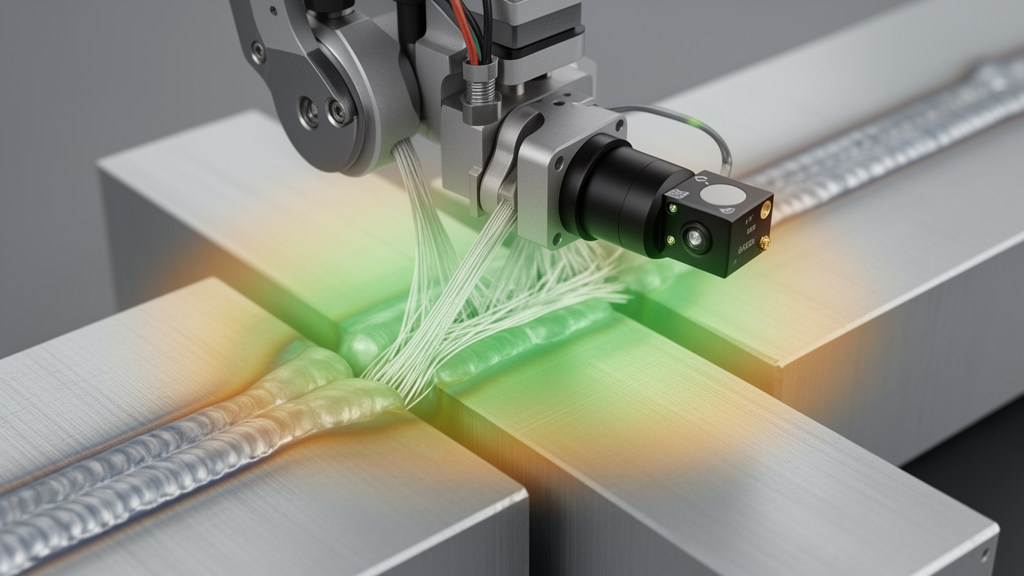
A physics-informed machine-learning framework achieved high predictive accuracy for the tensile strength of aluminum joints reinforced with multiwalled carbon nanotubes and silicon nitride. In a proof-of-concept study based on just 25 experimental observations, an optimized XGBoost regression model produced a mean absolute error of 5.70 megapascals, a root mean square error of 7.74 megapascals and a coefficient of determination, R², of 0.9772 under leave-one-out cross-validation. The study concerns friction welding of tube-to-tube plate using an external tool, a configuration abbreviated FWTPET, and does not yet establish that the model can predict joints made under other conditions.
The experimental program joined an AA6063 aluminum tube to an AA6061 plate containing cavities for the addition of the two reinforcements. A Taguchi L25 orthogonal array covered carbon nanotube content from 0.01 to 0.05 weight percent, silicon nitride content from 0.07 to 0.19 weight percent, tool rotational speeds from 1,000 to 1,800 revolutions per minute and plunge depths from 0.5 to 2.5 millimeters. The welded specimens were then subjected to tensile testing, and the measured strengths became the data set for model development. Because specimen fabrication and mechanical testing are expensive, the resulting sample was small, making validation strategy an important part of the analysis rather than a minor technical detail.
To make the sparse measurements more physically meaningful, the researchers created ten engineered descriptors from the four original process variables. These included a Heat Generation Index, defined as rotational speed multiplied by plunge depth; a Specific Energy Index, defined as rotational speed divided by depth; and a Composite Heat Index combining rotational speed, depth and total reinforcement. Other descriptors represented reinforcement loading, the carbon-nanotube-to-silicon-nitride ratio, mixing intensity, interaction between the two reinforcements, nanotube and ceramic dispersion, and reinforcement density. The formulas were physics-inspired surrogates rather than solutions derived directly from first-principles governing equations. Their purpose was to give the algorithms variables associated with frictional heating, material flow, plastic deformation and reinforcement distribution rather than a collection of arbitrary transformations.
Exploratory analysis found a strong linear association between carbon nanotube content and tensile strength, with a Pearson correlation of 0.9707 and a Spearman correlation of 0.9806. The engineered Dispersion Index, defined as rotational speed multiplied by carbon nanotube content, also ranked strongly, with correlations of 0.9548 and 0.9746. Composite Interaction, the product of the two reinforcement contents, and Composite Ratio were the next prominent features in several ranking methods. Recursive feature elimination, Boruta selection, permutation importance and SHAP analysis broadly agreed on this order, while eight of the 10 highest-ranked descriptors came from the engineered set. High variance inflation factors revealed substantial multicollinearity because the new variables were mathematical combinations of the same four inputs. The authors therefore interpreted individual feature contributions as the collective influence of correlated process descriptors rather than as independent physical effects.
Six regression algorithms were trained with leave-one-out cross-validation: XGBoost, LightGBM, CatBoost, Random Forest, Gaussian Process Regression and Support Vector Regression. Each iteration trained on 24 observations and tested on the withheld case, allowing all 25 specimens to contribute to model assessment. Optuna-based hyperparameter optimization was then applied, and the final reported metrics correspond to the optimized models. XGBoost performed best, with an MAE of 5.70 MPa, RMSE of 7.74 MPa, R² of 0.9772, adjusted R² of 0.9608 and mean absolute percentage error of 1.26%. LightGBM followed with an RMSE of 10.21 MPa, while CatBoost, Gaussian Process Regression and Random Forest clustered between 11.83 and 12.11 MPa. Support Vector Regression was less accurate, with an RMSE of 22.26 MPa.
SHAP analysis of the final XGBoost model offered an explanation of how the prediction was assembled. Carbon nanotube content had by far the largest mean absolute SHAP value, 27.30, followed by the Dispersion Index at 14.98. Composite Interaction and Composite Ratio had values of 0.88 and 0.70, respectively, while the remaining descriptors made smaller contributions. High carbon nanotube values were generally associated with positive contributions to predicted tensile strength, and the dependence plot showed a broadly positive relationship between the Dispersion Index and predicted strength. In one sample explanation, the model began from a baseline near 466 MPa; carbon nanotube content contributed about 51.8 MPa and the Dispersion Index about 36.35 MPa. These are model attributions, not causal estimates, and they do not independently prove that changing a descriptor would cause the corresponding strength change.
The most important qualification emerged from an ablation analysis comparing four input configurations under the same cross-validation protocol. The model using only the original variables—carbon nanotube content, silicon nitride content, rotational speed and plunge depth—performed better than either the engineered-only model or the combination of original and engineered features. The original set achieved an MAE of 8.35 MPa, RMSE of 11.60 MPa and R² of 0.9487; the engineered-only set produced an RMSE of 22.72 MPa and R² of 0.8031, while the combined set gave an RMSE of 13.52 MPa and R² of 0.9303. These results do not support a claim that the engineered variables improved predictive accuracy. Their demonstrated advantage is interpretability: they provide physically motivated representations of heat, flow, dispersion and reinforcement interaction that can supplement the measured process variables.
The authors relate the predictive patterns to established friction-welding mechanics, but the study did not directly measure every proposed mechanism. Rotation and plunge depth can jointly influence frictional heating, plastic strain and material flow; increasing heat may reduce flow stress and promote consolidation, while excessive heat can contribute to grain growth or instability. The Mixing Index represents the combined intensity of stirring and reinforcement concentration, and the Dispersion Index represents the rotational contribution to nanotube distribution. Uniformly dispersed CNTs may transfer load and bridge cracks, whereas silicon nitride contributes ceramic particle reinforcement, hardness and resistance to localized plastic deformation. The authors also invoke grain refinement and barriers to dislocation motion as possible contributors, but grain size was not calculated in this work. The SHAP results are therefore consistent with a physical interpretation of the data without demonstrating those metallurgical pathways causally.
Several limitations constrain how far the results can be generalized. The model was built from only 25 observations, evaluated solely with internal cross-validation and never tested against an independent experimental data set. Feature selection and hyperparameter optimization were not fully nested within each cross-validation fold, meaning some optimistic bias in the reported performance cannot be excluded. The engineered descriptors also had considerable multicollinearity, which can divide or redistribute importance among correlated variables and complicate interpretation. In addition, the experiments covered a specific AA6061–AA6063 FWTPET configuration, restricted reinforcement contents and a defined processing window; applicability to other alloys, joint geometries, reinforcement systems or operating conditions remains untested. The learning curve indicated that validation error continued to decline as more training observations became available, reinforcing the need for a larger data set and fully nested cross-validation before the framework could be treated as a dependable general-purpose engineering predictor.
Taken together, the study demonstrates a promising way to combine scarce experimental measurements, process-informed variables and explainable machine learning for a difficult welding problem. Its clearest result is not that physics-inspired feature engineering guarantees better predictions, but that it can reveal meaningful structure in a small experimental data set while remaining subordinate to the original measured variables for accuracy in this study. XGBoost provided the strongest numerical fit, and SHAP identified carbon nanotube content and reinforcement dispersion as the dominant model features. At the same time, the ablation result, limited sample and absence of external validation place the framework firmly in the proof-of-concept stage. Larger experiments, independent testing, fully nested validation and evaluation across other materials and welding configurations will be needed before these predictions can guide production welding or reduce experimental effort with demonstrated reliability.
Subject of Research: Physics-inspired and explainable machine learning for predicting tensile strength in CNT–Si₃N₄-reinforced friction-welded aluminum joints
Article Title: Physics-inspired feature engineering and explainable machine learning for tensile strength prediction of CNT–Si₃N₄ reinforced FWTPET joints
Article References: Venkatachalam, K., Selvaraj, S. K., Lokeshkumar, R., & Sundaramali, G. (2026). Physics-inspired feature engineering and explainable machine learning for tensile strength prediction of CNT–Si₃N₄ reinforced FWTPET joints. Frontiers in Artificial Intelligence, 9, Article 1952539. https://doi.org/10.3389/frai.2026.1952539
Image Credits: AI Generated
DOI: 10.3389/frai.2026.1952539
Keywords: tensile strength prediction, explainable machine learning, XGBoost, physics-inspired features, feature engineering, friction welding, carbon nanotubes, silicon nitride, aluminum joints, small-data modeling, Physics-inspired, feature
Cite Scienmag News
Denise Maddox. (October 20, 2026). Explainable AI predicts strength of hybrid-reinforced welded aluminum joints. Scienmag. https://scienmag.com/explainable-ai-predicts-strength-of-hybrid-reinforced-welded-aluminum-joints/
Denise Maddox. "Explainable AI predicts strength of hybrid-reinforced welded aluminum joints." Scienmag, 20 October 2026, https://scienmag.com/explainable-ai-predicts-strength-of-hybrid-reinforced-welded-aluminum-joints/. Accessed 20 October 2026.
Denise Maddox. "Explainable AI predicts strength of hybrid-reinforced welded aluminum joints." Scienmag. October 20, 2026. https://scienmag.com/explainable-ai-predicts-strength-of-hybrid-reinforced-welded-aluminum-joints/


