


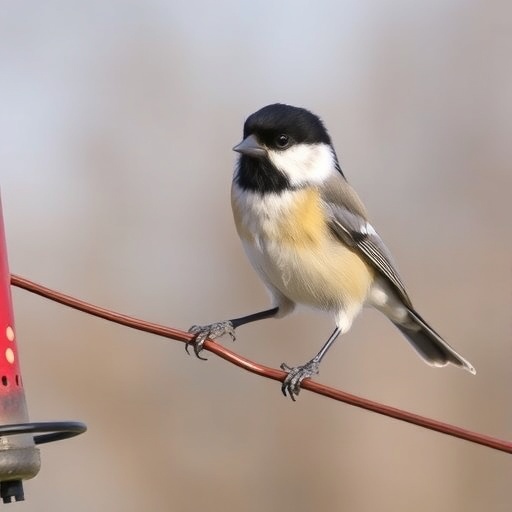
In a groundbreaking study published in Animal Cognition, researchers investigated the relationship between initial learning experiences and cognitive flexibility in food-caching chickadees. Chickadees, a well-studied species known for their remarkable memory capabilities, exemplify the intricate mechanisms of avian cognition, particularly in how they navigate and remember spatial environments. The study led by Richmond and colleagues, provides crucial insights into how experience shapes cognitive functions, highlighting the evolutionary advantages afforded by enhanced spatial memory in these birds.
The research team observed the behaviors and learning patterns of black-capped chickadees, a species renowned for their ability to cache food. This study sought to explore whether an increase in initial learning experiences would improve the birds’ cognitive flexibility. Cognitive flexibility, often synonymous with an organism’s ability to adapt their behavior in response to changing environmental conditions, is essential for survival. For chickadees, who rely on caching food strategically to weather winter months, this flexibility can mean the difference between life and death.
Utilizing a systematic approach, the researchers designed an experiment to quantify how varying degrees of exposure to spatial environments affected cognitive outcomes in chickadees. Initially, some birds were provided with enriched environments with ample opportunities to explore, learn, and cache food, while others experienced more restrictive environments. The findings highlighted stark differences in behavioral adaptability between the two groups, suggesting that experience played a significant role in enhancing their cognitive functions.
Chickadees trained in more complex environments demonstrated superior navigational skills compared to their less-exposed counterparts. The data indicated that birds who engaged in richer spatial learning exhibited increased cognitive flexibility. This suggests that early experiences create neural pathways that enhance learning, encouraging efficient information retrieval and decision-making processes later in life.
Moreover, the researchers examined how different caching strategies were employed based on their experience. Birds with more varied exposure to their surroundings developed unique strategies for food storage, reflecting greater cognitive complexity. This adaptability could be attributed to a more advanced understanding of their spatial environment, enabling them to remember the locations of their caches more effectively.
The implications of these findings extend beyond chickadees and raise pertinent questions about animal intelligence more broadly. The study posits that learning experiences, especially in formative stages, may fundamentally alter cognitive capabilities. This could have applications in understanding wildlife survival strategies, which, in turn, sheds light on the evolutionary pressures shaping cognitive landscapes across species.
In addition, researchers noted the necessity for future investigations to delve deeper into the neurological basis of these cognitive changes. Understanding how experience modifies brain structures and functions can generate novel insights into the plasticity of the avian brain. Such insights can further illuminate the relationship between cognitive flexibility and survival-depended behaviors across avian species and beyond.
Interestingly, the study also opens discussions regarding implications for conservation efforts. If cognitive flexibility is influenced by environmental exposure, habitat restoration projects might benefit from integrating aspects that encourage exploratory behavior in local bird populations. By fostering environments that enhance learning, conservationists could potentially improve the resilience of local bird populations to changing climates and habitats.
As researchers continue to illuminate the cognitive capabilities of birds, it becomes increasingly clear that experience plays a crucial role in shaping intelligence. This study not only adds depth to our understanding of avian cognition but also invites re-evaluation of how we approach animal learning and memory. If cognitive flexibility can be cultivated through richer experiences, then fostering such environments could prove beneficial in avian management and conservation practices.
In conclusion, the research conducted by Richmond and colleagues represents a significant contribution to understanding the interplay between experience and cognitive function in animals. Their findings emphasize that increasing initial learning experiences can enhance cognitive flexibility in chickadees, showcasing how behavioral adaptations might stem from enriched learning environments. Understanding these relationships can ultimately inform strategies for wildlife conservation, underscore the importance of habitat preservation, and inspire new avenues of research into animal cognition.
As we continue to explore the complexities of intelligence in the animal kingdom, studies like these reinforce the notion that cognitive abilities are not static yet evolve in response to the challenges posed by the environment. The ability of animals to adapt their behavior—as demonstrated by these remarkable chickadees—could very well be a key driver in their long-term survival and prosperity.
Through detailed observation and rigorous experimentation, the work by Richmond et al. stands as a testament to the remarkable capabilities found in the animal world and invites further investigation into the dynamic relationship between learning, experience, and cognitive evolution.
Richmond, A.A.H., Heinen, V.K., Welklin, J.F. et al. More experience in the initial learning of spatial information improves cognitive flexibility in food-caching chickadees.
Anim Cogn 29, 8 (2026). https://doi.org/10.1007/s10071-025-02024-2
Cite Scienmag News
Drew Townsend. (January 27, 2026). Experience Enhances Cognitive Flexibility in Chickadees. Scienmag. https://scienmag.com/experience-enhances-cognitive-flexibility-in-chickadees/
Drew Townsend. "Experience Enhances Cognitive Flexibility in Chickadees." Scienmag, 27 January 2026, https://scienmag.com/experience-enhances-cognitive-flexibility-in-chickadees/. Accessed 3 September 2026.
Drew Townsend. "Experience Enhances Cognitive Flexibility in Chickadees." Scienmag. January 27, 2026. https://scienmag.com/experience-enhances-cognitive-flexibility-in-chickadees/


