

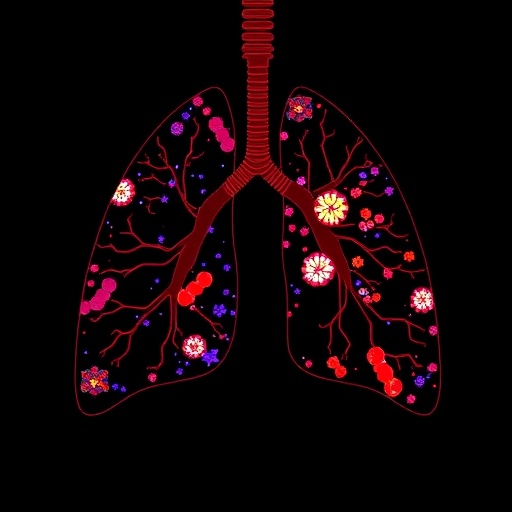
In an extraordinary leap forward in cancer research, a landmark study now unravels the elusive molecular underpinnings and microenvironmental dynamics propelling lung-tropic metastasis. Published recently in Medical Oncology, the investigation reveals an exosomal blueprint intricately orchestrating the spread of primary tumors specifically to lung tissue. This breakthrough sheds unprecedented light on the communication networks that cancer cells exploit, promising a new frontier for diagnostic and therapeutic strategies.
Metastasis remains the deadliest aspect of cancer, responsible for about 90% of all cancer fatalities. Lung-tropic metastasis, wherein malignant cells preferentially colonize the lungs, is notoriously aggressive and difficult to predict or control. The current study demystifies the complexity of this process by focusing on extracellular vesicles known as exosomes—tiny, lipid-bilayered packets secreted by tumor cells carrying a cargo of proteins, nucleic acids, and signaling molecules. These exosomes essentially act as molecular messengers, preparing distant organs like the lungs for tumor invasion.
At the heart of the research lies an exhaustive molecular profiling of these tumor-derived exosomes, revealing a distinct signature that directs lung metastasis. The investigators employed advanced proteomics, transcriptomics, and lipidomics to decode the cargo that orchestrates this targeted migration. Their findings underscore the presence of unique integrins, microRNAs, and other biomolecules packaged selectively to manipulate the lung microenvironment, effectively ‘conditioning’ it to support circulating cancer cells upon arrival.
The altered microenvironment or “pre-metastatic niche” is a pivotal discovery highlighted in this study. Exosomal cargo remodels resident stromal cells, endothelial barriers, and immune components within the lung tissue, creating a hospitable and immunosuppressive milieu. This conditioning not only facilitates adhesion and extravasation of tumor cells but also accelerates their proliferation and survival once lodged in the lungs. The insight emphasizes how non-mutational adaptations, orchestrated remotely via exosomes, critically influence metastatic success.
Further technical exploration reveals that integrins, particularly α6β4 and α6β1 present on exosomal surfaces, mediate selective homing to the pulmonary environment. By binding lung-specific extracellular matrix proteins, these integrins serve as ‘ZIP codes’ guiding exosomes to their target organ. Concurrently, exosomal miRNAs modulate gene expression in lung fibroblasts and immune cells, dampening anti-tumor responses and promoting matrix remodeling—a double-edged strategy to evade immune clearance while enhancing invasiveness.
The translational implications are profound. Researchers propose harnessing the unique exosomal profiles as non-invasive biomarkers detectable in blood samples, enabling early prediction of lung metastasis risk. Beyond diagnostics, neutralizing the exosomal pathways offers a novel therapeutic avenue—blocking exosome production, release, or uptake could thwart the establishment of pre-metastatic niches, effectively halting the metastatic cascade at a preliminary stage.
Moreover, the study delved into functional assays demonstrating that lung-tropic exosomes markedly increase vascular permeability and promote recruitment of bone marrow-derived cells, critical steps for metastatic colonization. These findings elucidate the multi-dimensional role of tumor exosomes as modulators of systemic physiology, transcending their traditional perception as passive debris.
Cutting-edge imaging and in vivo models validated these mechanistic insights. Fluorescently labeled exosomes traced real-time journey and localization, confirming their pulmonary predilection. Lung histology post-exosome exposure revealed characteristic stromal alterations and establishment of pro-inflammatory niches conducive to tumor cell engraftment. These robust validations anchor the molecular discoveries in tangible biological phenomena.
This research also highlights the heterogeneity among different cancer types in their exosomal cargo and metastatic tropism. While the lung is a common site of metastasis for breast, melanoma, and sarcoma, each cancer’s exosomes bear tailored signatures influencing organotropism. Understanding this specificity can tailor personalized interventions and optimize clinical surveillance protocols.
Challenges remain, primarily in translating these complex molecular insights into clinical practice. The scalability of exosome isolation, standardization of biomarker panels, and identification of the most effective inhibitors are hurdles that warrant focused multidisciplinary efforts. Nonetheless, this study lays a foundational framework guiding future drug development and clinical trials aimed at intercepting metastasis.
The investigative team calls for integrative studies combining exosomal molecular profiling with patient-derived data to refine predictive algorithms. Incorporating artificial intelligence and machine learning could enhance interpretation of complex datasets, facilitating real-time risk stratification and individualized therapy adjustments.
In sum, this seminal work reshapes our conceptual understanding of cancer metastasis, spotlighting exosomes as pivotal architects in the metastatic niche formation in lungs. The duality of exosomal roles—as messengers decoding the metastatic itinerary and as architects remodeling distant microenvironments—opens new vistas for cancer biology.
Clinicians and researchers alike are urged to recognize the exosomal communication axis as a fertile target. Therapeutics designed to interrupt these molecular conversations can revolutionize metastasis management, potentially converting a terminal diagnosis into a controllable chronic condition.
In the era of precision oncology, integrating exosome-based diagnostics and therapeutics offers unprecedented potential to outmaneuver cancer’s lethal dissemination. These insights herald the dawn of a novel biomolecular paradigm in metastatic oncology centered on intratumoral communication and microenvironmental engineering.
As the scientific community embraces these findings, the frontier of metastatic cancer research promises a transformation from reactive treatment to proactive interception, steering us closer to the ultimate goal of complete metastasis prevention and cure.
Subject of Research: Exosomal molecular mechanisms and microenvironmental conditioning in lung-tropic cancer metastasis.
Article Title: “Exosomal blueprint of lung-tropic metastasis: molecular signatures, microenvironmental conditioning, and translational implications in cancer”.
Article References:
Ebrahim, N.A.A., Farghaly, T.A. & Soliman, S.M.A. “Exosomal blueprint of lung-tropic metastasis: molecular signatures, microenvironmental conditioning, and translational implications in cancer”. Med Oncol 43, 93 (2026). https://doi.org/10.1007/s12032-025-03217-y
Image Credits: AI Generated


