


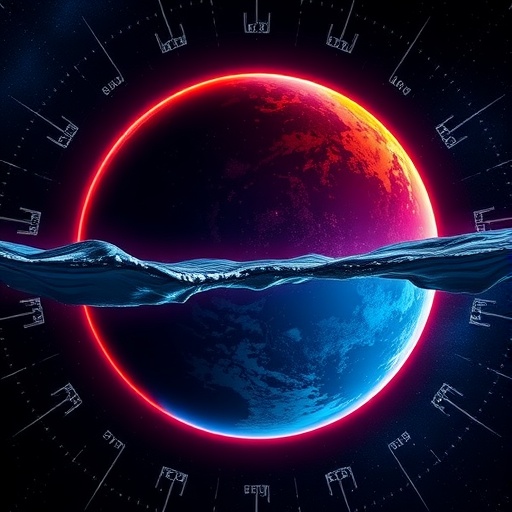
An exoplanet identified as K2-18b, located 124 light-years from Earth, recently ignited interest and speculation within the scientific community and beyond. The excitement initially centered on a study that suggested this planet, classified as a sub-Neptune, could potentially harbor vast oceans, hinting that it might be a marine world rich in life. However, fresh insights from a subsequent study led by researchers at ETH Zurich have cast a shadow of doubt over these initial claims, suggesting that K2-18b and similar exoplanets are far less likely to be ocean-dominated. The implications of these findings stretch beyond the realm of K2-18b, challenging our understanding of planetary formation and the conditions necessary for life.
The research surrounding K2-18b highlighted a fundamental misconception that many scientists held regarding the nature of sub-Neptunes. Previously considered candidates for Hycean worlds—planets expected to have thick atmospheres rich in hydrogen coupled with global oceans—the new study suggests that K2-18b may not have abundant water after all. Caroline Dorn, a professor specializing in exoplanets, explained that prior models underestimated the intricate interplay between the atmosphere of these planets and their interiors. This oversight, they argue, led to a misunderstanding of the water content that these planets could realistically harbor.
K2-18b, categorized as a sub-Neptune, is new to the catalog of exoplanets. It possesses dimensions larger than that of Earth but remains smaller than Neptune, a classification of planet not found within our solar system. Data gathered from extensive observations suggest that planets like K2-18b are common throughout the cosmos, potentially formed far from their central stars. This formation likely occurred beyond the snow line, where elements freeze into ice. Nevertheless, researchers originally hypothesized that during their development, sub-Neptunes could accumulate significant quantities of water, making them prime candidates for life-sustaining conditions.
Prevailing theories posited that these sub-Neptunes, including K2-18b, could have also accumulated water beneath a dense atmosphere, forming so-called Hycean planets. These planets were believed to harbor deep oceans that could facilitate the emergence of life. However, Dorn and her team’s investigations revealed an entirely different narrative, one where the idea of plentiful water was fundamentally flawed. Their research focused on rectifying a crucial oversight: the neglect of the coupling chemical interactions occurring between the planet’s core and its atmosphere during the formative stages.
In their work, the researchers proposed that K2-18b likely underwent a formative period enveloped by a vast magma ocean, which could have persisted for millions of years, maintained by a stable hydrogen-rich gaseous layer. This insight drastically changes the perception of water contents in sub-Neptune exoplanets. By rigorously examining the chemical processes taking place between exposed magma and atmospheric elements, the team was able to shed light on the limits of water accumulation in planets such as K2-18b.
The researchers set out to model the equilibrium state of various chemical components within 248 simulated planets. Through advanced computer simulations, they demonstrated a stark reality: chemical processes appear to obliterate a significant majority of H2O molecules. As hydrogen and oxygen chemically bond with metallic compounds during the planet’s course of development, they largely disappear into the planet’s core, providing further evidence that sub-Neptunes like K2-18b possess little water than previously thought.
These calculations not only challenge existing theories but also raise substantial questions regarding the conditions necessary for life beyond Earth. The implications extend beyond scientific discussions to the broader quest for extraterrestrial life. The findings suggest that potential habitable conditions may exist primarily on smaller planets, emphasizing the need for better observational tools capable of detecting such worlds compared to current instrumentation like the James Webb Space Telescope. Consequently, the search for life may be more complicated than earlier beliefs suggested, as scientists will need to refine the criteria for what constitutes a habitable exoplanet.
Dorn’s reflection on Earth within the context of these new findings provides yet another layer of intrigue to the study. With much of the research suggesting that planets like K2-18b may possess similar water content to Earth, it raises a thought-provoking notion: Earth itself may not be as unique as previously believed. If Earth shares common water characteristics with many distant exoplanets, it prompts a reevaluation of our assumptions regarding planetary rarity and habitability.
Moreover, an unexpected revelation emerged regarding the origins of the most water-rich atmospheres among exoplanets. Contrary to previous hypotheses linking ice-rich formation beyond the snow line to favorable water-rich atmospheres, the studies indicate that such water is typically generated through chemical reactions occurring within magma oceans. This perspective could redefine core principles of planetary formation theories and also significantly influence astronomers’ interpretations of exoplanetary atmospheres moving forward.
As scientists continue to grapple with the meaning and implications of their findings regarding sub-Neptunes, the story of K2-18b serves as a reminder of the complexity and mystery surrounding planetary development and habitability. The research conducted allows us to glimpse into a world where our principles regarding the cosmos may need substantial revisions. Indeed, K2-18b embodies the very essence of modern astronomy; it opens doors to a future built on more accurate simulations, advanced methodologies, and a deeper understanding of the universe’s diversity.
The insights arising from this research will likely resonate within the field of planetary sciences for years to come. Not only do they influence the ongoing studies of K2-18b, but they also provide a cautionary tale regarding assumptions that may arise in exoplanetary studies. Scientists now have a renewed appreciation for the necessity of integrating a holistic approach which considers all aspects—geological, chemical, and atmospheric—in discerning the true characteristics of celestial bodies outside our solar norm.
This emerging understanding reinforces the critical value of continued exploration and study within the celestial expanses, ultimately guiding the search for new worlds and enhancing our comprehension of the universe as a whole. With every advancement in knowledge, we inch closer to unraveling the mysteries of life beyond Earth and the enigmas that lie within our own planetary system.
Keywords
Exoplanet, K2-18b, sub-Neptune, Hycean planets, extraterrestrial life, planetary formation, water content, atmosphere, chemistry, James Webb Space Telescope.
Cite Scienmag News
Grant Pearson. (September 18, 2025). Exoplanets: More Than Just Water Worlds. Scienmag. https://scienmag.com/exoplanets-more-than-just-water-worlds/
Grant Pearson. "Exoplanets: More Than Just Water Worlds." Scienmag, 18 September 2025, https://scienmag.com/exoplanets-more-than-just-water-worlds/. Accessed 4 September 2026.
Grant Pearson. "Exoplanets: More Than Just Water Worlds." Scienmag. September 18, 2025. https://scienmag.com/exoplanets-more-than-just-water-worlds/


