


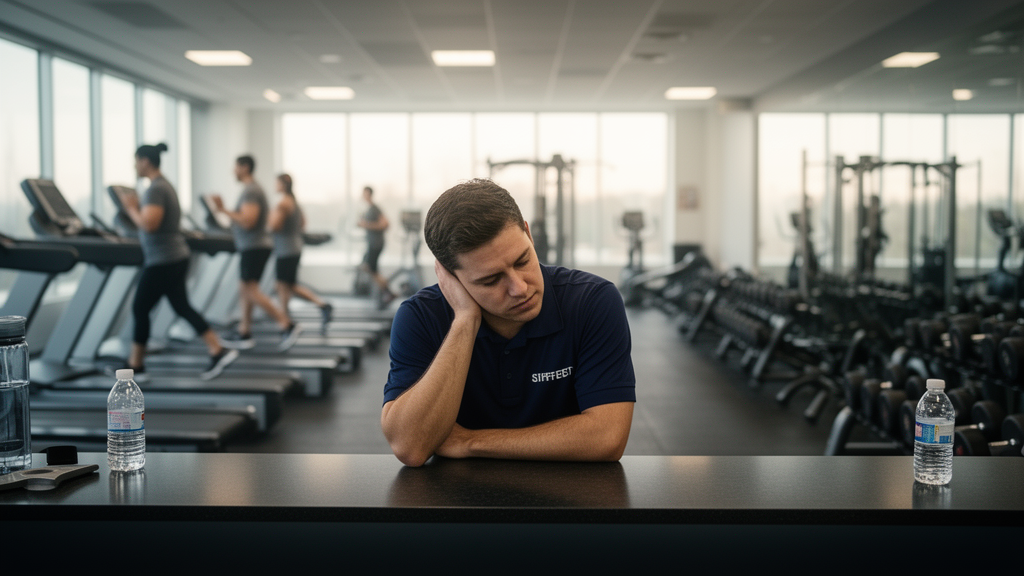
Employees of private sports facilities who feel emotionally drained by their jobs are more likely to quietly quit — staying in their posts while deliberately limiting their effort to the bare minimum the role requires — according to a new cross-sectional study of 646 trainers, instructors and administrative staff in Türkiye. The research, published in Frontiers in Psychology, also found that regret about one’s career choice statistically accounted for a small slice of that association, suggesting that how workers evaluate their occupational path may form one cognitive bridge between burnout and withdrawal, though the study’s design cannot prove any causal sequence.
The research team, led by Faik Orhun Tapşın of Dicle University with colleagues at Kocaeli University, surveyed administrative staff, fitness trainers, personal trainers, Pilates instructors and yoga instructors working in private sports facilities across four districts of the Sakarya and Kocaeli provinces. Participants were approached face-to-face at their workplaces between May and June 2026 and completed questionnaires voluntarily. Of 700 questionnaires collected, 54 were excluded as incomplete or incorrectly filled out, leaving 646 valid cases — a valid-case proportion of 92.3 percent, which the authors note is not a response rate. All participants were aged 19 or over and had worked at private sports facilities for at least one year.
The sample was young and relatively new to the sector: 69.2 percent of participants were aged 19 to 27, and 73.4 percent had between one and five years of experience in the sports sector. Women made up 54.5 percent of the group, 76.9 percent were single, and 43.2 percent worked part-time. The researchers used three validated instruments: the Job-Related Emotional Exhaustion Scale, which measures the core emotional dimension of burnout on a 0-to-24 range; the Quiet Quitting Scale, a nine-item measure covering detachment, lack of initiative and lack of motivation; and the Career Decision Regret Scale, a five-item measure of whether individuals believe a different career path might have served them better.
Quiet quitting, as defined in the study, is distinct from neighboring concepts. Unlike work disengagement, which reflects a general lack of energy for work, or turnover intention, which signals a desire to leave the employer, quiet quitting describes a deliberate restriction of effort to formally required tasks while remaining in the job. It also goes beyond reduced organizational citizenship behavior, since it involves reduced initiative and motivation within the role itself. In a sector built on continuous face-to-face contact with members — where instructors are expected to motivate clients through every session — such withdrawal could carry direct consequences for service quality.
The statistical picture was clear. Job-related emotional exhaustion was positively correlated with quiet quitting (r = 0.474, p < 0.001), a moderate association by conventional benchmarks, and with career decision regret (r = 0.253, p < 0.001). Quiet quitting and career decision regret were also positively correlated (r = 0.344, p < 0.001). In a hierarchical regression, emotional exhaustion and career decision regret each significantly predicted quiet quitting after demographic variables were entered, with the explained variance rising from 4.1 percent to 34.2 percent across the models. Age was the only demographic variable that significantly predicted quiet quitting in the final regression.
The mediation analysis used the PROCESS macro, Model 4, with 5,000 bootstrap samples and age as a covariate. The total statistical association between emotional exhaustion and quiet quitting was B = 0.5096. When career decision regret was added as the mediator, the direct association dropped to B = 0.4275 but remained significant, indicating partial mediation. The indirect pathway through career decision regret was small but significant (B = 0.0821; 95 percent bootstrap confidence interval [0.0481, 0.1218]), corresponding to roughly 16.1 percent of the total association as a descriptive ratio — a figure the authors explicitly caution should not be read as a causal proportion mediated.
The theoretical framing draws on Conservation of Resources theory, which holds that people strive to obtain and protect valued resources and that resource loss weighs more heavily than resource gain. From this perspective, sustained emotional demands deplete workers’ psychological reserves, and those whose reserves run low may adopt a defensive posture, limiting further investment of effort to protect what remains. Restricting effort to the minimum requirements of the role — quiet quitting — can thus be viewed as one possible resource-conserving response. Career decision regret, in turn, may act as a cognitive-evaluative link: workers who feel persistently exhausted may re-evaluate their career expectations, and those who come to regret their occupational choice may see less reason to invest discretionary effort.
Secondary, exploratory comparisons revealed demographic patterns with small effect sizes. Men reported higher career decision regret than women (p < 0.001), but emotional exhaustion and quiet quitting did not differ by gender. Married employees reported higher quiet quitting than single employees, and part-time employees reported higher emotional exhaustion than full-time employees, while full-time employees reported higher career decision regret. All three scores differed across age and duration-of-employment groups in non-linear patterns: for both exhaustion and quiet quitting, the 28-to-37 age group had the lowest mean ranks while those aged 38 and older had the highest, and exhaustion peaked among employees with 11 to 15 years of tenure. The authors stress that these patterns do not support a simple increase with age or experience, and that some subgroup sizes were small — as few as 37 participants in the longest-tenure group.
The researchers are careful about what the study cannot show. Because all variables were measured by self-report at a single time point, the cross-sectional design cannot determine whether exhaustion leads to regret and quiet quitting, whether regret makes work feel more exhausting, or whether the three variables share unmeasured causes such as working conditions or organizational support. Convenience sampling from private facilities in two provinces limits generalizability to other regions, public facilities, and other parts of the sports sector such as clubs and federations. Common-method bias may have inflated the observed associations, and the Quiet Quitting Scale was analyzed as a total score despite its original three-factor structure, with modest reliability reported in its Turkish adaptation (0.68; 0.71 in this sample).
Within those limits, the findings carry practical signals for facility managers, offered by the authors as suggestions derived from associations rather than proven interventions. Predictable scheduling and manageable session loads may matter for part-time staff, who reported the most exhaustion; visible career pathways may matter for full-time staff, who reported the most regret; and workload review and supervisor support may be worth considering for mid- and late-career employees, who showed the highest exhaustion and regret. Because emotional exhaustion showed the strongest association with quiet quitting, periodic assessment of employee well-being may help facilities notice depletion early. The authors call for longitudinal and experimental designs to test the temporal ordering of the three variables, and for future models to incorporate organizational commitment, job satisfaction, psychological resilience and perceived organizational support.
Subject of Research: Associations among job-related emotional exhaustion, career decision regret and quiet quitting among private sports facility employees in Türkiye
Article Title: Associations of job-related emotional exhaustion and career decision regret with quiet quitting among private sports facility employees: a cross-sectional mediation study
Article References: Tapşın, F. O., Tapşın, F. O., & Çakmak, G. (2026). Associations of job-related emotional exhaustion and career decision regret with quiet quitting among private sports facility employees: a cross-sectional mediation study. Frontiers in Psychology, 17, Article 1968120. https://doi.org/10.3389/fpsyg.2026.1968120
Image Credits: AI Generated
DOI: 10.3389/fpsyg.2026.1968120
Keywords: quiet quitting, emotional exhaustion, career decision regret, burnout, sports facilities, fitness instructors, Conservation of Resources theory, mediation analysis, cross-sectional study, occupational psychology, employee well-being, Türkiye
Cite Scienmag News
Glenn Wilkins. (October 26, 2026). Exhausted Gym Staff May Quiet Quit, With Career Regret Playing a Supporting Role. Scienmag. https://scienmag.com/exhausted-gym-staff-may-quiet-quit-with-career-regret-playing-a-supporting-role/
Glenn Wilkins. "Exhausted Gym Staff May Quiet Quit, With Career Regret Playing a Supporting Role." Scienmag, 26 October 2026, https://scienmag.com/exhausted-gym-staff-may-quiet-quit-with-career-regret-playing-a-supporting-role/. Accessed 26 October 2026.
Glenn Wilkins. "Exhausted Gym Staff May Quiet Quit, With Career Regret Playing a Supporting Role." Scienmag. October 26, 2026. https://scienmag.com/exhausted-gym-staff-may-quiet-quit-with-career-regret-playing-a-supporting-role/


