


Adolescence is often described as a period of emotional turbulence, but new evidence suggests that some of the most important changes taking place during these years are happening beneath the surface—in the brain systems that help young people pause before acting, hold information in mind and navigate complex social situations. A large-scale study of 33,622 Chinese adolescents has now mapped age-related patterns in two core components of executive function, or EF, providing one of the most detailed population-level benchmarks yet for how these abilities develop between ages 11 and 18. The findings also identify periods when unusually weak performance may be especially informative for understanding emerging mental-health difficulties.
Executive function is a collection of cognitive processes that allows people to regulate behavior in pursuit of goals. It includes inhibitory control, the ability to suppress an impulsive response or resist distraction, and working memory, the capacity to temporarily store and manipulate information. These abilities support everything from following a conversation and solving a mathematical problem to resisting peer pressure and managing intense emotions. Although EF is widely understood to mature throughout childhood and adolescence, researchers have lacked sufficiently large normative datasets to determine precisely when different components reach their developmental milestones—and whether falling below age-expected performance is linked to specific patterns of psychological vulnerability.
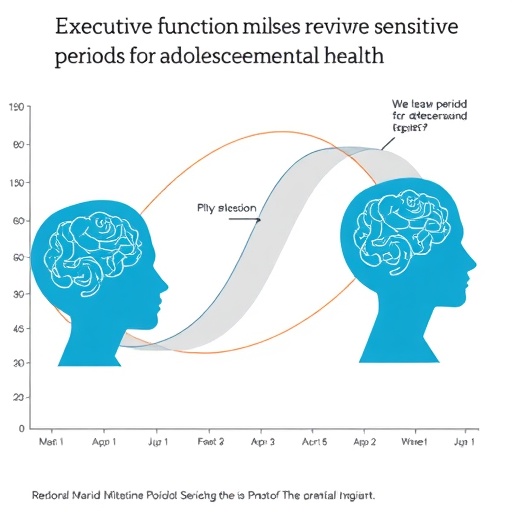
The new analysis found that inhibitory control continued to mature into late adolescence. In practical terms, older teenagers, on average, became progressively better at withholding an automatic response and selecting a more appropriate one. Working memory followed a different trajectory: it improved earlier and then reached a plateau before the end of adolescence. This divergence is important because executive function is not a single ability developing at one uniform speed. Different neural systems and computational demands may mature on partially independent schedules, meaning that an adolescent can show relatively advanced working memory while still experiencing substantial difficulty with impulse control.
The researchers also observed a decline in interindividual variability with age. Younger adolescents differed more widely from one another in their EF performance, whereas the range of scores narrowed as development progressed. This pattern suggests that adolescence is not only a period of average improvement but also one of increasing developmental convergence. At the same time, the existence of a narrower age-related range makes deviations from the norm potentially more meaningful. A score that is typical for an 11-year-old may signal unusual difficulty in a 16-year-old, while a modest difference from the average may carry greater psychological significance during a particular developmental window.
To examine those deviations, the investigators compared each adolescent’s EF performance with age-normed expectations rather than relying only on raw scores. This approach is technically important because cognitive abilities naturally change with age. A single threshold cannot distinguish ordinary immaturity from an atypical developmental pattern across the entire 11-to-18 age range. By estimating what performance is typical at each age, the researchers could assess whether an individual was performing substantially below the expected level for their developmental stage. They then examined how those differences related to measures of behavior and mental health.
Adolescents whose inhibitory control or working memory fell further below age-normed expectations were more likely to show peer problems and conduct difficulties. Lower-than-expected EF was also associated with greater hyperactivity and inattention, as well as reduced prosocial behavior—the willingness to cooperate, help others and respond with concern. These relationships do not demonstrate that weak executive function directly causes mental-health problems. Instead, they indicate that atypical neurocognitive performance and behavioral vulnerability tend to cluster together. Difficulties with inhibition may make it harder to control anger or resist risky impulses, while limited working memory may interfere with keeping social rules, instructions or long-term consequences active during emotionally charged situations.
The strength of these associations depended on age. They were most pronounced during early adolescence and gradually weakened later in the teenage years. This pattern points to a sensitive period in which deviations from typical EF development may be especially predictive of emerging psychopathology. Early adolescence brings major changes in social relationships, school demands, emotional reactivity and sensitivity to peer evaluation. Executive systems are being asked to manage increasingly complex situations at precisely the time when they remain under construction. A developmental weakness that might be difficult to detect in childhood could therefore become more visible when social and academic pressures intensify.
The findings were replicated in an independent sample of 11,549 adolescents from the United States, producing convergent results despite differences in national context and population. Cross-national replication strengthens the case that the observed patterns reflect broad features of adolescent development rather than an artifact of a single dataset. However, the researchers’ results should be interpreted as population benchmarks and risk indicators, not as diagnostic rules. Executive function is influenced by education, sleep, stress, socioeconomic conditions, physical health and family environments, and performance on cognitive tasks can vary depending on motivation and testing conditions. A below-average score alone cannot predict an individual teenager’s future or establish a mental-health diagnosis.
The study’s wider significance lies in its potential to shift adolescent mental-health screening from a one-size-fits-all model toward developmentally timed assessment. Normative EF curves could help clinicians and educators recognize when a young person’s cognitive profile is substantially out of step with age expectations, particularly during early adolescence when the link to behavioral difficulties appears strongest. The results may also guide prevention programs that train self-regulation, strengthen attentional control or adapt classroom demands to developmental capacity. Rather than treating executive function as a fixed trait, the study presents it as a changing system whose timing matters—and whose deviations may offer an early, measurable signal of vulnerability before more severe problems become entrenched.
Cite Scienmag News
Glenn Wilkins. (August 17, 2026). Executive function milestones reveal sensitive periods for adolescent mental health. Scienmag. https://scienmag.com/executive-function-milestones-reveal-sensitive-periods-for-adolescent-mental-health/
Glenn Wilkins. "Executive function milestones reveal sensitive periods for adolescent mental health." Scienmag, 17 August 2026, https://scienmag.com/executive-function-milestones-reveal-sensitive-periods-for-adolescent-mental-health/. Accessed 4 September 2026.
Glenn Wilkins. "Executive function milestones reveal sensitive periods for adolescent mental health." Scienmag. August 17, 2026. https://scienmag.com/executive-function-milestones-reveal-sensitive-periods-for-adolescent-mental-health/


