


The world of scientific research consistently pushes the boundary of what is known, particularly in the fields of material science and imaging technology. Recently, an exciting breakthrough has emerged in the realm of organic scintillators, which are materials that emit light when exposed to radiation. This development has profound implications, specifically in applications such as cultural relic identification and industrial radiographic testing.
In the early days of the field, the scintillation behavior of organic materials was first identified using anthracene crystals in 1947. However, interest in these materials remained stagnant until the significant advancements in organic electronics began to surface. Despite these advancements, a notable challenge persists: the light yield of organic scintillators continues to lag far behind that of their inorganic counterparts. This discrepancy poses a critical barrier to the broader application of organic scintillators, especially in fields that demand high sensitivity and precision.
In recent studies, researchers have employed innovative strategies to enhance the performance of organic scintillators. A compelling approach taken was the incorporation of heavy atom elements and thermally activated delayed fluorescence (TADF) properties into the scintillation process. TADF properties enable these materials to harness and convert energy more efficiently, thereby boosting their light yield. However, while these improvements are promising, the gap in light yield remains a key issue to address.
In light of this challenge, a novel concept emerged from the recent research where scientists designed an organic scintillator featuring a stable charge-separated (CS) state trap through a donor-acceptor (D-A) doping strategy. This design capitalizes on the unique properties of the CS state trap, specifically the thermally activated delayed phosphorescence (TADP) mechanism it produces. Utilizing this mechanism, the researchers successfully enhanced the capture and conversion of high-energy carriers, marking a significant step forward for organic scintillator performance.
The results derived from this pioneering research are impressive. The new organic scintillator demonstrated a remarkable radiation luminescence intensity that far surpasses that of traditional commercial inorganic scintillators. The relative light yield achieved by this innovation reached an astonishing 65,535 photons per MeV, establishing a new benchmark in the field. This finding not only highlights the potential of organic scintillators but also establishes their viability for practical applications in imaging technologies.
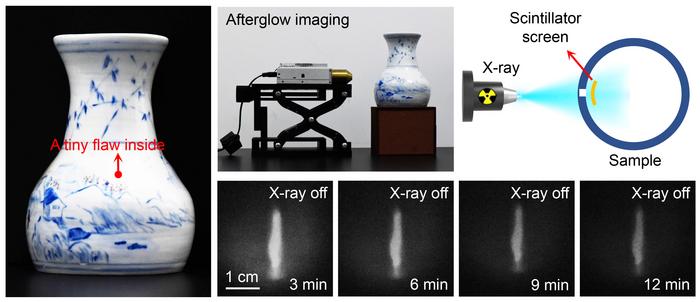
Further adding to the allure of this breakthrough is the scintillator’s extraordinary afterglow phenomenon. Following X-ray excitation, this organic scintillator emitted a vivid afterglow visible to the naked eye for up to 7 hours. This duration of afterglow emission in organic small molecules under X-ray conditions is unprecedented, representing a significant milestone that could transform non-destructive testing methods across various industries.
The applications of X-ray afterglow imaging technology developed from this new scintillator extend beyond mere curiosity within scientific circles. The ability to effectively observe internal structural defects in objects like bottles and to detect fine scratches in the inner metal layers of metal-plastic composite pipes could serve invaluable roles in industries reliant on durability and structural integrity. This technology allows for thorough inspections without compromising the integrity of the tested items, thereby radically transforming the approaches to quality control and archival integrity in cultural relic studies.
Moreover, the implications of this technology reverberate through various disciplines, providing a new lens through which cultural relics can be analyzed and preserved. As historians and conservators strive to maintain the integrity of fragile artifacts, the non-invasive method of X-ray afterglow imaging could enable detailed examinations of relics, enhancing our understanding of their composition and historical significance while ensuring their preservation for future generations.
In conclusion, this remarkable advancement in organic scintillators signifies not just progress in the material science discipline, but represents a holistic shift in our approach to imaging technologies. The newfound ability to observe and analyze fine details within both industrial and cultural contexts using this innovative scintillator paves the way for future research and applications in diverse fields. As scientists continue to unravel the complexities surrounding these materials, one can only anticipate even more groundbreaking developments that lie ahead, profoundly reshaping our interaction with the materials and artifacts that reflect our shared history.
Keywords
Organic scintillators, X-ray imaging, cultural relic identification, non-destructive testing, thermally activated delayed fluorescence, afterglow, radiation luminescence, material science.
Cite Scienmag News
Bethany Barker. (March 25, 2025). Excited-State Traps Increase Radio-Luminescence in Organic Scintillators. Scienmag. https://scienmag.com/excited-state-traps-increase-radio-luminescence-in-organic-scintillators/
Bethany Barker. "Excited-State Traps Increase Radio-Luminescence in Organic Scintillators." Scienmag, 25 March 2025, https://scienmag.com/excited-state-traps-increase-radio-luminescence-in-organic-scintillators/. Accessed 4 September 2026.
Bethany Barker. "Excited-State Traps Increase Radio-Luminescence in Organic Scintillators." Scienmag. March 25, 2025. https://scienmag.com/excited-state-traps-increase-radio-luminescence-in-organic-scintillators/


