


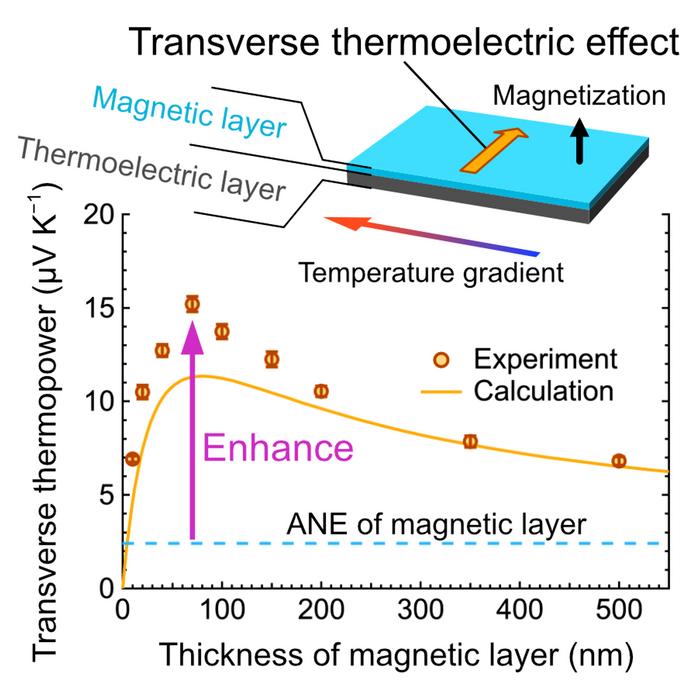
1. A NIMS research team has demonstrated for the first time ever that a simple stack of thermoelectric and magnetic material layers can exhibit a substantially larger transverse thermoelectric effect—energy conversion between electric and heat currents that flow orthogonally to each other within it—than existing magnetic materials capable of exhibiting the anomalous Nernst effect. This mechanism may be used to develop new types of thermoelectric devices useful in energy harvesting and heat flux sensing.

Credit: Weinan Zhou
National Institute for Materials Science,
Yuya Sakuraba
National Institute for Materials Science
1. A NIMS research team has demonstrated for the first time ever that a simple stack of thermoelectric and magnetic material layers can exhibit a substantially larger transverse thermoelectric effect—energy conversion between electric and heat currents that flow orthogonally to each other within it—than existing magnetic materials capable of exhibiting the anomalous Nernst effect. This mechanism may be used to develop new types of thermoelectric devices useful in energy harvesting and heat flux sensing.
2. Seebeck effect-based thermoelectric technologies capable of converting waste heat and other heat sources into electricity have been extensively researched in recent years. The Seebeck effect normally generates an electric current that flows parallel to the associated heat flow (i.e., a longitudinal thermoelectric effect). This physical limitation requires Seebeck effect-based devices to have complex structures, leading to reduced service lives and increased manufacturing costs. On the other hand, by leveraging transverse thermoelectric effects such as the anomalous Nernst effect, thermoelectric devices can have much simpler structures than Seebeck effect-based devices, making them potentially useful in energy harvesting and heat flux sensing. However, the room-temperature thermoelectric conversion performance resulting from the anomalous Nernst effect is currently very low—less than 10 μV of electricity can be generated by a 1 K temperature difference at room temperature—presenting a major disadvantage.
3. This research team fabricated a thermoelectric composite with a very simple structure—a pair of thermoelectric and magnetic material layers stacked tightly atop one another so that electricity can flow across them. This device was able to exhibit a transverse thermoelectric effect significantly larger than that produced solely by existing magnetic materials capable of exhibiting the anomalous Nernst effect in the first-ever experimental demonstration of its kind. To achieve the large transverse thermoelectric effect, the team first constructed a theoretical model and estimated the optimal thickness ratio between the paired thermoelectric silicon (Si) substrate capable of exhibiting a large Seebeck effect and the magnetic iron-gallium (Fe-Ga) alloy thin film. The team then stacked the Fe-Ga thin film atop an Si substrate with the optimum thickness ratio. This composite produced a maximum output voltage of 15.2 μV/K—approximately six times larger than that generated by the Fe-Ga alloy alone (2.4 μV/K) based on the anomalous Nernst effect.
4. This research team demonstrated that a simple layered structure composed of a pair of thermoelectric and magnetic material layers in direct contact was able to produce a significantly larger transverse thermoelectric effect than magnetic materials capable of exhibiting the anomalous Nernst effect when used alone. This composite is expected to be applicable in a wide range of practical thermoelectric devices. Moving forward, research will be expanded to include large bulk materials required for practical applications, aimed at contributing to society’s energy conservation through thermoelectric power generation device applications.
***
5. This project was carried out by Weinan Zhou (ICYS Research Fellow, International Center for Young Scientists, NIMS), Yuya Sakuraba (Group Leader, Magnetic Functional Device Group, Research Center for Magnetic and Spintronic Materials (CMSM), NIMS), Ken-ichi Uchida (Distinguished Group Leader, Spin Caloritronics Group, CMSM, NIMS) and Taisuke Sasaki (Group Leader, Nanostructure Analysis Group, CMSM, NIMS).
This work was conducted as part of the Uchida Magnetic Thermal Management Materials project (Research Director: Ken-ichi Uchida; grant number: JPMJER2201) under JST’s ERATO Strategic Basic Research Program.
6. This research was published in Advanced Science, an open access journal, on March 6, 2024.
Journal
Advanced Science
Method of Research
Experimental study
Subject of Research
Not applicable
Article Title
Direct-Contact Seebeck-Driven Transverse Magneto-Thermoelectric Generation in Magnetic/Thermoelectric Bilayers
Article Publication Date
6-Mar-2024
Cite Scienmag News
Bethany Barker. (May 13, 2024). Exceptionally large transverse thermoelectric effect produced by combining thermoelectric and magnetic materials. Scienmag. https://scienmag.com/exceptionally-large-transverse-thermoelectric-effect-produced-by-combining-thermoelectric-and-magnetic-materials/
Bethany Barker. "Exceptionally large transverse thermoelectric effect produced by combining thermoelectric and magnetic materials." Scienmag, 13 May 2024, https://scienmag.com/exceptionally-large-transverse-thermoelectric-effect-produced-by-combining-thermoelectric-and-magnetic-materials/. Accessed 5 September 2026.
Bethany Barker. "Exceptionally large transverse thermoelectric effect produced by combining thermoelectric and magnetic materials." Scienmag. May 13, 2024. https://scienmag.com/exceptionally-large-transverse-thermoelectric-effect-produced-by-combining-thermoelectric-and-magnetic-materials/

