


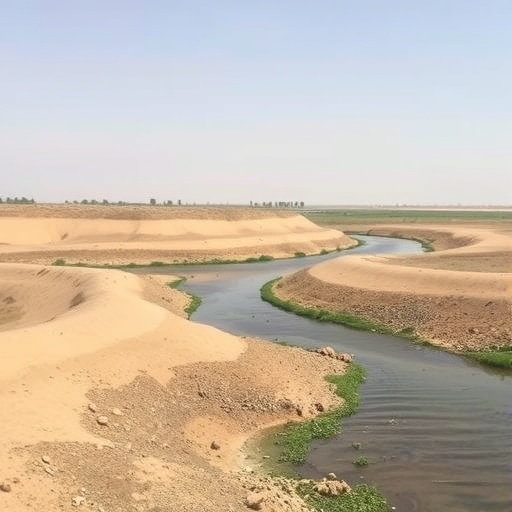
In a groundbreaking study presented in the journal Environmental Monitoring and Assessment, researchers led by Vaid et al. embark on a comprehensive exploration of water quality trends in the Najafgarh Drain, situated in Delhi, India. The Najafgarh Drain, a crucial hydrological feature for the region, has faced numerous environmental challenges, particularly due to rapid urbanization and varying land use practices. This study adopts a multiscale analytical approach to unravel the intricate relationship between land use gradients and water quality metrics, making significant contributions to both environmental science and public health.
The Najafgarh Drain has increasingly become a focal point in discussions about urban water management and sustainability. Historically, this drain has served as a primary outlet for stormwater and wastewater from the bustling city of Delhi, which, combined with agricultural runoff, poses substantial threats to water quality. Given the complex interplay of these factors, Vaid and colleagues’ study examines a multitude of variables that could indicate how differing land uses directly impact water quality within this ecologically significant area.
Central to the research is the methodology that employs both temporal and spatial scales to gauge shifts in water quality over time and across various land use types. By analyzing water samples that represent distinct geographical positions along the drain, the researchers sought to establish correlations between urban development patterns and the concentration of common pollutants. Notably, parameters like pH, turbidity, dissolved oxygen levels, and the presence of pathogens were meticulously quantified to paint a clearer picture of water safety for local communities dependent on these resources.
The study highlights that regions subjected to intense urbanization exhibited significantly poorer water quality compared to areas dominated by agricultural practices. This variable serves as a stark reminder of the adverse effects that rapid industrial and urban growth can impose on natural water systems. Additionally, the findings suggest that the degradation of water quality may not follow linear trends but could vary significantly depending on specific geographic and temporal conditions.
Another key aspect captured by the multiscale analysis is the seasonal variation in water quality. The researchers noted distinct fluctuations corresponding to monsoon and dry seasons. During the monsoon, increased runoff can dilute pollutants; however, this often leads to a surge in turbidity and the introduction of new contaminants. On the other hand, dry seasons exacerbate concentrations of pollutants due to reduced flows within the drain. These insights emphasize that effective water management strategies must consider seasonal dynamics to ensure water safety year-round.
The study also ventures into the implications of deteriorating water quality for public health. Regions dependent on the Najafgarh Drain for agricultural irrigation face heightened health risks, particularly for communities relying on untreated water sources. The potential for waterborne diseases to flourish in such environments
Cite Scienmag News
Violet Maxwell. (October 16, 2025). Examining Water Quality Trends Across Land Use in Najafgarh. Scienmag. https://scienmag.com/examining-water-quality-trends-across-land-use-in-najafgarh/
Violet Maxwell. "Examining Water Quality Trends Across Land Use in Najafgarh." Scienmag, 16 October 2025, https://scienmag.com/examining-water-quality-trends-across-land-use-in-najafgarh/. Accessed 4 September 2026.
Violet Maxwell. "Examining Water Quality Trends Across Land Use in Najafgarh." Scienmag. October 16, 2025. https://scienmag.com/examining-water-quality-trends-across-land-use-in-najafgarh/


