


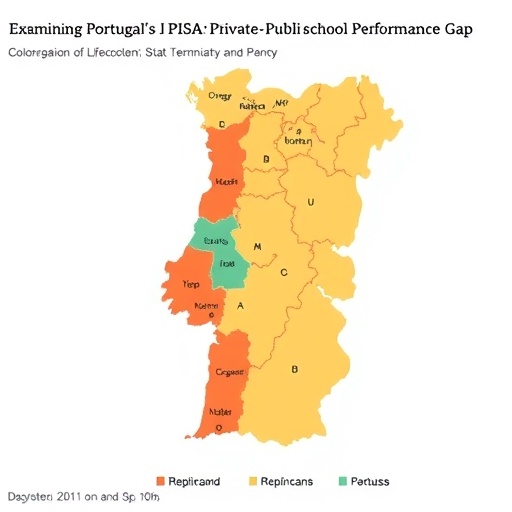
In the evolving landscape of education, the disparities between public and private schools have garnered increasing attention, particularly highlighted by international assessments such as the Programme for International Student Assessment (PISA). Recent research conducted by Colaço, Freitas, and Nunes delves deep into the factors contributing to the performance gap between private and public schools in Portugal. This vital study not only sheds light on the multifaceted nature of educational inequalities but also emphasizes the urgent need for policymakers to address these discrepancies.
PISA serves as a crucial benchmark for evaluating educational systems worldwide. It measures the performance of 15-year-olds in reading, mathematics, and science every three years, providing an opportunity to compare educational outcomes across diverse countries. With Portugal’s participation in PISA, a census of student performance against rigorous international standards has emerged. This granular performance data is indispensable for understanding the origins of educational inequalities within the country.
In examining the public-private school divide, the researchers note several critical dimensions, ranging from socioeconomic factors to institutional structures. Private schools often boast smaller class sizes and more resources, including advanced technologies and extracurricular opportunities. These elements contribute to a more conducive learning environment, which can foster heightened student engagement and achievement. However, the question remains: is it solely the resources that account for these differences, or are there deeper systemic issues at play?
Socioeconomic status is a prevalent factor influencing educational outcomes. Families with greater financial means can afford to send their children to private schools, which may offer specialized programs and dedicated personal attention. In contrast, students from lower-income households often attend public schools, which may face challenges including overcrowding and limited funding. This socioeconomic divide creates a cycle of educational inequity that further complicates the performance landscape in PISA assessments.
The pedagogical approach in public versus private institutions also demands scrutiny. Many private schools implement innovative teaching styles and curricula that emphasize critical thinking and creativity. Such approaches can lead to improved student outcomes, yet public schools often adhere to more traditional teaching methods constrained by regulatory requirements. This disparity in teaching philosophies can exacerbate the performance gap observed in PISA results.
Moreover, parental involvement plays a significant role in the educational success of students. In families where parents are actively engaged in their child’s education, students are more likely to thrive academically. Private schools may attract more involved parents due to their financial investment in education, while public schools may have varying levels of parental engagement influenced by socioeconomic factors. This difference can further skew performance results in favor of private institutions.
The study also highlights the importance of accountability measures within the education system. Private schools, often operating under less bureaucratic oversight, have the flexibility to implement curricula that are tailored to student needs and local demands. In contrast, public schools must navigate complex regulations that can hinder their responsiveness to students’ educational requirements, potentially undermining their performance on assessments like PISA.
Another critical aspect that the research explores is the role of teacher quality. Research consistently shows that teacher effectiveness is one of the most significant predictors of student achievement. Private schools often have the advantage of attracting highly qualified educators, sometimes offering competitive salaries and professional development opportunities that are not always available in public schools. This discrepancy in teacher quality contributes to the performance gap and raises questions about how best to support educators in public institutions.
Additionally, the cultural context surrounding education in Portugal plays a fundamental role in shaping student outcomes. Attitudes towards public education versus private education can vary significantly among communities, affecting parental choices and student motivation. In regions where public education is viewed unfavorably, students may experience an intrinsic disinterest in their schooling, which can perpetuate cycles of underachievement reflected in PISA scores.
To address the private-public school performance gap, the researchers propose a multifaceted approach that includes policy interventions, increased resource allocation to public schools, and programs aimed at enhancing instructional quality. They stress the importance of equitable funding models that ensure all schools, irrespective of their public or private status, have equal access to quality resources.
The findings of this research are not limited to Portugal but reflect a recurring theme seen across global education systems. Countries around the world grapple with similar challenges in addressing the imbalances between different types of educational institutions. As such, the implications of this study resonate far beyond national borders, serving as a call to action for countries striving to create equitable education systems.
As this pivotal research continues to circulate, it may ignite discussions among educators, policymakers, and the wider community regarding the importance of addressing systemic inequities in education. This topic, if embraced by stakeholders, could inspire a movement towards lasting change that enhances educational quality for all students, regardless of their background or economic status.
In summary, Colaço, Freitas, and Nunes’s investigation into the performance gap between private and public schools in Portugal reveals critical insights into the factors underpinning educational inequalities. From socioeconomic influences to pedagogical strategies, the study underscores the complexity of developing effective educational policies that bridge these gaps and ensure equitable outcomes for every student. As the world looks towards the future of education, the need for informed interventions, designed to mitigate these disparities, has never been more pressing.
Colaço, R., Freitas, P., Nunes, L.C. et al. Understanding the private-public school performance gap in PISA: evidence from Portugal. Large-scale Assess Educ 13, 1 (2025). https://doi.org/10.1186/s40536-024-00234-7
Cite Scienmag News
Courtney Benton. (August 24, 2025). Examining Portugal’s PISA Private-Public School Performance Gap. Scienmag. https://scienmag.com/examining-portugals-pisa-private-public-school-performance-gap/
Courtney Benton. "Examining Portugal’s PISA Private-Public School Performance Gap." Scienmag, 24 August 2025, https://scienmag.com/examining-portugals-pisa-private-public-school-performance-gap/. Accessed 4 September 2026.
Courtney Benton. "Examining Portugal’s PISA Private-Public School Performance Gap." Scienmag. August 24, 2025. https://scienmag.com/examining-portugals-pisa-private-public-school-performance-gap/


