

Monday, May 25, 2026
Science
No Result
View All Result
  • Login
  • HOME
  • SCIENCE NEWS
  • CONTACT US
  • HOME
  • SCIENCE NEWS
  • CONTACT US
No Result
View All Result
Scienmag
No Result
View All Result
Home Science News Agriculture

Evolutionary history shapes variation of wood density

May 13, 2024
in Agriculture
Reading Time: 3 mins read
0
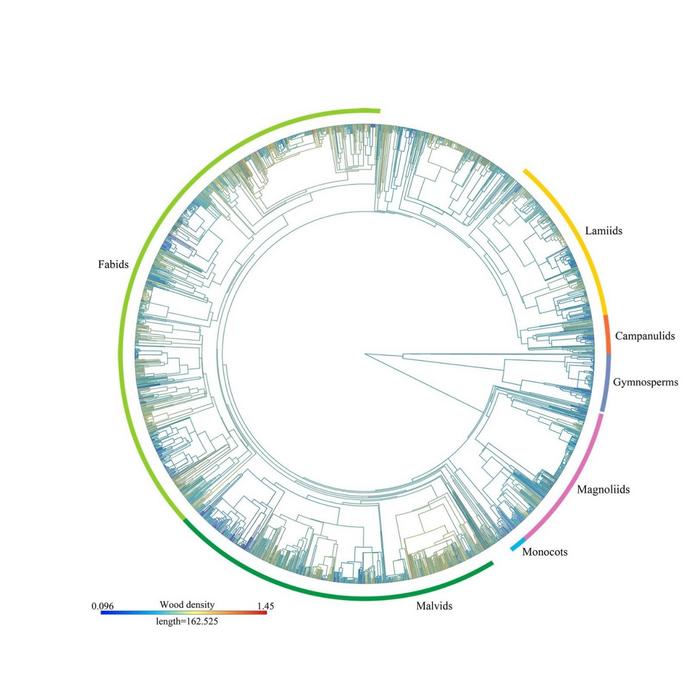
Phylogenetic tree of wood density for 2,621 species investigated in this study
65
SHARES
595
VIEWS
Share on FacebookShare on Twitter
ADVERTISEMENT

Ecology and evolutionary biology suggest that closely related species are more likely to exhibit morphological and functional similarities compared to distantly related species. Each tree species represents a unique genetic reservoir and is a product of long-term evolutionary processes, with specific morphological structures and functional traits. However, previous studies have overlooked the relationship between the allometric biomass and wood density and phylogeny.

Phylogenetic tree of wood density for 2,621 species investigated in this study

Credit: Li, F. et al.

Ecology and evolutionary biology suggest that closely related species are more likely to exhibit morphological and functional similarities compared to distantly related species. Each tree species represents a unique genetic reservoir and is a product of long-term evolutionary processes, with specific morphological structures and functional traits. However, previous studies have overlooked the relationship between the allometric biomass and wood density and phylogeny.

To that end, our study utilized a comprehensive global dataset to show that phylogeny plays a significant role in shaping wood density patterns. We assessed phylogenetic signal in different taxonomic (e.g., angiosperms and gymnosperms) and ecological (e.g., tropical, temperate, and boreal) groups of tree species, explored the biogeographical and phylogenetic patterns of wood density, and quantified the relative importance of current environmental factors (e.g., climatic and soil variables) and evolutionary history (i.e., phylogenetic relatedness among species and lineages) in driving global wood density variation.

We found that wood density displayed a significant phylogenetic signal. Notably, wood density differed among different biomes and climatic zones, with higher mean values of wood density in relatively drier regions (highest in subtropical desert).

Our study, published in the KeAi journal Plant Diversity, revealed that at a global scale, for angiosperms and gymnosperms combined, phylogeny and species (representing the variance explained by taxonomy and not direct explained by long-term evolution process) accounted for 84.3% and 7.7% of total wood density variation, respectively. In contrast, current environmental factors accounted for only 2.7% of total wood density variation. When analyzing angiosperms and gymnosperms separately, the breakdown of explained variation differed: 84.2%, 7.5% and 6.7% for angiosperms, and 45.7%, 21.3% and 18.6% for gymnosperms.

###

Contact the author: Xing-Zhao Huang, Anhui Province Key Laboratory of Forest Resources and Silviculture, xingzhaoh@163.com

The publisher KeAi was established by Elsevier and China Science Publishing & Media Ltd to unfold quality research globally. In 2013, our focus shifted to open access publishing. We now proudly publish more than 100 world-class, open access, English language journals, spanning all scientific disciplines. Many of these are titles we publish in partnership with prestigious societies and academic institutions, such as the National Natural Science Foundation of China (NSFC).


Journal

Plant Diversity

DOI

10.1016/j.pld.2024.04.002

Method of Research

Meta-analysis

Subject of Research

Not applicable

Article Title

Evolutionary history shapes variation of wood density of tree species across the world

COI Statement

The authors declare that they have no known competing financial interests or personal relationships that could have appeared to influence the work reported in this paper.

Share26Tweet16
Previous Post

DOE lands top two spots on list of fastest supercomputers

Next Post

Same-sex marriage has caused no harms to different-sex couples

Related Posts

DNA Uncovers Hidden Biodiversity Loss in Ontario Streams, Introducing a Powerful New Tool for Freshwater Monitoring — Agriculture
Agriculture

DNA Uncovers Hidden Biodiversity Loss in Ontario Streams, Introducing a Powerful New Tool for Freshwater Monitoring

May 22, 2026
Exploring Soil Science: How AI Could Revolutionize the Protection of a Crucial Global Resource — Frontiers in Science Deep Dive Webinar Series — Agriculture
Agriculture

Exploring Soil Science: How AI Could Revolutionize the Protection of a Crucial Global Resource — Frontiers in Science Deep Dive Webinar Series

May 22, 2026
Rainforest Foragers Boosted Plant Use Millennia Before Agriculture Emerged — Agriculture
Agriculture

Rainforest Foragers Boosted Plant Use Millennia Before Agriculture Emerged

May 20, 2026
New Research Develops Strategy to Shield Amazonian Cocoa from Witches’ Broom Disease — Agriculture
Agriculture

New Research Develops Strategy to Shield Amazonian Cocoa from Witches’ Broom Disease

May 19, 2026
New PollinERA Policy Brief Advocates Regional Budget System for Pesticide Management Across Europe — Agriculture
Agriculture

New PollinERA Policy Brief Advocates Regional Budget System for Pesticide Management Across Europe

May 19, 2026
Study Finds Shared Benefits for Agriculture and Conservation Following Klamath Dam Removals — Agriculture
Agriculture

Study Finds Shared Benefits for Agriculture and Conservation Following Klamath Dam Removals

May 19, 2026
Next Post
Same-sex marriage has caused no harms to different-sex couples

Same-sex marriage has caused no harms to different-sex couples

  • Mothers who receive childcare support from maternal grandparents show more parental warmth, finds NTU Singapore study

    Mothers who receive childcare support from maternal grandparents show more parental warmth, finds NTU Singapore study

    27649 shares
    Share 11056 Tweet 6910
  • University of Seville Breaks 120-Year-Old Mystery, Revises a Key Einstein Concept

    1052 shares
    Share 421 Tweet 263
  • Bee body mass, pathogens and local climate influence heat tolerance

    680 shares
    Share 272 Tweet 170
  • Researchers record first-ever images and data of a shark experiencing a boat strike

    543 shares
    Share 217 Tweet 136
  • Groundbreaking Clinical Trial Reveals Lubiprostone Enhances Kidney Function

    529 shares
    Share 212 Tweet 132
Science

Embark on a thrilling journey of discovery with Scienmag.com—your ultimate source for cutting-edge breakthroughs. Immerse yourself in a world where curiosity knows no limits and tomorrow’s possibilities become today’s reality!

RECENT NEWS

  • FAM129C Mutation Drives Achalasia via GABAA Immunity
  • USP35 Drives Kidney Damage via Endothelial Ferroptosis
  • Life Cycle Emissions in EU Buildings and Construction
  • GABA in NG2 Glia Drives Empathy-like Behavior

Categories

  • Agriculture
  • Anthropology
  • Archaeology
  • Athmospheric
  • Biology
  • Biotechnology
  • Blog
  • Bussines
  • Cancer
  • Chemistry
  • Climate
  • Earth Science
  • Editorial Policy
  • Marine
  • Mathematics
  • Medicine
  • Pediatry
  • Policy
  • Psychology & Psychiatry
  • Science Education
  • Social Science
  • Space
  • Technology and Engineering

Subscribe to Blog via Email

Enter your email address to subscribe to this blog and receive notifications of new posts by email.

Join 5,146 other subscribers

© 2025 Scienmag - Science Magazine

Welcome Back!

Login to your account below

Forgotten Password?

Retrieve your password

Please enter your username or email address to reset your password.

Log In
No Result
View All Result
  • HOME
  • SCIENCE NEWS
  • CONTACT US

© 2025 Scienmag - Science Magazine

Discover more from Science

Subscribe now to keep reading and get access to the full archive.

Continue reading
