


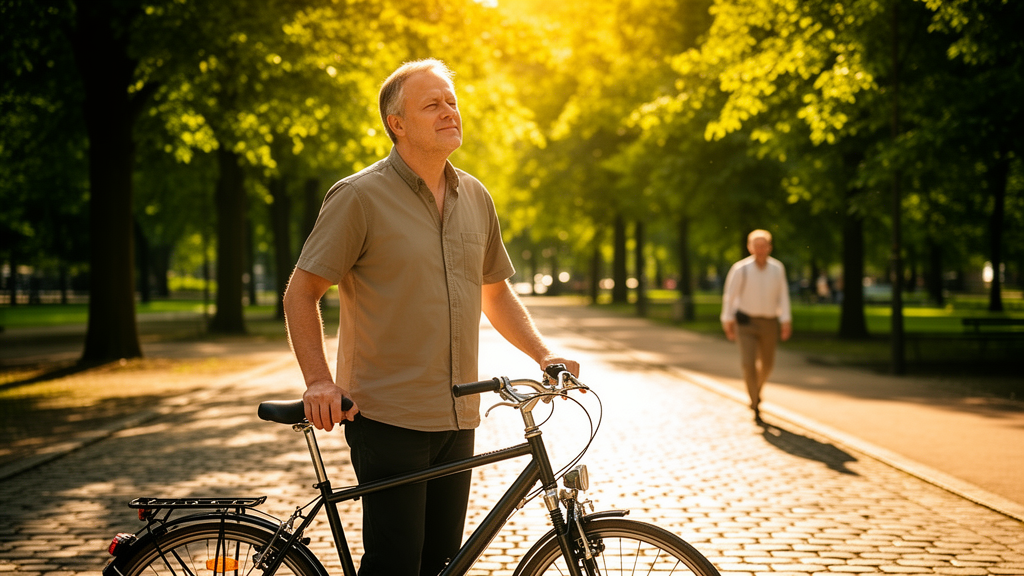
A short bicycle ride to work or a ten-minute walk to the supermarket seems harmless enough, but a new nationwide study from Germany suggests these everyday journeys are a blind spot in skin cancer prevention. Researchers at Friedrich-Alexander-Universität Erlangen-Nürnberg analyzed data from more than 3,200 German adults who regularly travel on foot or by (e-)bike for transport, and found that while most people take some precautions against the sun, the use of sunscreen and other protective measures during active travel remains surprisingly low. The findings, published in Frontiers in Sports and Active Living, are the first to systematically examine sun protection during active mobility, a situation that has largely escaped the attention of prevention researchers even as skin cancer rates climb across Western industrialized nations.
Solar ultraviolet radiation is the primary environmental risk factor for skin cancer, driving both keratinocyte carcinoma and malignant melanoma, whose incidence has risen steadily in recent decades. Public health authorities therefore recommend consistent sun protection: avoiding intense UV exposure by seeking shade, wearing clothing that covers exposed skin, and applying sunscreen to uncovered areas. Yet most prevention messaging targets deliberate sun exposure, such as beach vacations or outdoor sports, leaving routine exposures like a twenty-minute commute under high-UV conditions largely unaddressed. The new study set out to fill that gap by asking how often people use recommended protective measures during everyday trips of ten minutes or longer on foot or by bicycle.
The data came from the 2025 wave of the National Cancer Aid Monitoring online (NCAM-online), a nationwide survey of 4,304 Germans aged 16 to 65 recruited through an ISO-certified online panel with quotas for sex, age, education, and federal state. After excluding people who did not actively travel in summer and those who walked or cycled solely for recreation, such as dog walking, the final sample comprised 3,264 active travelers. Participants reported how often they used six protective measures: sunscreen on the face, sunscreen on other exposed body areas, a shirt with sleeves covering the shoulders, headwear, sunglasses, and traveling in the shade. Answers were dichotomized into frequent use, meaning often or always, versus less frequent use.
The results reveal a clear hierarchy of habits. The most common measure was wearing a shirt with sleeves covering the shoulders, reported by 52.1 percent of travelers, followed by sunglasses at 46.8 percent and traveling in the shade at 38.5 percent. Sunscreen lagged well behind, used often or always on the face by only 32.5 percent and on the rest of the body by just 26.6 percent. Headwear was the second-least common measure at 29.5 percent. The pattern held across trip purposes, whether people were commuting to work or school, traveling to leisure activities, or running errands, with only minor variation between subgroups.
Striking differences emerged between men and women. Women were considerably more likely to apply sunscreen, with 43.7 percent using it on the face compared with 22.2 percent of men, and 31.6 percent versus 22.0 percent on the body. Women also favored sunglasses and shade-seeking more than men. Men, by contrast, were more likely to wear sleeved shirts, 54.6 percent versus 49.4 percent, and far more likely to wear headwear, 37.5 percent versus 20.8 percent. The authors caution that these patterns may reflect fashion and practical preferences as much as deliberate sun protection: men’s caps and helmets may serve primarily for style or safety, while women’s summer wardrobes more often include sleeveless tops that leave shoulders exposed.
One of the most encouraging findings concerns children. Among the 554 participants who traveled with children, the youngsters were consistently better protected than the adults accompanying them, and every comparison was statistically significant. Roughly two thirds of caregivers reported that children wore headwear, 69.1 percent, sleeved shirts, 67.9 percent, sunscreen on the body, 65.9 percent, and sunscreen on the face, 65.7 percent, while half said the children traveled in the shade. The one exception was sunglasses, worn by only 30.9 percent of children, making eye protection the weakest link in children’s sun safety. Notably, the caregiver’s own protection remained lower across the board, and female caregivers reported more sun protection for children than male caregivers, particularly for sunscreen use and shade-seeking.
Travel frequency also mattered. People who walked or cycled often were more likely than occasional travelers to use sunscreen on the face, 37.3 percent versus 27.1 percent, and on the body, as well as to cover their shoulders, wear headwear, and wear sunglasses. The same held for those who frequently accompanied children, who protected both themselves and the children more consistently than occasional accompaniers. This is a hopeful signal, the authors note, because the people with the greatest cumulative exposure are also the ones most likely to adopt protective habits, though overall adherence still leaves substantial room for improvement, especially among occasional travelers who may underestimate their risk.
The study also uncovered a fascinating behavioral trade-off between two health-promoting activities. When solar radiation was perceived as high, 42.8 percent of active travelers said they opted not to walk or cycle at all and instead took a car or public transport, a choice that reduces UV exposure but also sacrifices physical activity. Occasional travelers were especially likely to abandon active travel under high-UV conditions, at 50.7 percent compared with 35.6 percent of frequent travelers. Meanwhile, 53.2 percent reported adding extra sun protection when radiation was elevated. The authors stress that abandoning active travel is not a viable long-term solution, given the well-documented benefits of physical activity in preventing chronic disease, and that this tension underscores the need for better shade along walking and cycling routes.
Why is sunscreen the least used measure during active travel? Prior research points to practical barriers such as forgetting, lack of routine, and perceived effort, along with product-related complaints about greasy or sticky textures. The authors add a transportation-specific consideration: one of active travel’s advantages, its door-to-door speed, can be substantially reduced or erased by the time needed to apply sunscreen. They also question whether the low use of shaded routes in the survey reflects a general shortfall in shade provision along pedestrian and cycling corridors, an issue that urban planners could address. The study argues for a dual approach combining individual education with structural interventions, particularly as climate change intensifies both heat and UV exposure.
As an exploratory study, the work has limitations the authors acknowledge candidly. Data were self-reported in November, raising the possibility of recall and social desirability bias, and quota sampling may limit generalizability. The survey did not capture children’s ages or the duration of trips, both of which likely shape protection behavior, and recreational walking and cycling were deliberately excluded. Still, the message is clear: even comparatively short exposures, such as a twenty-minute bicycle ride at midday in summer, can cause sunburn and contribute to skin cancer risk. The researchers call for prevention campaigns to explicitly address everyday journeys, an untapped opportunity to protect the millions of people whose daily commute puts them, quite literally, in the sun.
Subject of Research: Sun protection behavior during walking and cycling for transport in Germany
Article Title: Sun protection during active travel on foot or by (e-)bike: an exploratory nationwide cross-sectional study from Germany
Article References: Voß, L., Görig, T., Kubbe, A. K., Tristram, C., & Diehl, K. (2026). Sun protection during active travel on foot or by (e-)bike: an exploratory nationwide cross-sectional study from Germany. Frontiers in Sports and Active Living, 8, Article 1957202. https://doi.org/10.3389/fspor.2026.1957202
Image Credits: AI Generated
DOI: 10.3389/fspor.2026.1957202
Keywords: sun protection, active travel, UV radiation, skin cancer, sunscreen, cycling, walking, children, Germany, public health, urban planning, cross-sectional study
Cite Scienmag News
Nathaniel Bowman. (October 17, 2026). Everyday Walks and Bike Rides Leave Germans Underprotected Against Skin Cancer Risk. Scienmag. https://scienmag.com/everyday-walks-and-bike-rides-leave-germans-underprotected-against-skin-cancer-risk/
Nathaniel Bowman. "Everyday Walks and Bike Rides Leave Germans Underprotected Against Skin Cancer Risk." Scienmag, 17 October 2026, https://scienmag.com/everyday-walks-and-bike-rides-leave-germans-underprotected-against-skin-cancer-risk/. Accessed 17 October 2026.
Nathaniel Bowman. "Everyday Walks and Bike Rides Leave Germans Underprotected Against Skin Cancer Risk." Scienmag. October 17, 2026. https://scienmag.com/everyday-walks-and-bike-rides-leave-germans-underprotected-against-skin-cancer-risk/


