

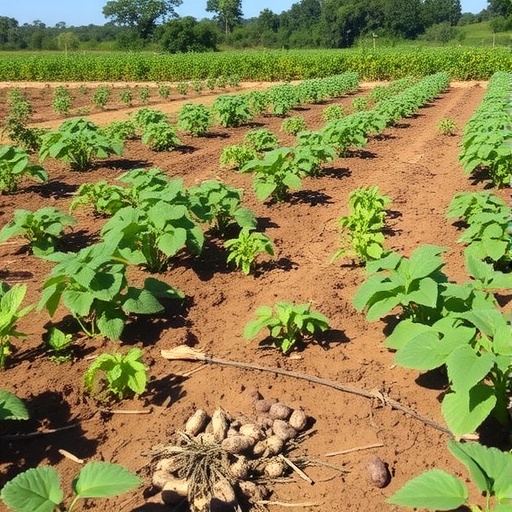
In a groundbreaking study set to reshape the agricultural landscape in Ethiopia, researchers Aragaw and Endris have conducted a meticulous analysis on the potato production efficiency among smallholder farmers in the Awi Zone of the Amhara region. As the global population continues to rise, the demand for staple crops like potatoes has never been more pressing. This study not only highlights the challenges faced by smallholder farmers but also offers innovative strategies for improving production efficiency in a region that has been historically reliant on agriculture.
Potatoes have become a key crop for food security in Ethiopia, and the Awi Zone is particularly known for its favorable growing conditions. However, smallholder farmers often struggle with low yields due to a myriad of factors including inadequate access to quality seeds, poor soil fertility, and limited market access. This research examines these issues in depth, providing a comprehensive overview of the obstacles that small farmers confront daily. The findings are crucial in understanding how to enhance productivity and ensure food security for a growing population.
One of the major revelations of this study is the significant gap between the potential and actual yields of potato farming in the Awi Zone. Farmers are equipped with traditional farming techniques that have not evolved with changing agricultural practices or climate conditions. Substantial differences in productivity were recorded, leading the researchers to advocate for a more modern approach toward potato cultivation. By leveraging improved farming techniques and better seed varieties, the farmers could increase their yield dramatically, thereby improving their livelihoods and food security.
Throughout the research, Aragaw and Endris utilized various methodologies to assess the efficiency of potato production. They conducted surveys and interviews with local farmers, gathering quantitative data on yield rates, costs, and farming practices. In addition, they employed various statistical tools to analyze this data, drawing correlations that highlight the inefficiencies present in the current farming model. This rigorous approach not only lends credibility to their findings but also reveals specific areas where targeted interventions could yield substantial improvements.
Moreover, the study emphasizes the critical role of education and training in enhancing production efficiency. Many smallholder farmers lack access to current agricultural practices and innovations which have proven effective in similar regions. By implementing training programs focused on sustainable agricultural practices, the potential for increasing knowledge and skills among these farmers could lead to significant economic benefits. Education emerges as a pivotal theme, underscoring the need for investment not only in technology but also in the human capital necessary to utilize these advancements effectively.
The sustainability of potato farming in the Awi Zone is another focal point of the research, with climate change presenting both challenges and opportunities. The changing climate patterns have necessitated the adaptation of farming practices to ensure resilience against pests and extreme weather conditions. The researchers argue that adopting sustainable practices such as crop diversification and integrated pest management can lead to more dependable harvests and enhance soil health. By fostering an environment where sustainable practices flourish, farmers can secure their livelihoods against the backdrop of global environmental changes.
In discussing the economic implications of improved potato production efficiency, the study provides a compelling argument for investing in local agriculture. With the right interventions, smallholder farmers can transition from subsistence farming to more profitable enterprises. By accessing better markets and receiving fair prices for their goods, farmers can reinvest in their farms, enhancing their overall economic standing. This economic empowerment is essential not only for individual farmers but for fostering growth within the wider community and national economy.
The research also considers the socio-cultural dimensions associated with potato farming in Ethiopia. Farming practices are not merely economic endeavors but are deeply entwined with cultural identities and traditions. The researchers emphasize that any intervention in agricultural practices must take into account the unique social fabric of the Awi Zone, ensuring that changes are culturally sensitive and accepted by the community. This holistic approach is vital for achieving long-term success in improving agricultural efficiency.
As they conclude their study, Aragaw and Endris present a series of recommendations aimed at stakeholders in the agricultural field, including policymakers, agricultural organizations, and nongovernmental organizations. The authors stress the importance of collaborative efforts to enhance potato production systems. By working together, stakeholders can develop comprehensive strategies that encompass better resource management, access to finance, and the promotion of local innovation.
This research not only offers a comprehensive snapshot of the current state of potato farming in the Awi Zone but also lays a blueprint for action. It serves as a call to action for all involved in agricultural development in Ethiopia and beyond. The insights gleaned from this study demonstrate that with the right support and resources, smallholder farmers can not only survive but thrive in an increasingly competitive global market.
In the realm of sustainable development, the challenges of food production can no longer be viewed in isolation. The findings of this study reveal the interconnectedness of agricultural efficiency, economic stability, and community resilience. By fostering a sustainable agricultural ecosystem, the potential to uplift entire communities is within reach. The significance of this research extends beyond the Awi Zone, echoing the universal need for sustainable hunger solutions that can be adapted in diverse contexts.
The implications of Aragaw and Endris’s study resonate well beyond Ethiopia. As other developing nations grapple with similar challenges of productivity and sustainability in agriculture, the insights derived from this comprehensive analysis offer valuable lessons. By focusing on enhancing production efficiency through targeted interventions, there lies an opportunity to improve food security and economic resilience on a global scale.
In sum, the research by Aragaw and Endris exemplifies the critical importance of understanding and improving potato production among smallholder farmers. Not only does it shed light on local agricultural practices but it also champions a framework for development that prioritizes efficiency, sustainability, and community engagement. The path forward for farmers in the Awi Zone, and indeed for smallholders worldwide, is rich with potential, provided that the necessary actions are taken to realize these opportunities.
Subject of Research: Analysis of potato production efficiency among smallholder farmers in Awi Zone, Amhara region, Ethiopia.
Article Title: Analysis of potato production efficiency among smallholder farmers in Awi Zone, Amhara region, Ethiopia.
Article References:
Aragaw, Y., Endris, E. Analysis of potato production efficiency among smallholder farmers in Awi Zone, Amhara region, Ethiopia. Discov Sustain (2025). https://doi.org/10.1007/s43621-025-02461-6
Image Credits: AI Generated
DOI: 10.1007/s43621-025-02461-6
Keywords: Potato production, smallholder farmers, agricultural efficiency, Ethiopia, sustainability.


