


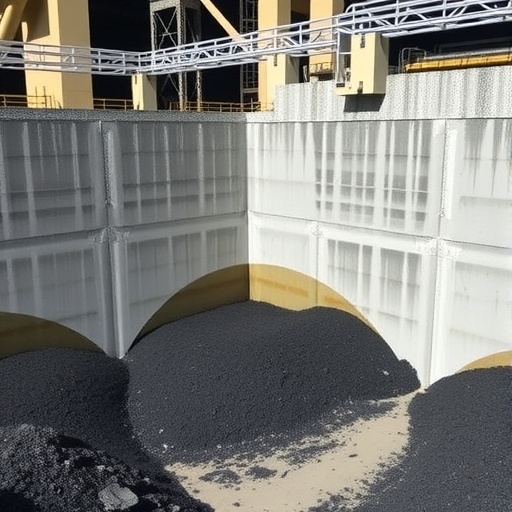
In the quest for sustainable construction materials, researchers are increasingly turning their attention to coal bottom ash, a byproduct of coal combustion. A recent study titled “Predictive Analysis and Performance Assessment of Coal Bottom Ash in Recycled Aggregate Concrete Under Elevated Temperatures” sheds light on the potential benefits and challenges associated with incorporating this material into recycled aggregate concrete. The findings are expected to be integral to future developments in eco-friendly construction practices.
As the environmental impact of traditional concrete production becomes increasingly concerning, alternative materials like coal bottom ash represent a promising avenue for research. Coal bottom ash, which is generated from coal-fired power plants, is often disposed of in landfills. However, its utilization in concrete mixes could reduce waste and lessen the demand for natural aggregates, ultimately resulting in a more sustainable construction industry.
One of the primary focuses of this study is the thermal performance of recycled aggregate concrete incorporating coal bottom ash. Elevated temperatures can significantly influence the mechanical and physical properties of concrete, which is crucial for structural applications. The researchers conducted a series of experiments to understand how coal bottom ash behaves at various temperature conditions, evaluating its performance in comparison to traditional concrete mixes.
The results of these experiments were illuminating. It was found that recycled aggregate concrete containing coal bottom ash exhibited favorable mechanical properties, even when subjected to high temperatures. This discovery suggests that coal bottom ash could be not only a sustainable alternative but also a high-performing material in environments where temperature fluctuations are a concern, such as in industrial and infrastructural applications.
Furthermore, the research highlights the importance of incorporating predictive analysis to assess the long-term performance of such materials. By utilizing advanced modeling techniques, the researchers were able to simulate various scenarios, providing insights into how recycled aggregate concrete with coal bottom ash might behave over time. This predictive approach is particularly useful for engineers and designers seeking reliable materials for future construction projects.
In addition to its performance characteristics, the environmental impact of coal bottom ash was a significant consideration in the study. The use of this waste product helps mitigate the environmental footprint of concrete production. By recycling coal bottom ash, the construction industry can move towards more sustainable practices while also addressing the ongoing challenges of waste management.
The study’s findings are timely, given the growing emphasis on sustainability in construction. Policymakers and industry leaders are increasingly advocating for greener building practices, prompting researchers to explore materials that can reduce carbon emissions and resource depletion. Coal bottom ash stands out as a potential solution, aligning with these goals while showcasing strong performance traits.
Another compelling aspect of the study is its consideration of economic factors. By potentially reducing the need for virgin aggregates, the incorporation of coal bottom ash could lead to cost savings in concrete production. This dual benefit of environmental sustainability and economic viability makes coal bottom ash a particularly attractive option for projects with budget constraints.
However, the research did not shy away from discussing the challenges that come with using coal bottom ash. One such challenge is the variability in the properties of bottom ash, which can depend on factors like the type of coal burned and the combustion conditions. This variability must be taken into account when designing concrete mixes, as it can affect consistency and performance.
The study also emphasizes the necessity of conducting further research into optimizing the formulation of concrete mixes that incorporate coal bottom ash. While the initial findings are promising, additional investigations will be essential to refine these materials for broader applications. This ongoing research is paramount for ensuring that the use of coal bottom ash can be standardized across the construction industry.
In conclusion, the study “Predictive Analysis and Performance Assessment of Coal Bottom Ash in Recycled Aggregate Concrete Under Elevated Temperatures” offers valuable insights into the potential of coal bottom ash as a construction material. With its favorable properties under high-temperature conditions and its sustainability benefits, coal bottom ash could contribute significantly to the evolution of concrete technology. As the construction industry looks to innovate, the findings of this research could pave the way for more environmentally friendly practices and materials in the years to come.
Strong advocacy from the scientific community and investment in research and development are crucial for realizing the full potential of coal bottom ash. As interest in green building materials continues to grow, it is likely that more studies will emerge, further exploring the capabilities and applications of this versatile waste product. The future of sustainable construction may well depend on the successful integration of materials like coal bottom ash into mainstream building practices, reducing both reliance on natural resources and the environmental impact of construction activities.
With coal bottom ash as a focal point of innovative research, the construction industry stands at the threshold of significant change. The successful implementation of such materials not only supports environmental sustainability but also promotes economic benefits, making it a win-win solution for all stakeholders involved in construction and building design.
As attention turns towards the practicality of using recycled materials in concrete production, the study conducted by Saxena et al. is a reminder that solutions for sustainable infrastructure are not just possible but also attainable. By embracing innovative materials and methodologies, the road to a more sustainable future in construction can become a reality.
Cite Scienmag News
Violet Maxwell. (January 17, 2026). Evaluating Coal Bottom Ash in High-Temperature Concrete. Scienmag. https://scienmag.com/evaluating-coal-bottom-ash-in-high-temperature-concrete/
Violet Maxwell. "Evaluating Coal Bottom Ash in High-Temperature Concrete." Scienmag, 17 January 2026, https://scienmag.com/evaluating-coal-bottom-ash-in-high-temperature-concrete/. Accessed 5 September 2026.
Violet Maxwell. "Evaluating Coal Bottom Ash in High-Temperature Concrete." Scienmag. January 17, 2026. https://scienmag.com/evaluating-coal-bottom-ash-in-high-temperature-concrete/


