

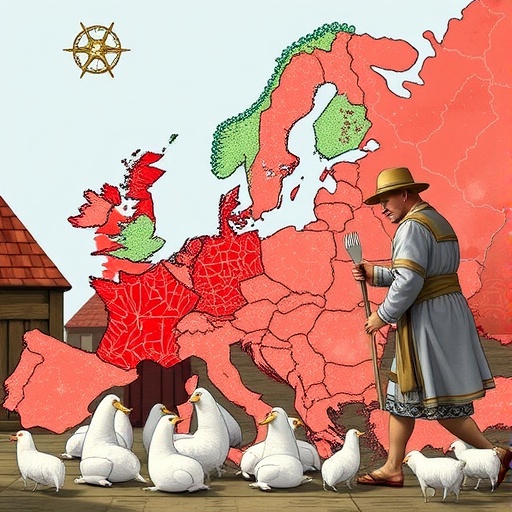
Access to nutritious food has long been recognized as a cornerstone of human development and survival, yet this essential resource has historically been unequally distributed across societies. Recent groundbreaking research has delved into the dietary patterns of pre-industrial European populations, uncovering enduring disparities in access to meat and other protein sources that span an astonishing 10,000 years. The implications of these findings extend far beyond simple nutritional history, touching upon deep-seated social structures, gender roles, and cultural norms that have shaped human civilization over millennia.
Central to this research is the use of isotopic analysis—a sophisticated technique that measures the ratios of stable carbon and nitrogen isotopes preserved in human bone collagen. Nitrogen isotope values serve as robust proxies for the amount of animal protein, primarily meat, consumed by individuals, while carbon isotope ratios provide insights into the types of plants included in diets, distinguishing those utilizing the C4 photosynthetic pathway such as millet, a crop historically associated with lower socioeconomic status, as well as marine food sources whose social standing fluctuated depending on context. Thus, isotopic data reveals not just what people ate, but also nuances of social stratification encoded in their dietary choices.
Interpreting isotopic results across diverse archaeological sites, however, is not without challenges. Environmental variables like climate variation and agricultural practices, including the application of manure fertilizers, can alter baseline isotopic signatures, complicating cross-site comparisons. To circumvent this inherent complexity, researchers Rozenn Colleter, Michael P. Richards, and their collaborators introduced the concept of the interdecile ratio. This innovative metric assesses inequality within isotopic data by comparing values at the extremes—the top 10% and bottom 10%—thus providing a quantitative measure of dietary disparity that transcends local environmental influences.
Using isotopic measurements from the bones of over 12,000 adult individuals unearthed at 673 European archaeological sites, this comprehensive study spans the entirety of the Holocene epoch, encompassing the transition from hunter-gatherer societies to agricultural civilizations and subsequently complex socio-political structures. The analysis revealed a persistent and remarkable male bias in the highest consumption tiers of meat and certain plant foods, suggesting that regardless of the societal phase, men consistently enjoyed privileged access to more protein-rich diets in comparison to women.
Intriguingly, while Neolithic agricultural societies exhibited relatively more egalitarian dietary patterns compared to later eras, significant gender differences in access to animal protein already existed even during these early periods. This challenges romanticized views of prehistoric egalitarianism and highlights how dietary inequality is a deeply rooted aspect of human culture. The data suggest that access to meat was not merely a function of availability but heavily influenced by prevailing gender norms and social hierarchy.
The persistence of nutritional disparity, especially in relation to protein consumption, can potentially be explained through a confluence of cultural, religious, and social factors. Food taboos relating to gender roles may have played a considerable part, with certain protein-rich foods being reserved for males or elite groups. Additionally, cosmological beliefs and mythologies might have reinforced gendered dietary rules, while widespread misperceptions about women’s physiological needs for protein may have justified inequitable food distribution.
It is equally plausible that the differential allocation of food reflected broader social norms that prioritized men’s nutritional requirements as a symbol of status and power. These patterns likely perpetuated systemic inequalities by linking diet directly to social rank and reinforcing hierarchies through everyday practices like meals and feasts. Beyond mere sustenance, eating habits became a ritualized performance of identity and dominance.
These findings open new avenues for understanding the evolution of social inequality through the lens of bioarchaeology and emphasize the power of interdisciplinary research combining chemical analyses, archaeology, and social anthropology. The ability to reconstruct detailed dietary profiles at an unprecedented scale enables scholars to trace the longue durée of gendered resource control and how it intersected with cultural transitions.
Moreover, the research challenges simplistic narratives about nutritional change and social progress by revealing the endurance of exclusionary practices. Even as societies evolved technologically and politically, the unequal distribution of one of the most fundamental resources—animal protein—remained a constant undercurrent shaping lived experiences.
This study also underscores the importance of moving beyond absolute raw data values by employing statistical tools like the interdecile ratio that capture inequality within populations instead of focusing solely on average consumption. Such methodologies hold promise for unlocking hidden dimensions of past human behavior and for application in analyses of contemporary dietary inequities.
Ultimately, the persistent male bias in access to animal protein observed in archaeological contexts resonates with ongoing global concerns about food justice and gendered disparities in nutrition today. Although separated by millennia, the roots of unequal food access documented by Colleter and colleagues reverberate within modern social structures, offering a sobering reflection on how much work remains to ensure equitable nutrition worldwide.
As the field advances, integrating isotopic evidence with broader archaeological, ethnographic, and historical datasets will be essential to fully unraveling the complex social fabrics that regulated food consumption. Such integrative frameworks promise richer insights into how human societies have navigated issues of scarcity, status, and identity through the fundamental act of eating.
In conclusion, the work by Colleter, Richards, and their team constitutes a major contribution to our understanding of historical dietary inequalities. By revealing the deep-time dimensions of gendered dietary disparity, they provoke a critical reconsideration of how food access has been structured socially and culturally across ten millennia of European history. These insights not only enrich archaeological knowledge but also bring a poignant perspective to contemporary debates around food equity and gender.
Subject of Research: Dietary inequality and gender disparity in protein consumption across 10,000 years in Europe
Article Title: Dietary inequality marker reveals 10,000 years of gender and cultural disparity in Europe
News Publication Date: 7-Apr-2026
Image Credits: Oscar Maso y Guëll Rivet
Keywords: Archaeology, Dietary Inequality, Isotopic Analysis, Gender Disparity, Protein Consumption, Pre-industrial Europe, Social Hierarchy


