


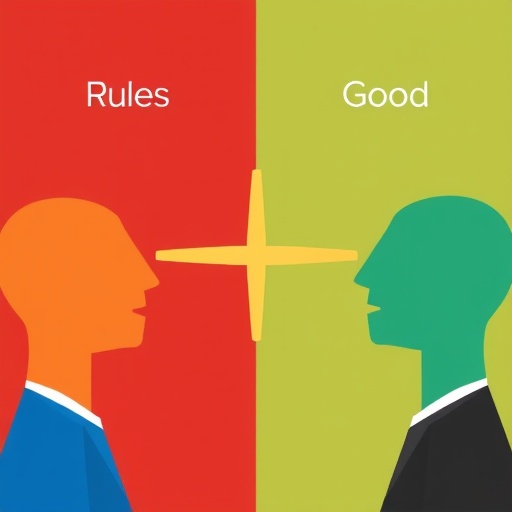
In a groundbreaking study exploring the neural and ethical underpinnings of moral decision-making, researchers have unveiled how university students prioritize fairness and the welfare of the most disadvantaged individual over utilitarian calculations or rigid moral rules. The experiment, conducted by Woo-Young Ahn and colleagues, introduces a meticulously designed ethical dilemma that pits the principles of utilitarianism—aimed at minimizing overall harm—against the Rawlsian concept emphasizing the improvement of conditions for the worst-off individual.
The dilemma at the heart of the study involved participants enduring a physical discomfort: submerging their hand in icy water. This sensory aversive stimulus was allocated in scenarios where participants had to choose between causing prolonged discomfort to one person or distributing shorter but cumulatively greater discomfort among a group of three or four people. The innovative aspect of the experiment is the intentional imbalance created—while the single individual would endure fewer seconds of discomfort than the aggregated time suffered by the group, the latter’s total harm was greater, challenging participants’ ethical intuitions.
Participants were placed inside functional magnetic resonance imaging (fMRI) scanners to capture neural activity during the moral decision-making process. This enabled the researchers to simultaneously study behavioral choices and their neural correlates, shedding light on the cognitive and emotional mechanisms underpinning ethical preferences. The inclusion of a default option in some trials—pre-selected by the system and preventing active button pressing—was designed to test whether people prefer avoiding direct causation of harm, a concept often labeled as a “do-no-harm” bias.
Contrary to expectations, the data revealed negligible bias toward default options, suggesting that individuals did not shy away from making morally consequential decisions merely to avoid personal responsibility. Instead, a clear preference emerged for allocating harm to the group rather than a single individual, reflecting a strong emphasis on fairness and the mitigation of disproportionate suffering for the worst-off party. On average, participants were willing to impose an additional 68 seconds of icy discomfort distributed across multiple persons to spare one individual from enduring a longer duration, indicating a sophisticated balancing of collective versus individual harm.
The neuroimaging data offered profound insights into the cognitive frameworks engaged during these moral evaluations. Brain regions associated with mentalizing—the ability to model and infer others’ mental states—such as the temporoparietal junction and medial prefrontal cortex, were actively recruited in these dilemmas. Additionally, valuation networks, including the ventromedial prefrontal cortex, played a critical role in integrating these social assessments with the subjective evaluation of harm, highlighting the interplay between empathy, fairness considerations, and cost-benefit analysis in ethical judgments.
The research challenges the traditional dichotomy between deontological and utilitarian ethics by illustrating that human moral cognition may operate through a more nuanced neurocomputational integration. Rather than strictly adhering to abstract moral rules or raw utilitarian calculus, individuals appear to prioritize fairness metrics that preserve the wellbeing of the disadvantaged, reflecting a cognitive architecture sensitive to social equity and comparative harm.
Remarkably, the study’s findings have implications beyond academic ethics, touching on real-world applications such as legal judgments, resource allocation, and policy-making. Understanding that humans intrinsically weigh the plight of the worst-off could inform the design of interventions, frameworks, and systems that resonate with innate moral proclivities, potentially improving compliance and social cohesion.
The use of direct sensory discomfort as a measurable, controllable form of harm distinguishes this study methodologically from previous work relying mainly on hypothetical or abstract dilemmas. This tangible and immediate experience anchors moral choices in real pain and suffering, allowing for more ecologically valid conclusions about how people weigh competing ethical considerations.
Furthermore, the absence of a default choice bias underscores that the reluctance to cause harm is not necessarily avoidance of responsibility but a calculated ethical stance—one that values fairness and equitable distribution of suffering, even if it means endorsing greater total harm. This nuanced finding calls for deeper investigation into how notions of personal responsibility and agency influence moral decision-making.
The study also advances the field of moral neuroscience by applying computational models to dissect the dynamics between competing ethical priorities, offering a framework to quantify preferences previously considered subjective or incommensurable. This opens avenues to explore individual differences, cultural variations, and developmental trajectories in moral cognition with precision and rigor.
In sum, this pioneering research illuminates the complex neurocomputational mechanisms through which humans navigate ethical dilemmas, revealing an intrinsic preference for protecting the worst-off even at the expense of greater aggregate harm. By combining real sensory harm, neural imaging, and computational modeling, the study provides a multifaceted portrait of moral decision-making that bridges philosophical theory and empirical science.
The ethical dilemma crafted for this investigation echoes foundational ideas from philosopher John Rawls, who argued for justice as fairness and the primacy of improving the position of the least advantaged in society. The findings translate these philosophical principles into concrete neural and behavioral data, offering empirical affirmation of Rawlsian ethics within the human brain.
Importantly, this research underscores the value of interdisciplinary approaches that merge psychology, neuroscience, philosophy, and economics to unravel the intricacies of human morality. It propels forward a scientific understanding that respects the deep social and emotional complexities shaping how we make ethical choices in everyday life.
Looking ahead, the research team anticipates expanding studies to diverse populations and exploring how these neurocomputational processes might vary with age, culture, or social context. Such knowledge could eventually inform educational programs, conflict resolution strategies, and technologies designed to foster moral reasoning and ethical sensitivity.
This seminal study represents a critical step towards decoding the mysterious computations at play when humans wrestle with ethical predicaments, blending cutting-edge neuroscience with age-old philosophical inquiry to better comprehend what it means to choose justly and fairly.
News Publication Date: 7-Apr-2026
Cite Scienmag News
Cassandra Pierce. (April 7, 2026). What Shapes Moral Choices: Rules, Greater Good, or Fairness? Scienmag. https://scienmag.com/what-shapes-moral-choices-rules-greater-good-or-fairness/
Cassandra Pierce. "What Shapes Moral Choices: Rules, Greater Good, or Fairness?" Scienmag, 7 April 2026, https://scienmag.com/what-shapes-moral-choices-rules-greater-good-or-fairness/. Accessed 4 September 2026.
Cassandra Pierce. "What Shapes Moral Choices: Rules, Greater Good, or Fairness?" Scienmag. April 7, 2026. https://scienmag.com/what-shapes-moral-choices-rules-greater-good-or-fairness/


