


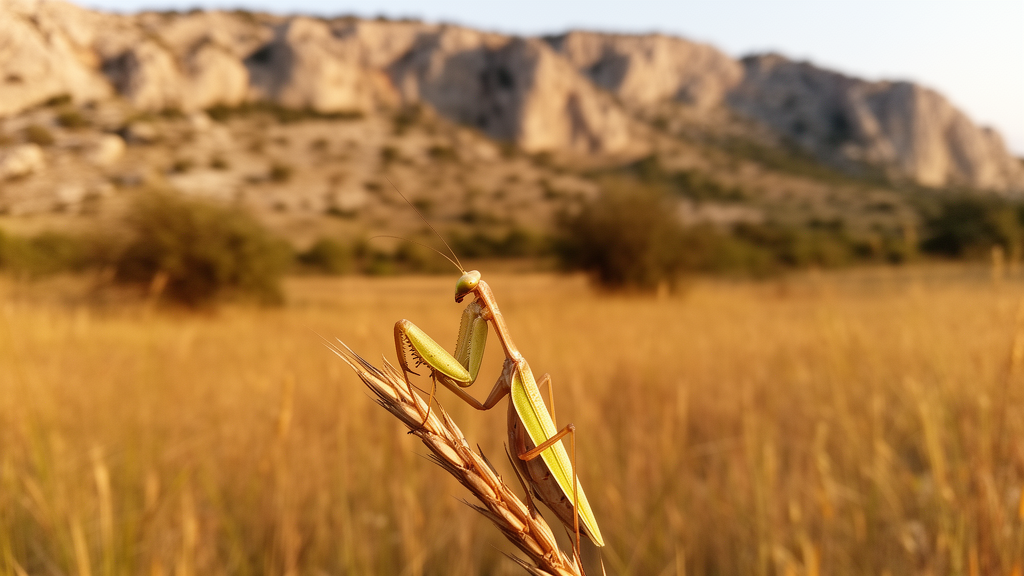
A small predatory insect with a big appetite has quietly established itself on the shores of the Black Sea. Researchers report the first records of the European dwarf mantis, Ameles spallanzania, in the Crimean Peninsula, a discovery that dramatically extends the known range of this Mediterranean species and raises fresh concerns about the vulnerability of native ecosystems to hitchhiking invaders. The findings, published in the Journal of Orthoptera Research, combine classic morphology with DNA barcoding to trace both the identity and the likely origin of the newcomers.
The story began in October 2021, when dozens of adult dwarf mantises were spotted in Dinopark, a recently landscaped city park in Sevastopol. Specimens of both sexes were collected, and by the following month the distinctive egg cases, called oothecae, had appeared on the vegetation. By the summer of 2022, the population had spread across a larger area of the park, and its presence was last confirmed there in December 2023, suggesting the mantises had survived for at least one full generation and may well be thriving. A second cluster of three individuals was photographed in September 2021 on a private property roughly 11.5 kilometers northeast of the park, hinting that additional undiscovered populations could exist in and around the city.
What makes the Crimean record so striking is that these mantises almost certainly could not have arrived on their own. Ameles spallanzania is widespread across the Mediterranean, from the Iberian Peninsula to Greece and North Africa, but the Crimean observations are the easternmost ever made. The nearest native populations sit on smaller Greek islands, and the flightless, short-winged females of this species are physically incapable of crossing hundreds of kilometers of sea and land. The researchers conclude that human assistance, whether accidental or otherwise, must have been involved.
The most probable smuggling route points to ornamental horticulture. The Dinopark population was found on Savin juniper, Juniperus sabina, a decorative shrub whose natural range overlaps almost exactly with the mantis’s south European distribution. Dozens of adult mantises and their egg cases turned up on these plants shortly after the park was landscaped, a pattern consistent with oothecae or nymphs arriving hidden among the nursery stock. Supporting this transport hypothesis, recent discoveries of the same species near large transportation hubs in Bulgaria reinforce the idea that vehicles and traded plants are the main highways for mantis invasions.
To pin down where the Crimean colonizers came from, the team turned to the COI barcode region of mitochondrial DNA. They generated new sequences from specimens collected in Crimea, Italy, Spain, and Portugal, and combined them with all publicly available barcodes of Ameles spallanzania and its close relative Ameles heldreichi, building a maximum likelihood phylogenetic tree rooted with the North American genus Litaneutria. The result was remarkably clear: the Crimean sequence clustered tightly with a sample from East Mani in Greece, with a pairwise genetic distance of just 0.45 percent, making the Mani Peninsula the most likely source of the introduction.
Distinguishing the invader from its native lookalike is no trivial matter, and the study provides the first detailed comparison of the two species in Crimea. Both are small mantises, around 22 to 32 millimeters long, with conical eyes, slightly enlarged hind femora, and females whose wings are so reduced they cannot fly. Males of A. spallanzania, however, have a shorter, stockier pronotum and a head capsule extended sideways, with eyes barely reaching over the vertex, whereas males of the native A. heldreichi show a more slender pronotum and eyes that extend well over it. The shape of the distal process of the ventral phallomere in the male genitalia offers a definitive diagnostic character, and females differ even more visibly: those of the invader are broad-bodied, with abdomens noticeably thicker than other body parts and curved toward the thorax, while native females remain slender and male-like apart from their short wings.
The molecular work also settled a long-standing taxonomic debate about the native species. The Crimean population of A. heldreichi was once treated as a separate species and later downgraded to the subspecies A. h. taurica, chiefly because Crimean individuals are somewhat smaller. The new analysis found that Crimean, Bulgarian, and Greek samples differ by no more than 1.71 percent in their barcodes and form a clade with very short internal branches, providing no molecular support for a distinct Crimean subspecies. Interestingly, specimens from Israel, Lebanon, and Turkey show considerably more genetic divergence, up to 3.97 percent, and could hint at a genuinely separate subspecies in the eastern Mediterranean. A juvenile female from Morocco examined during the study proved genetically so distinct, with pairwise distances of 25 to 33 percent, that it was left as Ameles sp., a useful reference point for future work on North African mantises.
Why should anyone worry about a mantis the size of a thumb? Because praying mantises are ambush predators sitting near the top of the arthropod food web, and introduced mantises have already demonstrated their capacity for ecological damage. In North America, large invasive mantises are responsible for most recorded predation events on hummingbirds. In New Zealand, the invasive South African mantis Miomantis caffra uses pheromones that inadvertently lure males of the country’s only native mantis to their deaths, driving the displacement of the endemic species. The parallels with domestic cats, linked to at least 63 global extinctions of birds, mammals, and reptiles, illustrate how efficient predators can reshape ecosystems they were never part of.
The specific danger in Crimea lies in timing. The park where the invaders established is also home to native mantises, including Mantis religiosa, Iris polystictica, and Empusa fasciata. The native species overwinter as eggs inside oothecae, with nymphs hatching in spring. Females of A. spallanzania, by contrast, show a far more flexible phenology and can sometimes diapause through winter as adults in their native range. That means hungry adult dwarf mantises may be active precisely when the vulnerable, freshly hatched nymphs of the native species emerge, creating a window for devastating predation. Crimea’s fauna also includes a high proportion of endemic species whose susceptibility to this new predator remains entirely unknown.
The broader context is sobering. The Crimean Peninsula has been absorbing invasive insects at an alarming rate of up to several new alien species per year, most of them agricultural pests arriving without their natural enemies and therefore facing almost unlimited potential for spread. Europe’s mantis fauna, decimated by the last glacial period, appears to leave ecological space that alien species can readily fill, and while modeling suggests native and alien mantises may not overlap strongly in their niches, the authors stress that broader ecological and taxonomic analyses are urgently needed. Both the morphological characters and the genetic barcodes published in this study now give researchers and citizen scientists the tools to rapidly identify Ameles species in the field and in the lab, a critical first step toward monitoring whether this Greek stowaway remains a curiosity in a city park or becomes the next quiet disruptor of Crimea’s native ecosystems.
Subject of Research: First record and likely Greek origin of the introduced praying mantis Ameles spallanzania in Crimea
Article Title: Ameles spallanzania ( Insecta , Dictyoptera ): A newly introduced species of Mantodea in Crimean fauna
Article References: Govorov, V. (2026). Ameles spallanzania (Insecta, Dictyoptera): A newly introduced species of Mantodea in Crimean fauna. Journal of Orthoptera Research, 35(1), 1-8. https://doi.org/10.3897/jor.35.150919
Image Credits: AI Generated
Keywords: Ameles spallanzania, praying mantis, Crimea, invasive species, DNA barcoding, COI, Sevastopol, Juniperus sabina, Mantodea, Ameles heldreichi, Greece, biological invasion
Cite Scienmag News
Patricia Pace. (October 17, 2026). European Dwarf Mantis Sneaks Into Crimea, DNA Points to Greece. Scienmag. https://scienmag.com/european-dwarf-mantis-sneaks-into-crimea-dna-points-to-greece/
Patricia Pace. "European Dwarf Mantis Sneaks Into Crimea, DNA Points to Greece." Scienmag, 17 October 2026, https://scienmag.com/european-dwarf-mantis-sneaks-into-crimea-dna-points-to-greece/. Accessed 17 October 2026.
Patricia Pace. "European Dwarf Mantis Sneaks Into Crimea, DNA Points to Greece." Scienmag. October 17, 2026. https://scienmag.com/european-dwarf-mantis-sneaks-into-crimea-dna-points-to-greece/


