


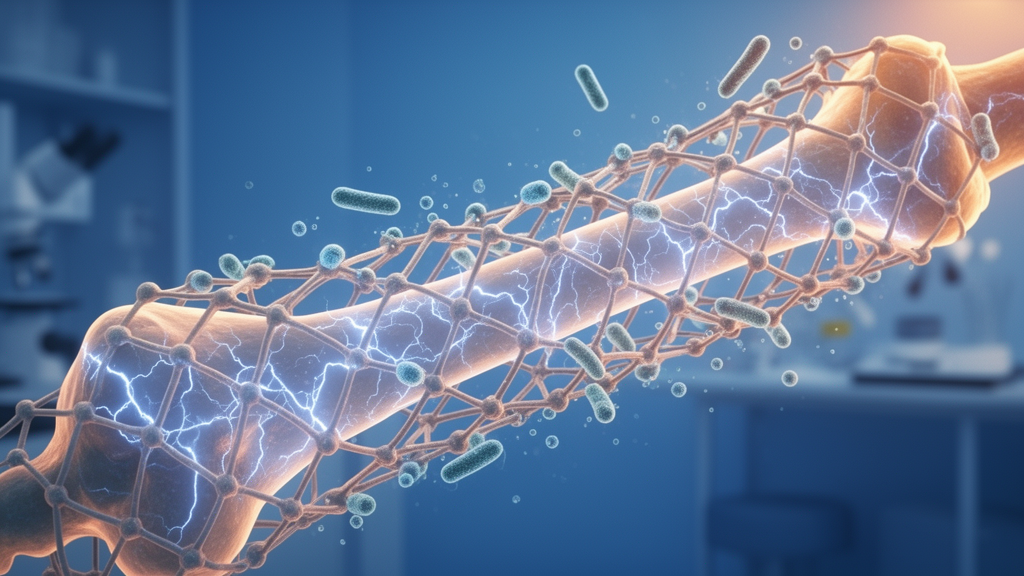
Bone infection has long been one of orthopedics’ most stubborn adversaries, and a new wave of research suggests that materials capable of generating electricity from mechanical force could finally tip the balance in clinicians’ favor. A comprehensive review published in Frontiers in Cell and Developmental Biology systematically examines how piezoelectric biomaterials—substances that produce localized electrical signals when subjected to mechanical stress—could transform the treatment of infected bone. The work, led by researchers from Sichuan University and collaborating institutions, synthesizes evidence across material science, microbiology, immunology, and regenerative medicine to argue that these materials could coordinate the entire therapeutic sequence that infected bone demands, from bacterial eradication through immune recalibration to new bone formation.
The clinical burden underlying this research direction is substantial. Osteomyelitis, the infection of bone marrow and surrounding bone tissue addressed in the review, is driven most often by Gram-positive staphylococci, with Staphylococcus aureus alone implicated in roughly 44% to 75% of cases and particularly dominant in chronic presentations. Once established, these infections resist conventional treatment not simply because the bacteria themselves are hardy, but because they organize into biofilms—structured communities that adhere to implant surfaces, necrotic bone fragments, and other hospitable niches. Within these communities, bacteria are shielded from both innate and adaptive immune responses and display markedly reduced susceptibility to antimicrobial drugs. The result is a vicious cycle in which surgical debridement and prolonged antibiotic courses frequently fail to eradicate the infection, leaving many patients to progress to chronic disease marked by inflammation-driven bone destruction, heightened osteoclast activity, and secondary osteonecrosis.
The piezoelectric principle at the heart of the proposed strategy rests on a deceptively simple physical property. Materials with non-centrosymmetric crystal lattices—meaning their internal structure lacks a center of symmetry—develop separated positive and negative charge centers when mechanically deformed. This deformation generates electric dipoles and, on the material surface, localized bound charges. The phenomenon runs in both directions: the direct piezoelectric effect converts applied mechanical force into electrical charge, while the inverse effect converts an applied electric field into mechanical deformation. For biomedical purposes, the direct effect is the more relevant one, since it allows the body’s own mechanical environment—walking, loading, ultrasound applied from outside, even subtle internal tissue movements—to be harvested as a source of localized electrical stimulation without any external power supply implanted at the site.
What makes this particularly attractive for infected bone is the multiplicity of antibacterial mechanisms that can flow from that single physical event. When a piezoelectric surface is mechanically stimulated, the resulting charge separation can, in catalytically active systems, drive redox reactions that generate reactive oxygen species. These highly reactive molecules damage bacterial membranes, interfere with intracellular redox balance and respiratory processes, and attack the extracellular polymeric matrix that gives biofilms their structural integrity. Importantly, the review emphasizes that reactive oxygen species are not the whole story. Electrical perturbation at the material surface, direct mechanical disruption of biofilm architecture, interfacial electron transfer, and the release of metal ions can each contribute to bacterial killing and biofilm dismantling. This mechanistic plurality matters clinically, because a therapy that attacks bacteria through several parallel pathways is inherently less vulnerable to the resistance mechanisms that defeat single-target antibiotics.
The review’s authors argue that the field has tended to organize itself around material classifications, antibacterial mechanisms, or application categories, and that this taxonomy has obscured something clinically essential: bone infection is not a static problem but a dynamic pathological sequence. Persistent biofilms, dysregulated antimicrobial immunity, excessive or unresolved inflammation, and impaired angiogenesis and osteogenesis are not independent events. They are interconnected processes that unfold in a characteristic order as infection is controlled and repair proceeds. A material that aggressively generates reactive oxygen species may be ideal in the first days after debridement, when bacterial load and biofilm burden are highest, yet counterproductive weeks later, when the priority shifts to protecting nascent blood vessels and differentiating osteoblasts from oxidative damage.
To resolve this tension, the authors propose a stage-adaptive therapeutic framework. In the early infection-control phase, the priorities are biofilm disruption, bacterial eradication, and activation of antimicrobial immune functions. Piezoelectrically generated electrical signals and reactive oxygen species serve these goals directly, while the same stimuli can polarize immune cells toward a microbicidal phenotype that complements the materials’ direct antibacterial action. Once the infectious burden has been sufficiently reduced, the therapeutic emphasis must pivot: oxidative stress must now be contained, persistent inflammation resolved, and the immune microenvironment remodeled toward a pro-reparative state that supports angiogenesis—the sprouting of new blood vessels that supply regenerating tissue—followed by osteogenesis, the deposition of new bone matrix.
This reframing has practical consequences for material design. Rather than seeking a single material that maximizes every desirable property simultaneously, the framework suggests that next-generation implants might be engineered to modulate their own behavior over time, for example by tuning piezoelectric output, incorporating catalytic components whose activity is triggered by the local microenvironment, or layering coatings that release pro-regenerative signals only after the acute phase has passed. The review also situates piezoelectric materials within a broader lineage of biomedical applications; these substances already serve as nanogenerators in soft tissue repair and underpin technologies from medical ultrasound transducers to aerospace actuators and radio-frequency filters in consumer electronics, reflecting decades of industrial maturation that could accelerate clinical translation.
The immune dimension of the framework deserves particular attention, because it connects the antibacterial and regenerative phases into a coherent narrative. The review synthesizes evidence that piezoelectric stimulation can modulate the infection-associated immune microenvironment, steering the inflammatory response in ways that support both bacterial clearance and subsequent repair. This is a subtle balancing act. The same inflammatory programs that mobilize bactericidal activity early in infection can, if left unresolved, drive the bone destruction and fibrosis that characterize chronic osteomyelitis. A material platform that first amplifies antimicrobial immunity and then facilitates its resolution—without requiring drug interventions at each transition—would address one of the most persistent failures of current therapy, in which dysregulated host responses perpetuate disease even after bacteria have been substantially cleared.
The authors are candid about the obstacles that remain between this framework and routine clinical use. Material design optimization is an ongoing challenge: piezoelectric coefficients, biocompatibility, degradation behavior, and mechanical properties must be balanced within a single implantable system, and the optimal parameters likely differ between the infection-control and repair phases. Mechanistic understanding also remains incomplete. While the individual pathways—piezocatalytic reactive oxygen generation, electrical stimulation of cells, immune modulation—have each been demonstrated, their relative contributions in vivo, their interactions with one another, and their dependence on the local mechanical loading environment are not yet fully mapped. Clinical translation faces the additional hurdle that most supporting evidence comes from in vitro and preclinical models, which rarely reproduce the complexity of human osteomyelitis with its mixed bacterial populations, devitalized bone, and compromised vascularity.
Nevertheless, the conceptual contribution of the review lies in its insistence that therapeutic functions be evaluated against the pathophysiological timeline of the disease rather than in isolation. By integrating antibacterial action, immunomodulation, and regeneration into a single stage-adaptive sequence, it offers researchers a design logic: identify which phase of the disease a given material property serves, and engineer materials whose properties evolve in step with the patient’s needs. If that logic can be validated experimentally and carried through to clinical devices, piezoelectric biomaterials could shift the treatment of infected bone from a reactive cycle of debridement and antibiotics toward an active, self-regulating partnership between implant and host tissue—one in which the mechanical energy of everyday movement becomes a therapeutic resource deployed precisely when and where the healing process requires it.
Subject of Research: Piezoelectric biomaterials for treating bone infection through bacterial eradication, immune modulation, and bone regeneration
Article Title: Immunomodulation and biofilm disruption of piezoelectric materials in bone infection
Article References: Wang, Z., Zheng, K., Tang, Y., Zhang, Z., Zhong, Z., Wang, D., Chen, Z., Wang, Y., Chen, Z., Feng, P., Huang, W., Liu, M., Hao, Y., Yu, F., Wang, G., Yi, M., & Deng, X. (2026). Immunomodulation and biofilm disruption of piezoelectric materials in bone infection. Frontiers in Cell and Developmental Biology, 14, Article 1976300. https://doi.org/10.3389/fcell.2026.1976300
Image Credits: AI Generated
DOI: 10.3389/fcell.2026.1976300
Keywords: piezoelectric materials, bone infection, biofilm, osteomyelitis, reactive oxygen species, immunomodulation, bone regeneration, antibacterial biomaterials, disruption, piezoelectric, materials, bone
Cite Scienmag News
Kristina Jarvis. (October 17, 2026). Piezoelectric Materials Could Rewrite the Rules of Bone Infection Treatment. Scienmag. https://scienmag.com/piezoelectric-materials-could-rewrite-the-rules-of-bone-infection-treatment/
Kristina Jarvis. "Piezoelectric Materials Could Rewrite the Rules of Bone Infection Treatment." Scienmag, 17 October 2026, https://scienmag.com/piezoelectric-materials-could-rewrite-the-rules-of-bone-infection-treatment/. Accessed 17 October 2026.
Kristina Jarvis. "Piezoelectric Materials Could Rewrite the Rules of Bone Infection Treatment." Scienmag. October 17, 2026. https://scienmag.com/piezoelectric-materials-could-rewrite-the-rules-of-bone-infection-treatment/


