


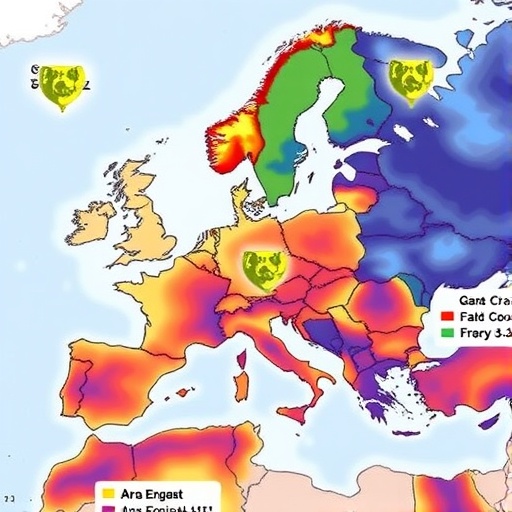
In an era where climate change headlines have become alarmingly common, a groundbreaking new study has brought into sharper focus the nuanced and region-specific alterations in precipitation patterns across Europe and the Mediterranean. With global warming accelerating at an unprecedented pace, understanding these distinct regimes of rainfall and drought holds critical importance for policymakers, scientists, and citizens alike. The research illuminates how shifting atmospheric dynamics and oceanic influences are carving out divergent precipitation futures across this volatile and climatically diverse region, offering both warning and guidance for adaptive strategies in the face of escalating climate threats.
At the core of this new analysis is a sophisticated synthesis of climate models and historical data, which allows researchers to dissect precipitation trends not as a monolithic phenomenon but as a collection of distinct and regionally varying regimes. By deploying high-resolution climate projections that factor in multiple greenhouse gas scenarios, the study reveals that while some areas might experience heightened rainfall intensities, others face escalating drought risks. This spatial heterogeneity is driven by complex interactions among atmospheric circulation patterns, sea surface temperatures in adjacent bodies such as the Mediterranean Sea, and land surface processes.
In Northern Europe, the study highlights an anticipated increase in winter precipitation. This warming-induced shift is attributed to a more vigorous North Atlantic storm track, which injects moisture-laden air masses into the continent. These changes are expected to intensify flood risks during the boreal winter months, challenging existing water management infrastructure and necessitating urgent upgrades. However, winter precipitation increases could be coupled with drier summer conditions, underscoring the intricate seasonal rhythms that policymakers must navigate.
Conversely, Southern Europe and the Mediterranean basin are projected to endure a starkly different fate. Rising temperatures and persistent high-pressure systems are expected to suppress rainfall during critical summer months, intensifying drought conditions and exacerbating water scarcity. This aridification trend is poised to impact agriculture, ecosystems, and human health, amplifying the vulnerability of already water-stressed areas. The research underscores the urgency in developing resilient agricultural practices and enhancing water conservation measures to mitigate the socioeconomic fallout of prolonged dry spells.
Beyond simple amounts of precipitation, the new findings also bring attention to the shifting nature of rainfall events themselves. The research documents an increase in the intensity and frequency of extreme precipitation events—short-lived but highly concentrated downpours—that elevate risks for flash floods and landslides, especially in urbanized and mountainous areas. Such events, coupled with longer dry spells, can disrupt natural hydrological cycles, influencing groundwater recharge rates and river flows in unpredictable ways. This duality of extremes poses complex challenges for environmental management and disaster preparedness.
An important facet of the study lies in its exploration of teleconnections—the remote climate influences that propagate precipitation anomalies across Europe and the Mediterranean. The research identifies alterations in the North Atlantic Oscillation and Mediterranean Oscillation patterns as key drivers reshaping regional precipitation regimes. Understanding these large-scale atmospheric drivers lends insight into seasonal predictability and reinforces the need for integrating climate variability knowledge into regional planning and forecasting systems.
The implications for ecosystems are profound. The variability and extremes in precipitation patterns threaten biodiversity hotspots by altering soil moisture availability, shifting vegetation zones, and disrupting phenological cycles. Species with narrow climatic tolerances may face shrinking habitable ranges, prompting concerns over local extinctions and reduced ecosystem services. Conversely, some resilient species might adapt or migrate, but the pace and scale of change raise questions about long-term ecological balance and conservation priorities.
Urban regions across Europe and the Mediterranean also emerge as critical hotspots in this narrative. Increases in intense precipitation events compound the challenges of stormwater management in cities prone to flooding, while heightened summer droughts stress urban water supplies and green spaces. The interplay of these climatic stressors demands integrated urban planning that encompasses green infrastructure, resilient water systems, and community engagement to build climate-adaptive cities capable of weathering the newfound extremes.
Crucially, the analysis does not merely present uncertainties but provides actionable intelligence. By identifying specific sub-regions—ranging from the temperate zones of Central Europe to the Mediterranean’s semi-arid areas—where precipitation regimes are expected to diverge, the study equips governments and stakeholders with the spatial specificity necessary for targeted adaptation measures. Water resource allocation, agriculture policy, infrastructure design, and disaster risk reduction can all benefit from this granular knowledge, improving resilience and sustainability.
This nuanced understanding of precipitation regime shifts signals a call to reframe climate adaptation in Europe and the Mediterranean. Rather than one-size-fits-all solutions, the study advocates for bespoke strategies cognizant of local climates, socio-economic contexts, and ecological sensitivities. Cross-border coordination becomes essential as climatic impacts transcend political boundaries, demanding cooperative frameworks and integrated management approaches that marry scientific insight with community-driven action.
Moreover, the research highlights the indispensability of sustained climate monitoring and model refinement. The evolving nature of precipitation regimes mandates that climate services continue to improve resolution and accuracy, incorporating new observational data and advancing physical process representations. Robust monitoring networks will ensure that emerging trends are detected early, allowing flexible and timely responses to the dynamic climate reality.
In summation, this pivotal study serves as a clarion call emphasizing the complexity and regional diversity inherent in climate change’s influence on precipitation across Europe and the Mediterranean. Its revelations compel a reorientation of both scientific inquiry and practical adaptations, moving toward a future where resilience to water-related risks is built upon a deep appreciation of the distinct, regime-specific changes unfurling under a warming planet. As climate shifts continue to accelerate, this research offers a vital compass to navigate the uncertain hydrological future bearing down on a region at the crossroads of environmental, economic, and social transformation.
Cite Scienmag News
Sloane Callahan. (April 29, 2026). Europe-Mediterranean Precipitation Shifts Amid Global Warming. Scienmag. https://scienmag.com/europe-mediterranean-precipitation-shifts-amid-global-warming/
Sloane Callahan. "Europe-Mediterranean Precipitation Shifts Amid Global Warming." Scienmag, 29 April 2026, https://scienmag.com/europe-mediterranean-precipitation-shifts-amid-global-warming/. Accessed 3 September 2026.
Sloane Callahan. "Europe-Mediterranean Precipitation Shifts Amid Global Warming." Scienmag. April 29, 2026. https://scienmag.com/europe-mediterranean-precipitation-shifts-amid-global-warming/


