


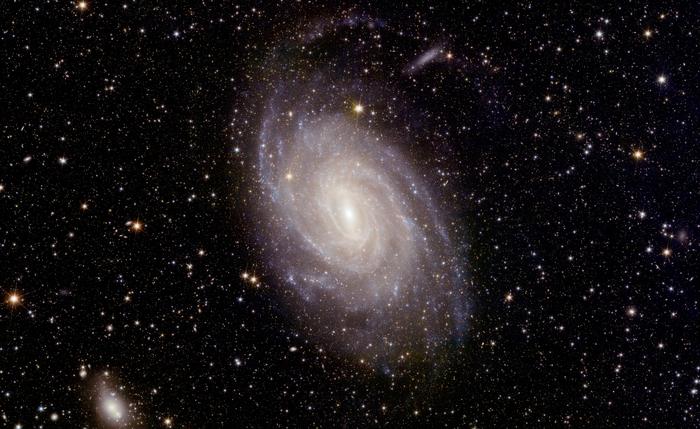
European space mission Euclid has released early scientific papers based on observations made by the space telescope, along with five new astronomical images of the Universe, as the project sets about unravelling the secrets of the cosmos.

Credit: ESA/Euclid/Euclid Consortium/NASA
European space mission Euclid has released early scientific papers based on observations made by the space telescope, along with five new astronomical images of the Universe, as the project sets about unravelling the secrets of the cosmos.
The new images are part of Euclid’s Early Release Observations (EROs) and accompany the mission’s first scientific data and 10 forthcoming science papers. Their publication comes less than a year after the space telescope’s launch and some six months after it returned its first full-colour images of the cosmos.
The scientific papers are based on observations and analysis of 17 targets and contain exciting scientific results including:
- the discovery of free-floating new-born planets
- newly identified extragalactic star clusters
- new low-mass dwarf galaxies in a nearby cluster of galaxies
- the discovery of very distant bright galaxies
The five new ERO images follow the release of an initial five images last November. The images obtained by Euclid are at least four times sharper than those that can be taken from ground-based telescopes. They cover large patches of sky at unrivalled depth, looking far into the distant Universe using both visible and infrared light.
The latest Euclid images include observations of:
- Messier 78, a reflection nebula
- Abell 2390 and Abell 2764, two giant clusters of galaxies
- NGC 6744, a spiral galaxy very similar to the Milky Way
- the Dorado Group, a loose agglomeration of galaxies
Speaking about the data release, Prof Peter Coles of Maynooth University’s Department of Theoretical Physics, the only Irish-based academic involved in the Euclid consortium, said: “Today’s release of new data and technical papers from Euclid is exciting in itself but also marks the start, after months of painstaking calibration and testing of the instruments, of Euclid’s main cosmological survey. We are on the threshold of a new era in cosmology.”
“Maynooth is the only University in Ireland to be involved in this mission and it is very exciting to be at the forefront of such an important scientific development.”
Launched from Cape Canaveral on July 1, 2023, Euclid’s mission is to map the distribution of distant galaxies across more than one-third of the sky to extract information about the constituents of the universe, and test whether current ideas about cosmic evolution are correct.
“Euclid is a unique, ground-breaking mission, and these are the first datasets to be made public – it’s an important milestone,” says Valeria Pettorino, ESA’s Euclid Project Scientist. “The images and associated science findings are impressively diverse in terms of the objects and distances observed. They include a variety of science applications, and yet represent a mere 24 hours of observations. They give just a hint of what Euclid can do. We are looking forward to six more years of data to come!”
The next thing to look forward to from Euclid is a taster for the main Euclid survey around March 2025. The first year of survey data (DR1) will be released in June 2026 while the full survey will be completed in 2031.
Prof Peter Coles is available to discuss Euclid and the recent data release.
Cite Scienmag News
Grant Pearson. (May 24, 2024). Euclid space mission releases first scientific results and new images of the cosmos. Scienmag. https://scienmag.com/euclid-space-mission-releases-first-scientific-results-and-new-images-of-the-cosmos/
Grant Pearson. "Euclid space mission releases first scientific results and new images of the cosmos." Scienmag, 24 May 2024, https://scienmag.com/euclid-space-mission-releases-first-scientific-results-and-new-images-of-the-cosmos/. Accessed 4 September 2026.
Grant Pearson. "Euclid space mission releases first scientific results and new images of the cosmos." Scienmag. May 24, 2024. https://scienmag.com/euclid-space-mission-releases-first-scientific-results-and-new-images-of-the-cosmos/

