


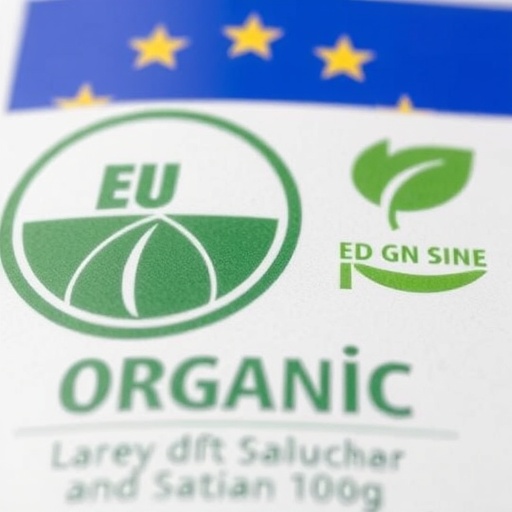
In an era where consumers increasingly prioritize sustainability, the clarity and effectiveness of sustainability labels on food products have become crucial. Despite their intended purpose to guide consumers toward environmentally responsible choices, many sustainability certifications fail to communicate their value clearly. A groundbreaking study conducted by researchers from the University of Bonn, Newcastle University, and Corvinus University of Budapest sheds light on the pivotal role of label design in influencing consumer perceptions and purchasing behavior. Focusing on the European Union’s organic certification logo, famously known as the “Green Leaf,” the research uncovers how subtle yet strategic modifications to the label’s design can drastically enhance its communicative power.
Sustainability labels serve as essential signals, aiming to reassure consumers that products meet rigorous environmental and ethical standards. However, the effectiveness of these marks relies heavily on their recognizability and perceived trustworthiness. The EU’s “Green Leaf” logo, established in 2010 to unify organic labeling across member states, is mandatory on certified organic goods and, in theory, should command high consumer awareness. Yet, recent surveys reveal notable deficits in public recognition and understanding of this symbol. According to a 2024 pan-European survey, only 56% of EU citizens recognize the logo, and less than half associate it correctly with EU organic standards, a finding that underscores the need for enhanced label legibility.
The study’s prime investigation centered on whether minor alterations to this pervasive symbol could amplify its clarity and, in turn, encourage more confident, sustainable consumer choices. Researchers introduced two key modifications: one variant included the word “BIO” or “ECO” embedded within the recognizable green leaf bordered by stars; another variant appended the phrase “EU-certified” alongside the emblem. Utilizing a robust sample size of 9,500 respondents across seven EU countries, participants were exposed to one of the three logos—original, “BIO/ECO” modified, or “BIO/ECO + EU-certified”—and asked to evaluate each on criteria such as clarity, trustworthiness, and utility for informed purchasing decisions.
The outcomes were compelling. Across all nations surveyed, participants consistently rated the modified labels as substantially clearer and more trustworthy than the original. Intriguingly, the additional “EU-certified” text provided no statistically significant boost beyond the clarity improvements afforded by the inclusion of “BIO” or “ECO.” This suggests that consumers primarily require an unmistakable visual cue that directly associates the label with organic production, rather than formal certification statements that may be less impactful or clear.
Delving deeper into the psychological mechanics underpinning these perceptions, the researchers conducted a focused follow-up study with approximately 500 German participants. This inquiry probed the cognitive and affective responses triggered by the different labels, particularly in terms of signal clarity, uncertainty reduction, trust formation, and purchase intentions. The findings revealed a remarkable enhancement of signal clarity with the modified versions, with nearly 90% of respondents correctly identifying the “BIO” or “ECO” augmented logo as a marker of organic certification—an increase of over 20 percentage points compared to recognition rates for the original logo.
The comprehensive analysis also uncovered that improved label clarity yields cascading effects on consumer attitudes, primarily by decreasing uncertainty and elevating trust in the product’s authenticity. Although direct influence on purchase intent was not statistically significant, the study identified a meaningful indirect effect: when consumers perceive a label as clear and trustworthy, they are correspondingly more inclined to choose the certified product. This mediation model emphasizes the critical intermediary role of psychological confidence in driving sustainable consumption behaviors.
From a design and policy standpoint, these results highlight the power of low-effort, high-impact interventions in sustainability communications. By integrating concise, comprehensible terms such as “BIO” or “ECO” into existing certification logos, producers and regulators can considerably enhance consumer understanding without overhauling well-established visual identities. This adaptive strategy supports more effective market signaling and ultimately contributes to the broader societal goal of promoting environmentally conscious purchasing.
The broader implications extend to the marketing and regulatory frameworks of sustainability labels beyond the EU. As global demand for transparent, trustworthy product information intensifies, ensuring label salience becomes an essential component of sustainable development initiatives. These findings beckon for collaborative efforts between designers, authorities, and researchers to recalibrate communication tools in ways that genuinely resonate with diverse consumer bases.
This research also underscores an ongoing challenge in sustainability: bridging the gap between regulatory standards and consumer comprehension. While the creation of unified organic labels such as the “Green Leaf” aims to standardize certification, actual efficacy depends on the ability to effectively convey the meaning of these symbols to the public. The study’s evidence positions design clarity as a fundamental lever to narrow this gap, reinforcing trust and enabling informed purchase decisions.
In reflecting on the methodology, employing extensive cross-national surveys combined with targeted cognitive analyses provided a comprehensive understanding of label perception dynamics. This mixed approach enables quantification of both surface-level preferences and underlying psychological mechanisms, a paradigm that can serve as a model for future research on eco-labeling and consumer behavior.
The collaborative work between the University of Bonn, Newcastle University, and Corvinus University, supported by the European Union’s Horizon 2020 program, exemplifies the interdisciplinary efforts necessary to tackle sustainability challenges. By integrating insights from agricultural economics, marketing, psychology, and environmental sciences, the study delivers actionable knowledge that can inform policy and industry standards globally.
In sum, the effective communication of sustainability credentials hinges not only on the existence of labels, but critically on their clarity and recognizability. The EU “Green Leaf” logo’s evolution through precise textual additions serves as a powerful case study demonstrating how even modest modifications can engender substantial improvements in consumer comprehension and trust. As conscious consumerism accelerates worldwide, such evidence-based refinements in label design are poised to play an indispensable role in shaping the future of sustainable food systems.
News Publication Date: 27-Jul-2025
Web References: http://dx.doi.org/10.1002/agr.70013
References: Monika Hartmann, Ching-Hua Yeh, Matthew Gorton, Barbara Tocco, Áron Török: “Enhancing Sustainability Label Effectiveness Through Logo Design Modification: An Analysis of the EU Green Leaf Logo”. Agribusiness, 2025.
Cite Scienmag News
Courtney Benton. (August 6, 2025). EU Organic Label: Why “Organic” Makes All the Difference. Scienmag. https://scienmag.com/eu-organic-label-why-organic-makes-all-the-difference/
Courtney Benton. "EU Organic Label: Why “Organic” Makes All the Difference." Scienmag, 6 August 2025, https://scienmag.com/eu-organic-label-why-organic-makes-all-the-difference/. Accessed 3 September 2026.
Courtney Benton. "EU Organic Label: Why “Organic” Makes All the Difference." Scienmag. August 6, 2025. https://scienmag.com/eu-organic-label-why-organic-makes-all-the-difference/


