


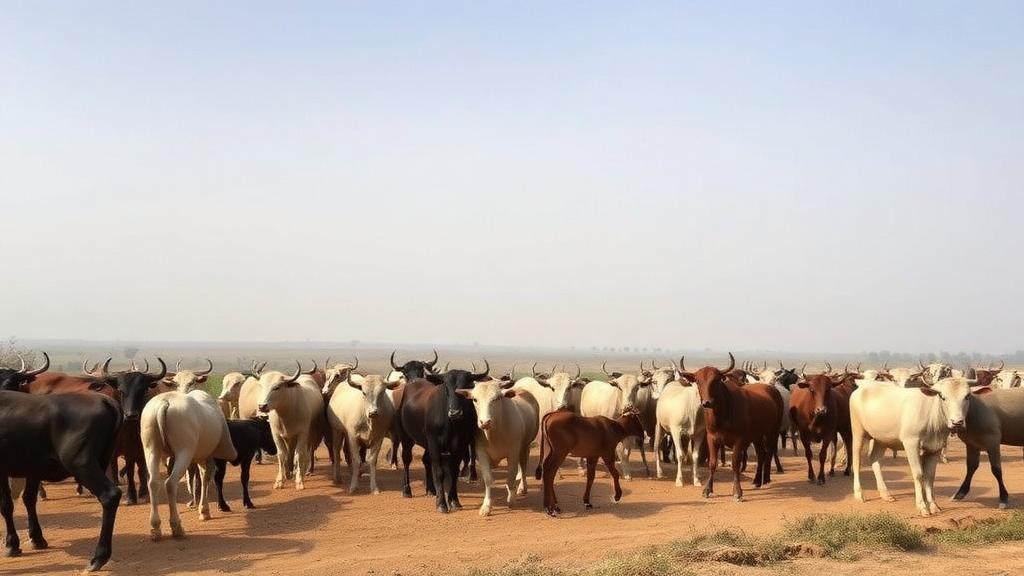
Ethiopia holds the largest livestock population in Africa and the fifth largest in the world, with roughly 70 million cattle, 42.9 million sheep, 52.5 million goats, 57 million poultry and millions of equines and camels, according to national statistics. Yet the animals that underpin the livelihoods of an estimated 15 to 16 million farming households are served by a veterinary system that a new systematic review describes as chronically underfunded, understaffed and structurally fragmented. The review, published in the open-access journal Veterinary Medicine and Science, synthesizes peer-reviewed studies and official reports published between 2000 and 2025 to map the obstacles preventing effective veterinary service delivery across the country, and its findings paint a picture of a sector in urgent need of reform.
The stakes are enormous. Agriculture employs between 80 and 85 percent of Ethiopia’s workforce and accounts for about 40 percent of gross domestic product, while livestock production alone contributes roughly 16 percent of GDP, more than 85 percent of agricultural revenues and over 90 percent of pastoral household profits. Despite this, productivity remains low, driven in part by suboptimal breed selection, poor management and, critically, a high burden of livestock disease. A 2011 World Organisation for Animal Health Performance of Veterinary Services assessment identified the state sector’s near-monopoly on service provision as a documented weakness, with limited participation from private practitioners, and subsequent analyses have confirmed that this model leaves vast gaps in coverage.
The numbers on access are stark. An estimated 30 to 40 percent of Ethiopians are currently served by government animal health services, and the review found that only 19 to 33 percent of farm households report consistent access to veterinarians or clinics, depending on the production system. Of 23 peer-reviewed articles and official reports addressing infrastructure, 83 percent documented inadequate and unevenly distributed veterinary facilities as a primary constraint. National estimates suggest Ethiopia has only about 3,500 to 4,000 public veterinary clinics and animal health posts, many of them lower-tier facilities staffed by animal health assistants rather than veterinarians, and concentrated in highland areas while pastoral lowlands go largely unserved. Fewer than a quarter of rural veterinary facilities are privately run, with private clinics clustered in peri-urban towns where commercial livestock farming makes them viable.
Diagnostic capacity is another critical weak point. Ethiopia operates a tiered laboratory system headed by the Animal Health Institute in Sebeta, the national reference laboratory providing confirmatory diagnostics, molecular testing and vaccine quality control. But regional laboratories are largely limited to routine diagnostics, and zonal and district facilities can perform only basic bacteriology, parasitology and serology. The review reports that Ethiopia still lacks operational sequencing infrastructure for pathogen genomic characterization, with the Animal Health Institute remaining the sole facility with routine molecular diagnostic capability. This deficit has direct operational consequences: genomic characterization is essential for identifying circulating foot-and-mouth disease serotypes O, A and SAT 2 to select matched vaccines, for distinguishing Peste des petits ruminants vaccine strains from field viruses during eradication efforts, and for providing early warning of mutations associated with mammalian transmission of highly pathogenic avian influenza. Without these tools, the country responds to outbreaks with limited pathogen intelligence and potentially mismatched vaccines.
The workforce shortage may be the most alarming finding. Of 31 papers examining human resources for animal health, 90 percent identified a shortage of qualified veterinary professionals as a major constraint. Ethiopia falls an estimated 12 to 14 times below the World Organisation for Animal Health’s recommended veterinarian-to-livestock ratio nationally, and 20 to 40 times below in pastoral areas. Neighboring Kenya maintains roughly one veterinarian per 20,000 livestock units and Tanzania one per 25,000, while Uganda and Sudan exceed Ethiopia’s ratio by three- to fivefold. Brain drain compounds the problem: an estimated 20 to 30 percent of Ethiopian Doctor of Veterinary Medicine graduates leave the country within five years of graduation, drawn abroad by low pay and limited career growth. At the current graduation rate of 500 to 650 veterinarians annually, the review calculates it would take 50 to 67 years to reach the international guideline, even before accounting for population growth, retirement or continued emigration.
Money, or the lack of it, runs through nearly every failure the review documents. Of 26 papers examining financial aspects, 88 percent documented chronic underfunding, and nearly half noted that veterinary services receive less than 1 percent of the national government budget, compared with 5 to 7 percent for human health and 15 to 20 percent for education. The review identifies eight interconnected drivers of this underinvestment, including the subsistence-oriented production system in which 80 to 85 percent of livestock keepers have limited cash income and studies show willingness to pay only one to five dollars per animal for care, far below actual delivery costs. Donor dependency is another factor, with 60 to 70 percent of veterinary funding coming from external sources such as the Food and Agriculture Organization, the World Bank and USAID, often tied to specific diseases rather than systemic strengthening, and prone to evaporate when donor priorities shift. Meanwhile, livestock diseases are estimated to cost the economy 300 to 500 million dollars annually, losses diffuse enough to remain politically invisible until major outbreaks strike.
Weak surveillance and regulation deepen the crisis. Ethiopia’s vast and heterogeneous terrain, poor transport and communication networks, and the constant mobility of pastoral herds impede timely outbreak reporting, while shortages of veterinarians and para-veterinarians limit routine inspections and sample collection. Vaccination coverage remains low due to poor cold chain management, logistical difficulties in reaching rural areas and vaccine shortages; in hot pastoral regions, cold-chain failures reduce the efficacy of vaccines for anthrax, blackleg and pasteurellosis. Enforcement of veterinary laws is frequently lax, allowing substandard and counterfeit medications to proliferate, and the illegal trafficking of animals and animal products undermines official disease control. A particular concern in pastoralist regions is the practice of free drug dumping, in which veterinary pharmaceuticals are distributed through donor-funded emergency responses without proper oversight, quality assurance or follow-up, distorting local markets and long-term planning.
Social and institutional barriers compound the technical ones. The review found that 87 percent of papers addressing public awareness identified uneven knowledge among livestock owners as a major barrier, with 77 percent noting that many owners wait until animals are obviously sick before seeking care, too late for effective treatment. Traditional beliefs, herbal remedies and spiritual explanations for disease lead some communities to prefer traditional healers over veterinarians, delaying disease reporting and vaccination. Culturally, livestock may be considered communal or sacred, restricting external interventions. The institutional landscape is similarly fragmented across federal, regional, district and community levels, with coordination bodies such as the National Veterinary Technical Committee and the Zoonotic Disease Technical Working Group hampered by weak information sharing, poor communication infrastructure and limited collaboration between public and private sectors. Community animal health workers, often trained and supported by nongovernmental organizations, provide vital services in remote areas, but many projects collapse or shrink when external funding stops.
The zoonotic dimension gives the crisis a public health edge. Rabies kills an estimated 2,700 to 3,000 Ethiopians annually, yet dog vaccination coverage in rural areas is estimated below 20 percent, despite legal mandates for control under Proclamation No. 1054/2017. Cattle serve as reservoirs for bovine tuberculosis, brucellosis and anthrax, camels carry MERS-related coronavirus risks, and poultry contribute to avian influenza and salmonellosis. The legal framework prescribes a One Health approach involving the Ministry of Agriculture, the Ministry of Health and the Ethiopian Public Health Institute, but enforcement is weakened by poor intersectoral coordination, limited funding for joint responses and inadequate regional laboratory capacity for confirmatory testing. A new Animal Welfare Proclamation, ratified in 2025, establishes for the first time legal requirements for humane treatment, pain relief and proper transport, though implementation will demand sustained commitment.
The review’s authors argue that reversing decades of underinvestment requires a multi-pronged strategy: expanding veterinary education capacity and retention incentives, investing in modern diagnostic technologies with standardized quality control, deploying fully functional mobile veterinary clinics suited to pastoral mobility, scaling up public education on preventive care, and objectively assessing public-private partnerships to bring private practitioners into underserved markets. Updating and enforcing veterinary regulations, establishing stronger centralized oversight and ensuring consistent policy implementation across regions are also deemed crucial. Without such interventions, the review concludes, Ethiopia’s veterinary services will remain a critical bottleneck, constraining not only the health of the continent’s largest livestock population but also the economic well-being and food security of the millions of people who depend on it.
Subject of Research: Challenges facing veterinary service delivery in Ethiopia
Article Title: Review on Major Challenges of Veterinary Service Delivery in Ethiopia
Article References: Muhammed, A., & Wamile, M. (2026). Review on Major Challenges of Veterinary Service Delivery in Ethiopia. Veterinary Medicine and Science, 12(5), Article e71208. https://doi.org/10.1002/vms3.71208
Image Credits: AI Generated
DOI: 10.1002/vms3.71208
Keywords: Ethiopia, veterinary services, livestock, animal health, veterinarian shortage, diagnostic laboratories, disease surveillance, vaccination, One Health, zoonoses, public-private partnerships, rural development
Cite Scienmag News
William Thompson. (October 1, 2026). Ethiopia’s Giant Livestock Herds Face a Veterinary System in Crisis. Scienmag. https://scienmag.com/ethiopias-giant-livestock-herds-face-a-veterinary-system-in-crisis/
William Thompson. "Ethiopia’s Giant Livestock Herds Face a Veterinary System in Crisis." Scienmag, 1 October 2026, https://scienmag.com/ethiopias-giant-livestock-herds-face-a-veterinary-system-in-crisis/. Accessed 4 October 2026.
William Thompson. "Ethiopia’s Giant Livestock Herds Face a Veterinary System in Crisis." Scienmag. October 1, 2026. https://scienmag.com/ethiopias-giant-livestock-herds-face-a-veterinary-system-in-crisis/


