


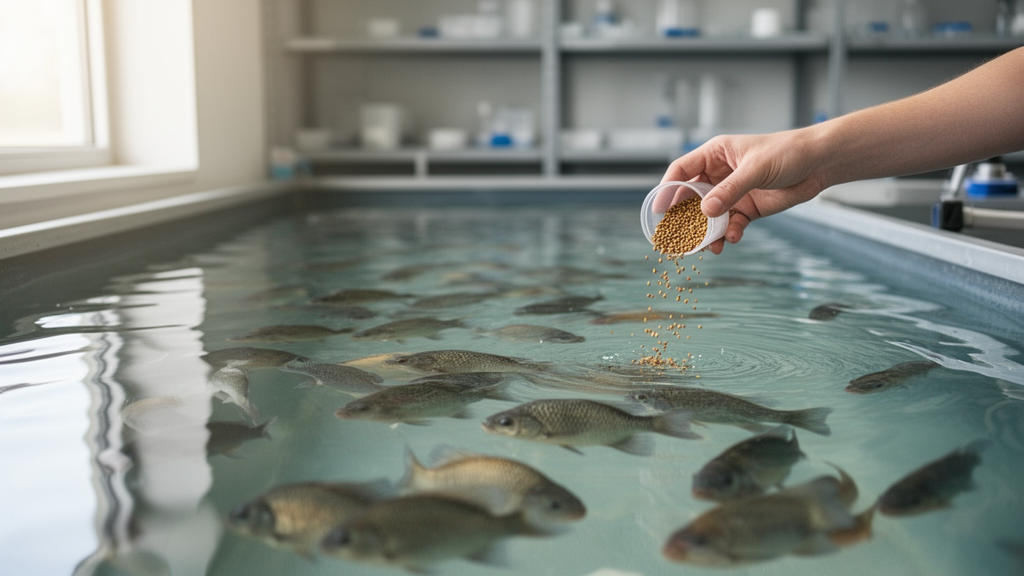
A saline-tolerant tilapia hybrid developed in the Philippines can be turned almost entirely female with a simple change to its diet, according to a new study that offers hatcheries a practical tool for boosting fry production in an era of rising salinity. Researchers at the University of the Philippines Visayas found that feeding young UPV SpiN tilapia (Oreochromis spilurus × O. niloticus) with 17β-estradiol for 28 days converted more than 94 percent of genetic males into phenotypic females, without harming survival. The work, published in Acta Ichthyologica et Piscatoria, is the first to evaluate feminization in this hybrid, which was bred to thrive in brackish water where conventional Nile tilapia cannot.
Tilapia is a cornerstone of Philippine aquaculture, ranking third in production volume among cultured fishery species, with Nile tilapia the dominant species. But Nile tilapia is a freshwater fish, and limited freshwater availability constrains expansion. To overcome this, UPV crossbred saline-tolerant O. spilurus males with fast-growing O. niloticus females, producing the UPV SpiN hybrid, which inherits salinity tolerance from one parent and rapid growth from the other. The hybrid is now cultured at the UPV multi-species hatchery for research and potential commercial production, particularly in coastal areas affected by seawater intrusion and climate change.
Monosex culture is standard practice in tilapia farming because uncontrolled reproduction leads to overstocking, disease, competition, and growth regression. All-male production is usually preferred commercially, since males grow faster and larger and command higher market prices, and sex reversal with androgens is widely used for that purpose. But broodstock operations need females: fry quality and quantity depend heavily on maternal size, gonadosomatic index, and fecundity, and breeding schemes typically use two to four, or even up to seven, females per male. A reliable supply of female breeders is therefore essential, and estrogen hormones such as 17β-estradiol (E2), chosen for its natural origin and ease of metabolism and excretion, can generate it.
The team tested two administration methods. In the first, swim-up fry after yolk-sac absorption received E2 through dietary supplementation at 0, 50, 100, or 200 mg per kg of feed for 28 days, with hormone dissolved in ethanol, sprayed onto commercial fry feed, and evaporated in a fume hood for at least 72 hours before use. In the second, larvae still carrying yolk sacs were immersed in E2 solutions at 0, 50, 100, 200, or 400 µg per liter for five days, until the yolk sac was fully absorbed. After treatment, all fish were reared without hormones in freshwater, then gradually acclimated to 10–20 ppt salinity until they reached 100–150 g for sex sorting.
Survival was remarkably high in both batches. Dietary supplementation produced survival rates of 99.17 to 100 percent, with no significant differences among treatments, showing that even the highest E2 dose did not harm the fry. Immersion survival ranged from 85.56 to 100 percent during the five-day exposure and from 83.33 to 98.89 percent afterward, again with no significant differences. The feminization outcomes, however, diverged sharply between the two methods.
Feeding E2 dramatically shifted sex ratios. The untreated control produced only 49.44 percent phenotypic females, while all hormone-treated groups produced far more: 97.94 percent at 50 mg per kg, 97.28 percent at 100 mg per kg, and 93.97 percent at 200 mg per kg, all significantly higher than the control. Feminization efficiency, calculated as the proportion of genetically male (XY) individuals that appeared as phenotypic females, peaked at 95.24 percent with 100 mg per kg and 94.74 percent with 50 mg per kg. The highest dose of 200 mg per kg offered no additional benefit, yielding 88.71 percent, a plateau consistent with findings in other species such as O. mossambicus, O. niloticus, wels catfish, and banana shrimp, where excess hormone can even cause intersex development, morphological anomalies, or reduced survival.
Immersion, by contrast, largely failed. Although survival remained high, phenotypic female ratios in treated groups did not differ significantly from the control, and only the 100 µg per liter group showed any feminization, at a low efficiency of 16.67 percent. The authors attribute this to the short exposure duration, the early developmental stage, and physiological limitations in hormone uptake at the yolk-sac stage. Previous studies that succeeded with immersion used longer exposures, such as 15 days in catfish, or varied efficiencies depending on embryo age and exposure length, suggesting that UPV SpiN larvae need more sustained contact with the hormone than five days allows.
A key strength of the study is its molecular confirmation of sex reversal. Rather than relying solely on external anatomy, which can be ambiguous, the researchers used PCR with the Marker-5 primer set targeting the amhy sex-determining gene on linkage group 23, amplifying a 1422 bp fragment from the X chromosome and a 982 bp fragment from the Y chromosome. Phenotypic females carrying XY genotypes were classified as sex-reversed genetic males, providing robust evidence that the hormone genuinely converted males rather than merely shifting natural sex ratios. To match each DNA sample to the correct individual without costly PIT tags or dye marks, the team devised a low-cost identification system: selectively excising the first six dorsal fin spines in distinct patterns, generating up to 63 unique codes. The excised spines heal naturally within weeks, but since DNA extraction and analysis finish within days, the temporary mark is sufficient.
The practical implications extend beyond broodstock supply. Identifying and selecting sex-reversed XY females is a critical step in producing YY supermales, which can generate all-male progeny without continued hormone treatment, integrating feminization protocols with sustainable monosex culture. All-female broodstock can also increase fry output, addressing the gradual decline in tilapia supply observed in recent years. Given the hybrid’s saline tolerance, the protocol is particularly valuable for aquaculture in regions affected by seawater rise and salinity intrusion driven by climate change.
The authors caution that further work is needed before the protocol reaches commercial maturity. Comprehensive evaluations of growth and reproductive performance in sex-reversed XY females compared with normal XX females are required to ensure their suitability for long-term breeding programs in saline-affected areas. Still, the study demonstrates that a 28-day dietary treatment with 50–100 mg per kg of E2 is an effective, reliable, and survival-safe method for feminizing UPV SpiN, offering hatcheries a straightforward strategy to build all-female stocks for sustainable tilapia breeding.
Subject of Research: Hormonal feminization of the saline-tolerant UPV SpiN tilapia hybrid using 17β-estradiol
Article Title: Feminization of a saline-tolerant tilapia hybrid, UPV SpiN ( Oreochromis spilurus × O. niloticus ) ( Actinopterygii , Cichliformes , Cichlidae ) using 17β-Estradiol: Effects of dose and administration method
Article References: Dinaga, C. J. P., Genciana, A. B. N., Failaman, A. A., Fontanilla, M. A. G., Estrada, R. A., Mameloco, E. J. G., Ferriols, V. M. E. N., Traifalgar, R. F. M., & Lumayno, S. D. P. (2025). Feminization of a saline-tolerant tilapia hybrid, UPV SpiN (Oreochromis spilurus × O. niloticus) (Actinopterygii, Cichliformes, Cichlidae) using 17β-Estradiol: Effects of dose and administration method. Acta Ichthyologica et Piscatoria, 55, 227-235. https://doi.org/10.3897/aiep.55.161420
Image Credits: AI Generated
Keywords: tilapia, aquaculture, 17β-estradiol, feminization, sex reversal, UPV SpiN hybrid, broodstock, PCR genotyping, saline tolerance, Philippines, monosex culture, hatchery
Cite Scienmag News
Daisy Hatcher. (October 18, 2026). Estrogen diet reliably turns male tilapia hybrid into females, study finds. Scienmag. https://scienmag.com/estrogen-diet-reliably-turns-male-tilapia-hybrid-into-females-study-finds/
Daisy Hatcher. "Estrogen diet reliably turns male tilapia hybrid into females, study finds." Scienmag, 18 October 2026, https://scienmag.com/estrogen-diet-reliably-turns-male-tilapia-hybrid-into-females-study-finds/. Accessed 18 October 2026.
Daisy Hatcher. "Estrogen diet reliably turns male tilapia hybrid into females, study finds." Scienmag. October 18, 2026. https://scienmag.com/estrogen-diet-reliably-turns-male-tilapia-hybrid-into-females-study-finds/


