

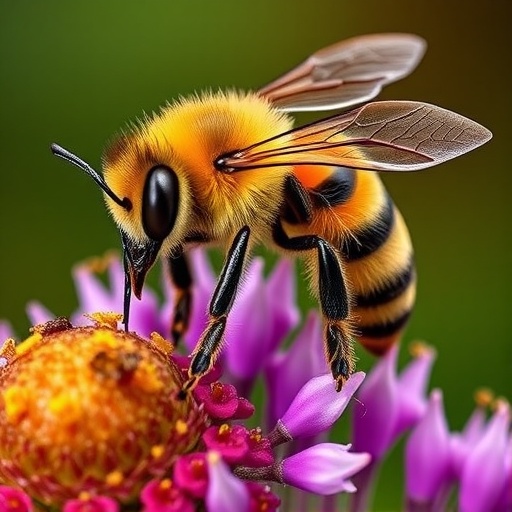
In a groundbreaking study published in Nature Communications, an international team of researchers has undertaken the most comprehensive estimation to date of global bee species richness, uncovering critical taxonomic gaps that challenge existing biodiversity assessments and conservation strategies. Bees, well-known as indispensable pollinators crucial to both natural ecosystems and agricultural productivity, have historically suffered from insufficient taxonomic representation and uneven geographical study focus. This research introduces innovative analytical methodologies to refine the global species count, expose neglected regions and groups, and provide an essential foundation for future biodiversity preservation efforts.
Bees represent a taxonomically diverse clade within Apoidea, comprising thousands of species that vary extensively in morphology, ecology, and behavior. Despite their ecological prominence, the true magnitude of global bee diversity has remained elusive. Traditional species inventories often underestimate actual richness because of limited field sampling, historical bias towards certain taxa, and a lack of comprehensive phylogenetic frameworks. Addressing these deficiencies, the study employs predictive modeling that integrates taxonomic and phylogenetic data, augmented by machine learning algorithms to estimate the undetected diversity and quantify uncertainty.
One of the central innovations in the study is the use of a novel hierarchical Bayesian approach that incorporates disparate data sources, including museum specimen records, scientific monographs, genetic barcodes, and citizen science databases. By synthesizing these varied datasets, the researchers were able to derive probabilistic estimates for the number of undescribed species within each biogeographical region and taxonomic group. This multi-dimensional assessment introduced an unprecedented level of statistical rigor, allowing for refined predictions with well-characterized confidence intervals.
The analyses reveal that current records likely represent only about 70% to 80% of the total bee species richness worldwide, with an estimated global species count approaching approximately 22,000 species, surpassing previous estimates significantly. These findings illuminate profound gaps in taxonomic completeness, especially in tropical regions such as the Congo Basin, Southeast Asia, and parts of the Amazon, where intensive field expeditions are sparse. The study highlights that many bee lineages inhabiting these biodiversity hotspots have yet to be formally described, signaling an urgent need for targeted taxonomic surveys.
Equally striking is the revelation of taxonomic blind spots, where entire genera or subfamilies are underrepresented in formal descriptions relative to their predicted diversity. The authors call attention to these groups, emphasizing that their omission can distort ecological models and hinder conservation prioritization. Such deficient taxonomic frameworks compromise our ability to monitor pollinator declines accurately, model ecosystem service resilience, and design effective habitat management strategies in the face of global change.
Additionally, the research contextualizes these taxonomic gaps against the backdrop of anthropogenic pressures, such as habitat loss, pesticide exposure, and climate change, which disproportionately threaten lesser-known species that inhabit fragmented or specialized niches. The authors argue that without filling taxonomic voids and enhancing species inventories, conservation efforts risk overlooking vulnerable bee populations whose ecological roles may be critical yet undocumented. This study thereby serves as a clarion call for integrating taxonomy into biodiversity monitoring frameworks more robustly.
In terms of methodology, the study leverages advances in molecular taxonomy, particularly the increased availability of environmental DNA (eDNA) data, to cross-validate species delimitations and support probabilistic models. Genetic barcoding facilitates the detection of cryptic species complexes that traditional morphological approaches might miss. The researchers advocate for expanding global molecular repositories, allowing for dynamic updating of species richness estimates as new data become available, thus enabling real-time tracking of biodiversity patterns.
The study also explores the implications of taxonomic gaps for ecosystem functioning. Bees exhibit diverse ecological roles, from generalist pollinators to specialists that maintain co-evolved mutualisms with certain plant species. Missing species in taxonomic records could skew evaluations of pollination networks and their resilience. The authors stress that improved taxonomic resolution will enhance models predicting how pollinator communities respond to environmental stressors, ensuring that ecosystem service assessments are grounded in complete biodiversity data.
Furthermore, the research underscores the significance of global collaboration among taxonomists, ecologists, data scientists, and conservationists. The interdisciplinary approach exemplified in this study sets a benchmark for future biodiversity assessments by demonstrating how combining traditional taxonomy with innovative computational techniques yields transformative insights. The authors propose an international consortium dedicated to standardizing data collection, harmonizing taxonomic workflows, and fostering open-access databases to accelerate the identification of unknown bee species.
Notably, the team discusses challenges inherent to taxonomic research, such as the declining number of trained taxonomists, limited funding, and the logistical complexities of tropical fieldwork. They argue that investments in capacity building and citizen science initiatives are crucial to bridge these gaps. Citizen scientist contributions, validated by expert oversight, have proven valuable in expanding geographic coverage and discovering novel taxa, as exemplified by global pollinator monitoring networks.
The implications of this work extend beyond academic circles. Policymakers and environmental agencies charged with pollinator conservation can leverage these refined species richness estimates to recalibrate conservation priorities and allocate resources more effectively. The study advocates for integrating taxonomic knowledge gaps into environmental impact assessments, biodiversity offset schemes, and monitoring protocols, thereby ensuring that overlooked species receive appropriate conservation attention.
Beyond conservation, agricultural stakeholders stand to benefit from understanding the full scope of bee diversity. The study highlights how overlooked pollinator species may contribute significantly to crop pollination, particularly in regions where managed honeybee populations are declining. Diversifying pollinator portfolios through ecosystem management practices that protect wild bee species could bolster food security and enhance agricultural resilience in the face of environmental change.
The research calls for a paradigm shift in how we conceptualize and approach biodiversity documentation, particularly for hyperdiverse and ecologically essential groups like bees. By framing taxonomy not as an academic luxury but as a foundational pillar of ecological science and conservation strategy, the study charts a course toward more comprehensive and actionable biodiversity data management in the 21st century.
In summary, this landmark study profoundly reshapes our understanding of bee species richness by uncovering significant taxonomic gaps previously obscured by uneven sampling and limited data integration. Employing sophisticated modeling techniques alongside traditional taxonomic expertise, the researchers produce rigorous, probabilistic estimates with direct implications for biodiversity science, conservation policy, and agricultural sustainability. It represents a decisive step forward in global efforts to catalog, understand, and conserve the planet’s pollinator biodiversity before it is irreversibly diminished.
Subject of Research: Global bee species richness estimation and identification of taxonomic gaps using integrative modeling approaches.
Article Title: Estimating global bee species richness and taxonomic gaps.
Article References:
Dorey, J.B., Gilpin, AM., Johnston, N.P. et al. Estimating global bee species richness and taxonomic gaps. Nat Commun 17, 1762 (2026). https://doi.org/10.1038/s41467-026-69029-4
Image Credits: AI Generated


