

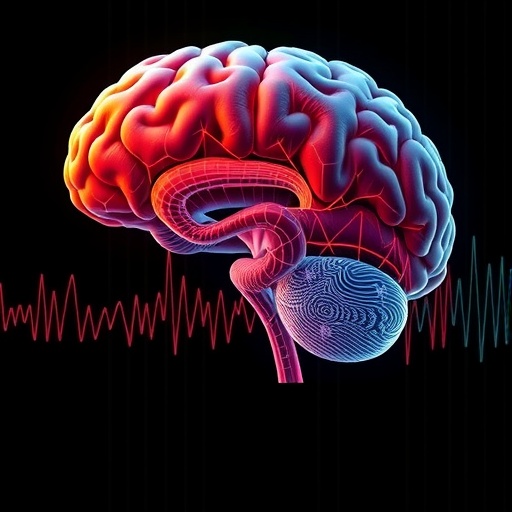
In a groundbreaking exploration into the mysteries of human memory, researchers have uncovered compelling evidence that the process of episodic memory encoding fluctuates rhythmically within the brain, particularly following theta waves oscillating between 3 and 10 Hertz. This discovery sheds new light on why certain experiences embed themselves more deeply in our minds, while others fade rapidly, offering the potential to revolutionize our understanding of memory formation at the neural level.
At the heart of this research lies a hypothesis inspired by the Separate Phases for Encoding and Retrieval (SPEAR) model—a prominent theoretical construct in cognitive neuroscience. According to this model, the brain’s theta rhythms do not merely accompany cognitive processes passively but actively orchestrate the dual tasks of encoding new memories and retrieving past ones by segregating them into distinct temporal phases. This rhythmic gating mechanism could explain the intermittent way our brains encode experiences, with fleeting moments ripe for memory formation alternating with windows dedicated to recall.
To probe this hypothesis, a deeply meticulous, preregistered study was conducted by researchers Biba, Decker, Herrmann, and colleagues, engaging a robust sample size of 125 participants. Using cutting-edge dense sampling techniques, the study meticulously reconstructed the timing of memory encoding down to the millisecond, capturing subtle fluctuations in participants’ ability to memorably encode experiences over the course of brief periods.
The findings reveal an unmistakable pattern: episodic memory encoding waxes and wanes in tune with a 3–10 Hz theta rhythm. These fluctuating memory windows suggest that our ability to form lasting memories is not a constant process but a rhythmic dance intricately timed with our brain’s endogenous oscillations. Crucially, these rhythms are behaviorally measurable, providing a fascinating window into transient neural dynamics that escape conscious awareness.
Importantly, the rhythmic nature of memory encoding observed by the study appears to be independent of rhythmic attentional processes—debunking an alternative explanation that these fluctuations could be driven merely by cycles of heightened attention or alertness. Instead, the mnemonic oscillations stand as a distinct phenomenon rooted in the neurophysiological properties of memory networks themselves.
Complementing the oscillatory evidence, the study also provides tantalizing clues about the neurochemical underpinnings that modulate these rhythms. Specifically, the researchers observed that putative markers of acetylcholine, a neuromodulator known to critically influence memory and cognition, modulate the theta rhythm associated with episodic encoding. This neurochemical modulation aligns with existing knowledge of how acetylcholine facilitates synaptic plasticity and neural coordination during learning.
This experimental evidence supporting the SPEAR model bridges a significant gap between theoretical neuroscience and observable human behavior. By demonstrating that the brain’s endogenous rhythms govern the precise timing of memory encoding, this research opens avenues for exploring how neural oscillations might be harnessed or disrupted in neurological conditions where memory processes fail.
What makes this discovery particularly captivating is its implication that the rhythms of memory encoding occur at speeds too rapid for conscious awareness, yet they crucially determine which experiences persist in memory. This rhythmic gating means that some memories are “fortunate,” formed at optimal phases of brain oscillations, while others fall victim to less favorable windows, explaining the uneven endurance of memories over time.
Methodologically, the employment of a dense temporal sampling approach stands out as an innovative technique. By capturing memory encoding with millisecond precision over multiple trials, the researchers could peel back the layers of temporal dynamics that traditional methods might obscure. This precision sampling made it possible to reconstruct the temporal structure of mnemonic operations that have long been hypothesized but rarely observed directly.
Notably, theta rhythms have historically been linked to hippocampal function—the brain’s epicenter for episodic memory—and are pivotal in synchronizing neural circuits during encoding and retrieval. By confirming the behavioral manifestation of such rhythms, the study not only validates prior electrophysiological findings but also translates them into observable cognitive effects in healthy individuals.
The implications for cognitive enhancement and therapeutic interventions are profound. Understanding that memory encoding is governed by rhythmic timing suggests potential strategies for optimizing learning, such as timing educational inputs or rehabilitation efforts to align with neural oscillatory states that favor encoding. Moreover, this rhythmic framework could inspire novel neuromodulatory treatments targeting acetylcholine systems to boost memory efficacy.
Furthermore, this research blurs the lines between neural oscillations as merely background phenomena and their active role in shaping complex cognitive functions. It underscores the sophistication of brain rhythms as more than simple periodic waves, highlighting them as orchestrators of information processing and memory storage.
The study’s robustness is underpinned by its preregistered design, large sample size, and sophisticated analytical methods, setting a high standard for replicable neuroscience research. By combining behavioral assays with physiological markers, the researchers present a comprehensive portrait of the temporal and neurochemical landscape of memory encoding.
Beyond memory studies, these insights could have far-reaching consequences in broader neuroscience domains. The rhythmic gating of cognition suggested here might be a universal principle extending to other cognitive functions beyond episodic memory, such as attention, perception, or executive control, each potentially modulated by rhythmic oscillations tuned to behaviorally relevant frequencies.
In sum, this pioneering research invites us to rethink memory formation as a dynamic, rhythmically orchestrated process, governed not just by what we try to remember but precisely when in time our brains are tuned to listen. This rhythmic encoding perspective enriches the science of memory, offering a nuanced, temporally refined picture of how experiences transition from ephemeral events into the enduring tapestries of our personal histories.
As future research capitalizes on these findings, we may soon develop interventions and technologies that synchronize teaching, therapeutic practices, or even daily experiences with the brain’s internal theta clock to maximize memory retention. This convergence of neuroscience and practical application promises new frontiers in enhancing human cognitive potential through the rhythm of our own minds.
Subject of Research: Episodic memory encoding and its rhythmic modulation by theta brain waves.
Article Title: Episodic memory encoding fluctuates at a theta rhythm of 3–10 Hz.
Article References:
Biba, T.M., Decker, A., Herrmann, B. et al. Episodic memory encoding fluctuates at a theta rhythm of 3–10 Hz. Nat Hum Behav (2026). https://doi.org/10.1038/s41562-026-02416-5
Image Credits: AI Generated


