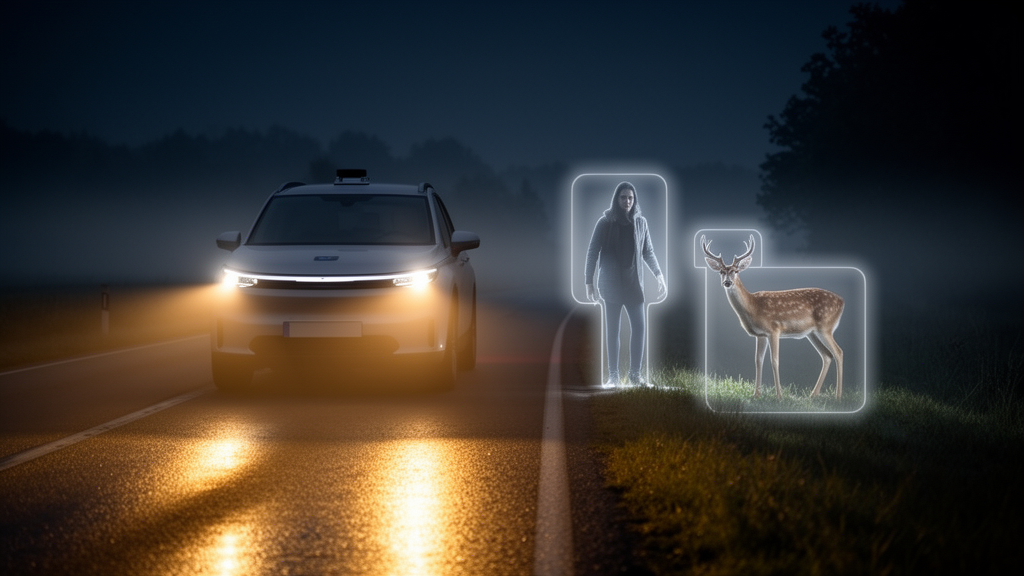
Night-time driving remains one of the hardest problems in autonomous vehicle perception, and a new deep learning framework claims to make a measurable dent in it. Researchers P. Ranjitha and Saira Banu Atham report in Discover Artificial Intelligence that their model, called EnPreNiNet, combined with a purpose-built image enhancement pipeline, achieved a mean Average Precision (mAP) of 76.3 percent on a dataset of night-time road scenes. That figure, the authors report, substantially exceeds the performance of existing detection methods they tested under the same low-light conditions, where conventional deep learning detectors have historically struggled.
The core problem the researchers set out to address is well known to anyone who has looked at footage from a dashboard camera after dark. Night images suffer from uneven pixel intensity distribution, low contrast, motion blur, partial occlusion, poor illumination and outright information loss. Streetlights and headlights can flood parts of the frame with light while other regions remain almost completely dark. The result is that foreground objects such as pedestrians, vehicles, roads, buildings and streetlights become difficult to distinguish from the background, which can cause segmentation failures and degraded multi-object detection.
Deep learning detectors that perform well in daylight or stable conditions lose significant accuracy in these adverse environments. In a benchmark the authors cite, the popular YOLOv5 model achieved 98.7 percent accuracy on normal vision but only 71 percent on night vision, 71 percent on night combined with rain, and 68.5 percent in low light. Because real driving scenes demand the simultaneous detection and classification of many objects rather than a single target, the researchers argue that robust multi-object detection at night is essential not only for autonomous driving but also for intelligent transportation systems, autonomous delivery, emergency response and smart city applications.
The new framework has two stages. The first is an improved image enhancement technique the authors call the GHE Ensemble model, which processes raw night images before detection. It reduces noise, improves contrast and redistributes pixel intensities more uniformly across the image, preserving scene information that would otherwise be lost. The enhancement pipeline draws on both spatial-domain gray-level transformations and frequency-domain techniques including histogram equalization, adaptive histogram equalization, Gaussian filtering and pixel normalization. The second stage is EnPreNiNet itself, an ensemble that merges two established detectors: an Enhanced Faster R-CNN and an Enhanced YOLOv5.
The choice to combine these two architectures reflects their complementary strengths. Faster R-CNN is a two-stage algorithm that processes an image through a convolutional backbone, in this case ResNet 150, generates region proposals through a region proposal network, applies region-of-interest pooling and then classifies each candidate region. This two-stage approach is particularly good at detecting small objects. YOLOv5, by contrast, is a single-shot detector that processes an image through a backbone, neck and head in one pass, using DarkNet as its backbone, and is prized for speed. Both models were trained separately on the enhanced images, each producing its own bounding boxes, confidence scores and class labels for every detected object.
To fuse the outputs, the researchers applied non-maximum suppression, which eliminates redundant bounding boxes and keeps only the highest-confidence detection for each object, followed by thresholding to discard low-confidence predictions. The six object classes the system detects in autonomous driving scenarios are cars, persons, buses, trucks, buildings and roads. Sample detections reported in the paper include a streetlight identified with 86 percent confidence and a truck detected with 95 percent confidence, alongside frames in which multiple cars and pedestrians were correctly localized.
The training data came from a newly assembled dataset the authors call BDD-Darko, created by extracting 20,000 night images containing multiple road objects from the openly available Berkeley DeepDrive BDD100K video dataset. The images were annotated using Roboflow. Frames were resized to 640 pixels and converted to grayscale before enhancement. The dataset was split with 70 percent of images for training, 20 percent for validation and 10 percent for testing. After augmentation, the enhanced dataset grew to 25,000 images with 90,126 annotated objects, and the final EnPreNiNet training set comprised 27,000 images containing 105,030 objects.
The results trace a clear progression across the pipeline. The original 20,000-image BDD-Darko dataset, containing 79,413 objects and trained with YOLOv5 without any enhancement, yielded an mAP of just 33.4 percent. Applying the GHE Ensemble enhancement and training YOLOv5 on the augmented data raised the mAP to 65.3 percent. The full EnPreNiNet ensemble pushed the figure to 76.3 percent. Per-class average detection rates were 84 percent for cars, 82 percent for people, 87 percent for roads, 82 percent for streetlights, 85 percent for buildings and 90 percent for trucks.
In head-to-head comparisons at confidence thresholds of 25, 50 and 75 percent, EnPreNiNet recorded average precision values of 55.9, 78.7 and 76.3 percent respectively. The competing methods the authors evaluated included Faster R-CNN, which achieved 35.7, 58.2 and 38.8 percent at the same thresholds; Cascade R-CNN at 39.3, 61.9 and 41.7 percent; Mask R-CNN at 32.3, 56.1 and 34.5 percent; RetinaNet and the Spatio-Temporal Sampling Network, both at 29.9, 53.0 and 30.2 percent; and the authors’ earlier GHE-YOLOv5 at 45.9, 65.3 and 55.9 percent. At a 0.5 confidence level, EnPreNiNet reached an mAP of 73.7 percent, ahead of YOLOv5 at 62.9 percent, YOLOv4 at 59.8 percent, RetinaNet at 58.2 percent, Faster R-CNN at 54.3 percent and GHE-YOLOv5 at 65.3 percent.
The work sits within a broader effort to make machine perception reliable across all environmental conditions, a prerequisite for autonomous vehicles that must perceive, plan and control with minimal human intervention. The authors frame their contribution as a step toward safer and more dependable night-time autonomy, and the reported gains are notable for a domain where even state-of-the-art detectors have trailed daylight performance by wide margins. As with any single-dataset study, the results are specific to the BDD-Darko night images and the six object classes evaluated, and independent validation on other night driving datasets would strengthen confidence in the approach. The datasets generated and analysed in the study are available from the corresponding author on reasonable request.
Subject of Research: Deep learning ensemble model for multi-object detection in night vision images for autonomous vehicles
Article Title: Improved multi object detection in night vision environment for autonomous vehicle using EnPreNiNet model
Article References: Ranjitha, P., & Atham, S. B. (2026). Improved multi object detection in night vision environment for autonomous vehicle using EnPreNiNet model. Discover Artificial Intelligence, 6(1), Article 971. https://doi.org/10.1007/s44163-026-02028-y
Image Credits: AI Generated
DOI: 10.1007/s44163-026-02028-y
Keywords: autonomous vehicles, object detection, night vision, deep learning, EnPreNiNet, YOLOv5, Faster R-CNN, image enhancement, computer vision, mean Average Precision, Berkeley DeepDrive, low-light perception
Cite Scienmag News
Blake Davidson. (October 28, 2026). Ensemble AI Model Sharpens Night Vision Object Detection for Autonomous Vehicles. Scienmag. https://scienmag.com/ensemble-ai-model-sharpens-night-vision-object-detection-for-autonomous-vehicles/
Blake Davidson. "Ensemble AI Model Sharpens Night Vision Object Detection for Autonomous Vehicles." Scienmag, 28 October 2026, https://scienmag.com/ensemble-ai-model-sharpens-night-vision-object-detection-for-autonomous-vehicles/. Accessed 28 October 2026.
Blake Davidson. "Ensemble AI Model Sharpens Night Vision Object Detection for Autonomous Vehicles." Scienmag. October 28, 2026. https://scienmag.com/ensemble-ai-model-sharpens-night-vision-object-detection-for-autonomous-vehicles/