


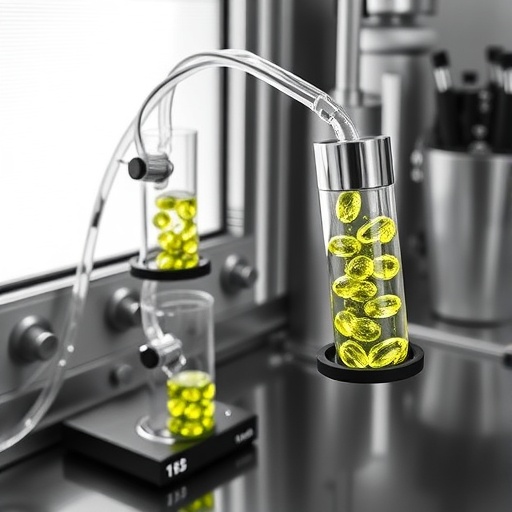
In the relentless pursuit of sustainable and high-efficiency protein extraction methods, researchers have recently achieved a groundbreaking advancement in the extraction and functional enhancement of soy 11S globulin. The study, led by Sun, Fan, Zhao, and colleagues, unveils an innovative approach utilizing reverse micelle systems augmented by chaotropic agents to revolutionize the forward extraction process. This novel methodology promises to impact the food biotechnology sector profoundly by optimizing extraction yields while preserving and even enhancing the functional properties of soy-derived proteins.
Soy 11S globulin, a major storage protein found in soybeans, is well-regarded for its potential as a plant-based protein source with applications ranging from food additives to nutraceuticals. Traditional extraction techniques, however, often grapple with issues such as protein denaturation, low yields, and environmental burdens due to the intensive use of solvents and high energy input. Addressing these challenges, the research team meticulously engineered a reverse micellar extraction system tailored to exploit the unique characteristics of chaotropic agents, a class of compounds known for their ability to disrupt hydrogen bonding networks and enhance solubility dynamics within biological molecules.
Reverse micelles, nanoscale water-in-oil droplets stabilized by surfactants, provide an amphiphilic microenvironment capable of selectively encapsulating and transporting proteins. By fine-tuning the parameters that govern micelle size, charge, and interfacial properties, the researchers created an optimal habitat for soy 11S globulin molecules. Introduction of chaotropic agents into this milieu further facilitated the disruption of protein aggregates and strengthened molecular interactions necessary for efficient solubilization and stable extraction.
The optimization process underscored a delicate balance between extraction efficiency and protein integrity. Chaotropic agents, while beneficial in enhancing solubility, can potentially destabilize protein conformation if not carefully managed. Through systematic experimentation and rigorous control of chaotropic concentrations, the team achieved an unprecedented extraction yield without compromising key functional attributes such as solubility, emulsifying capacity, and foaming ability — traits critical for food formulation and ingredient performance.
Moreover, the study delineated the kinetics of the forward extraction process within reverse micellar systems. Findings suggest that the presence of chaotropic agents modulates the thermodynamics of protein-micelle interactions, decreasing activation energy barriers and expediting protein transfer from the aqueous feed phase into the organic micellar phase. This acceleration translates into shorter extraction times and noteworthy energy savings, aligning well with sustainability goals in industrial bioprocesses.
Beyond the extraction mechanism, the investigation extended into the morphological and structural characterization of the soy 11S globulin proteins post-extraction. Employing advanced spectroscopic techniques and microscale analyses, the researchers confirmed preservation of the native secondary and tertiary structures, thereby safeguarding proteins’ nutritional and functional viability. This aspect holds tremendous promise for downstream applications where protein quality is paramount.
Functional evaluations demonstrated that soy 11S globulin extracted through this optimized reverse micelle method exhibited enhanced performance in model food systems. Enhanced emulsifying activity and stabilized foam formation imply better texture and mouthfeel potentials, which are highly sought after in plant-based dairy and meat analogues. These functional enhancements could unlock new avenues for soy protein use, ensuring competitive alternatives to animal-derived ingredients.
Industrial scalability of this technology also featured prominently in the discourse. The mild operating conditions and reduced solvent usage inherent to the reverse micellar extraction enhanced with chaotropic agents provide an attractive pathway for environmentally conscious manufacturing. The modularity of the system allows for facile integration into existing production lines, potentially reducing capital expenditure and operational complexities.
The implications of this research resonate through the larger context of global protein supply challenges. With burgeoning populations and increasing demand for sustainable plant proteins, technologies that amplify extraction efficiency while preserving functional integrity are invaluable. The synergistic use of reverse micellar systems and chaotropic agents represents a paradigm shift in bioprocess engineering, opening doors to more refined and eco-friendly protein isolation methodologies.
Ethical and environmental considerations are implicitly addressed as well. By minimizing the use of harsh chemicals and harnessing gentle extraction conditions, this innovative approach reduces the generation of industrial effluents and energy consumption. This aligns with the principles of green chemistry and responsible manufacturing, further amplifying the societal benefits of soy protein utilization.
Future research trajectories may explore the application of this method to other plant proteins, potentially extending benefits across diverse agricultural commodities. Additionally, tailoring chaotropic agent selection to modulate extraction selectivity might enable custom-designed protein preparations with targeted functionalities tailored for specific food or pharmaceutical applications.
Notably, the study contributes to fundamental scientific understanding by elucidating the interactive dynamics within reverse micelle systems in the presence of chaotropic agents. These insights have broad ramifications, enhancing the toolbox available to scientists endeavoring to manipulate macromolecular behaviors within confined nanoscale environments.
In conclusion, Sun and colleagues have charted a transformative path in soy protein technology by integrating reverse micellar forward extraction with the strategic use of chaotropic agents. This dual approach not only enhances yield and functional properties of soy 11S globulin but also propels the field towards more sustainable and efficient protein extraction solutions. As the global community pivots towards plant-based nutrition and eco-friendly processing, such innovations will undoubtedly play a pivotal role in shaping the future of food science and biotechnology.
Cite Scienmag News
Drew Townsend. (August 28, 2025). Enhancing Soy 11S Globulin Extraction with Chaotropes. Scienmag. https://scienmag.com/enhancing-soy-11s-globulin-extraction-with-chaotropes/
Drew Townsend. "Enhancing Soy 11S Globulin Extraction with Chaotropes." Scienmag, 28 August 2025, https://scienmag.com/enhancing-soy-11s-globulin-extraction-with-chaotropes/. Accessed 4 September 2026.
Drew Townsend. "Enhancing Soy 11S Globulin Extraction with Chaotropes." Scienmag. August 28, 2025. https://scienmag.com/enhancing-soy-11s-globulin-extraction-with-chaotropes/


