

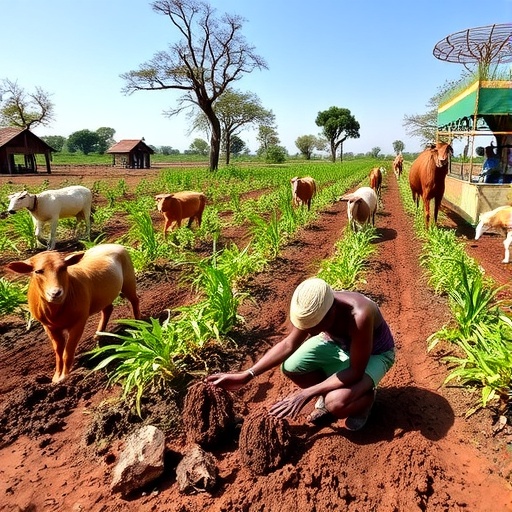
In the semi-arid agrozone of Samburu County, Kenya, a groundbreaking approach to enhancing soil fertility is being explored through the optimization of manure quality. This innovative research, spearheaded by a collaborative team including Lesharana, Otieno, and Ngie, focuses on the effective use of cattle and goat manure to fortify the fragile soils prevalent in this region. The study recognizes the significant challenges that farmers face in such semi-arid climates where soil degradation and nutrient depletion hamper agricultural productivity.
The soil fertility issues in Samburu are not isolated; they reflect a broader global concern regarding sustainable farming practices in arid and semi-arid regions. Diminishing natural fertility due to overgrazing, erosion, and inadequate organic matter contributes to the persistent cycle of poverty among local farmers. The introduction of high-quality organic fertilizers derived from livestock waste presents a crucial opportunity to ameliorate these conditions. This research aims to identify the optimal characteristics of manure that can enhance soil health, crop yields, and, ultimately, the livelihoods of the farming community.
At the heart of this study is the understanding that both cattle and goat manure can serve as valuable organic amendments when properly managed. The researchers delve into the nutritional profiles of these manures, analyzing their nutrient content, microbial diversity, and other vital parameters. By conducting a series of field experiments, the team assesses the effects of varying application rates and methods on soil fertility and plant growth. The outcomes of these experiments are anticipated to shed light on the best practices for manure application that can be adopted by farmers in the region.
One of the compelling findings of the research is the potential for improved nutrient retention in soils treated with optimized manure. The study emphasizes the role of organic matter in enhancing soil structure, which in turn facilitates better water retention. This is particularly important in semi-arid areas, where rainfall can be sporadic and unpredictable. By incorporating high-quality manure into soil systems, farmers can create a buffer against drought conditions, ensuring more reliable crop production even during dry spells.
The research further highlights the importance of microbial activity in the soil, which can be significantly enhanced by the application of well-composted manure. Healthy microbial communities contribute to nutrient cycling, breaking down organic matter and releasing essential nutrients for plant uptake. The researchers are keen to document the relationships between manure quality, microbial diversity, and soil fertility, aiming to provide a comprehensive guide for future manure management practices.
In addition to the agricultural benefits, this research also carries environmental implications. The effective use of livestock manure can mitigate waste disposal issues prevalent in farming communities. Instead of being considered a burden, manure becomes a resource that can help close the nutrient loop, minimizing reliance on chemical fertilizers that can have detrimental effects on health and the ecosystem. By reducing chemical inputs, the research aligns with global sustainability goals, promoting healthier farming practices for a resilient agricultural system.
Another vital aspect of the study is understanding the socio-economic effects of enhancing soil fertility through improved manure quality. The researchers are collecting data on farmers’ perceptions of manure use, their willingness to adopt new practices, and the potential economic benefits these changes could bring. By engaging with local communities, the study aims to create a framework that not only enhances agricultural outputs but also empowers farmers through increased knowledge and resource management.
Ultimately, this research represents a step towards sustainable agriculture in vulnerable regions. By optimizing cattle and goat manure quality, the team hopes to transform how farming is approached in semi-arid landscapes. The results of their work could serve as a blueprint for similar ecological contexts, offering scalable practices that can contribute to food security and poverty alleviation globally.
The findings from this study are expected to contribute to the academic discourse on sustainable agricultural practices. The researchers plan to disseminate their results through various channels, including peer-reviewed publications and partnerships with local agricultural organizations. This multi-faceted approach aims to ensure that the knowledge gained reaches the farmers who will benefit most from it.
As the research progresses, the team remains hopeful that more stakeholders will recognize the value of organic farming methods and the role of manure in building resilient soil ecosystems. The potential for policy changes at local and national levels that support organic fertilizer use is also an area the researchers are eager to explore, as they believe that integrating these practices into broader agricultural policies could have far-reaching impacts.
In conclusion, the optimization of cattle and goat manure quality to improve fertility in fragile soils is not just an agricultural innovation; it is a vital endeavor towards environmental sustainability and social equity. The insights gained from this research will provide critical evidence for advocating organic amendments, contributing to the overall well-being of farmers and the ecosystems they depend on. As the world continues to grapple with the challenges posed by climate change and population growth, studies like this one offer a glimmer of hope for sustainable agricultural practices that nurture both the land and the people who cultivate it.
Subject of Research: Optimizing cattle and goat manure quality to improve soil fertility in semi-arid agrozone of Samburu County, Kenya.
Article Title: Optimizing cattle and goat manure quality to improve fertility status of fragile soils in semi-arid agrozone of Samburu County, Kenya.
Article References: Lesharana, P.L., Otieno, E.O., Ngie, M. et al. Optimizing cattle and goat manure quality to improve fertility status of fragile soils in semi-arid agrozone of Samburu County, Kenya. Environ Sci Pollut Res (2025). https://doi.org/10.1007/s11356-025-37336-w
Image Credits: AI Generated
DOI: https://doi.org/10.1007/s11356-025-37336-w
Keywords: manure quality, soil fertility, semi-arid agrozone, organic amendments, sustainable agriculture, Samburu County, Kenya.


