


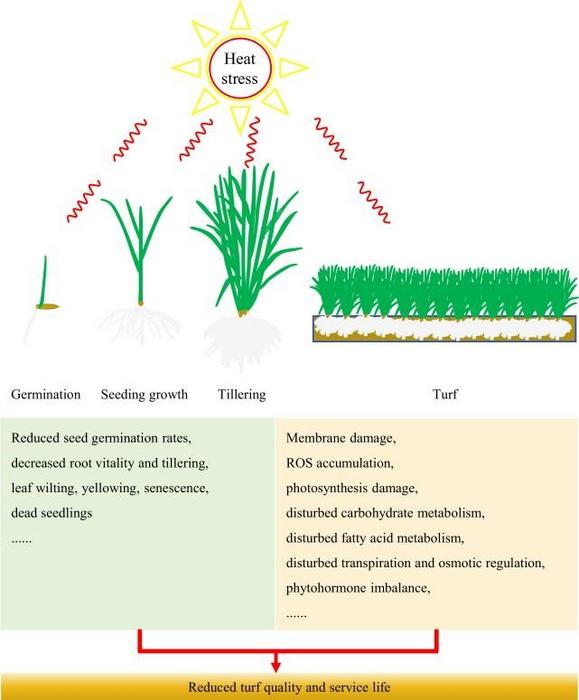
A research team reviewed the physiological and morphological changes in cool-season turfgrasses under high temperature stress, alongside advances in molecular characterization of their temperature regulatory networks. They proposed methods to enhance the turfgrasses’ heat tolerance and highlighted the challenges in researching heat tolerance mechanisms. This work holds significant value for improving the ornamental and functional quality of urban and sports greenery, potentially leading to the development of more resilient turfgrass varieties.

Credit: The authors
A research team reviewed the physiological and morphological changes in cool-season turfgrasses under high temperature stress, alongside advances in molecular characterization of their temperature regulatory networks. They proposed methods to enhance the turfgrasses’ heat tolerance and highlighted the challenges in researching heat tolerance mechanisms. This work holds significant value for improving the ornamental and functional quality of urban and sports greenery, potentially leading to the development of more resilient turfgrass varieties.
Turfgrasses are categorized into cool-season and warm-season types, based on their climatic origins. Cool-season turfgrasses perform optimally at temperatures ranging from 15-24°C aboveground and 10-18°C underground. These grasses, known for their dark green foliage and adaptability to cold, face challenges when exposed to temperatures above 30°C, experiencing issues such as wilting, yellowing, and seedling death. This temperature sensitivity adversely affects their aesthetic appeal and increases maintenance costs, particularly in temperate and transitional zones. Current research is centered on understanding the physiological and biochemical reactions of turfgrass to heat stress, pinpointing heat-tolerance genes, and elucidating the underlying molecular mechanisms. This knowledge is crucial for breeding heat-resistant varieties and improving turf management practices.
A study (DOI: 10.48130/grares-0024-0008) published in Grass Research on 10 April 2024, details the physiological and morphological impacts of high temperature on cool-season turfgrasses, examines advances in molecular characterization, proposes improvement strategies, and highlights research gaps in understanding heat tolerance mechanisms.
High temperature stress leads to suboptimal conditions for the growth of cool-season turfgrasses, resulting in reduced seed germination rates, decreased root vitality and tillering, wilting and yellowing leaves, and the occurrence of dead seedlings. For example, the germination rates of ‘Yatsyn’, ‘Nui’, and ‘Mathilde’ varieties were significantly reduced to 3.3%, 29.7%, and 1.6% at 36°C, respectively, and the root vitality and tillering in species like tall fescue and creeping bentgrass decreased significantly under high temperature stress. Meanwhile, high temperature stress results in membrane damage, ROS accumulation, photosynthesis damage, disturbed carbohydrate metabolism, disturbed fatty acid metabolism, disturbed transpiration and osmotic regulation, and phytohormone imbalance in cool-season turfgrasses. In addition, they summarized molecular mechanisms of cool-season turfgrasses to high temperature stress. Heat stress induces expression of heat stressrelated genes (HSFs, F-box, MBF1C, HOXs, etc) or miRNA, which controls the expression of downstream genes to regulate plant heat tolerance. Finally, the review proposes strategies to improve thermotolerance in cool-season turfgrasses, including cultivation and maintenance management, breeding of heat tolerant turfgrass varieties by genetic engineering. It identifies gaps in understanding the exact molecular mechanisms behind heat tolerance and suggests focusing future research on these areas to aid in developing heat-tolerant cool-season turfgrasses.
According to the study’s lead researcher, Zhulong Chan, “We aim to provide references for the research on characterization of heat tolerance mechanism and breeding heat tolerant cold-season turfgrass.” This research brings comprehensive insights for enhancing the aesthetic and functional aspects of urban and sports turf, potentially paving the way for the creation of more robust turfgrass varieties.
###
References
Original Source URL
Authors
Tianxiao Sun1,2 , Weiliang Wang1 and Zhulong Chan1,3*
Affiliations
1 National Key Laboratory for Germplasm Innovation & Utilization of Horticultural Crops; College of Horticulture and Forestry Sciences, Huazhong Agricultural University, Wuhan 430070, Hubei, China
2 College of Landscape Architecture and Art, Henan Agricultural University, Zhengzhou 450002, Henan, China
3 Hubei Hongshan Laboratory, Wuhan 430070, China
Journal
Grass Research
Method of Research
Experimental study
Subject of Research
Not applicable
Article Title
How do cool-season turfgrasses respond to high temperature: progress and challenges
Article Publication Date
10-Apr-2024
COI Statement
The authors declare that they have no competing interests.
Cite Scienmag News
Courtney Benton. (April 25, 2024). Enhancing heat tolerance in cool-season turfgrasses: a comprehensive review of physiological changes, molecular advances, and breeding strategies. Scienmag. https://scienmag.com/enhancing-heat-tolerance-in-cool-season-turfgrasses-a-comprehensive-review-of-physiological-changes-molecular-advances-and-breeding-strategies/
Courtney Benton. "Enhancing heat tolerance in cool-season turfgrasses: a comprehensive review of physiological changes, molecular advances, and breeding strategies." Scienmag, 25 April 2024, https://scienmag.com/enhancing-heat-tolerance-in-cool-season-turfgrasses-a-comprehensive-review-of-physiological-changes-molecular-advances-and-breeding-strategies/. Accessed 5 September 2026.
Courtney Benton. "Enhancing heat tolerance in cool-season turfgrasses: a comprehensive review of physiological changes, molecular advances, and breeding strategies." Scienmag. April 25, 2024. https://scienmag.com/enhancing-heat-tolerance-in-cool-season-turfgrasses-a-comprehensive-review-of-physiological-changes-molecular-advances-and-breeding-strategies/

