


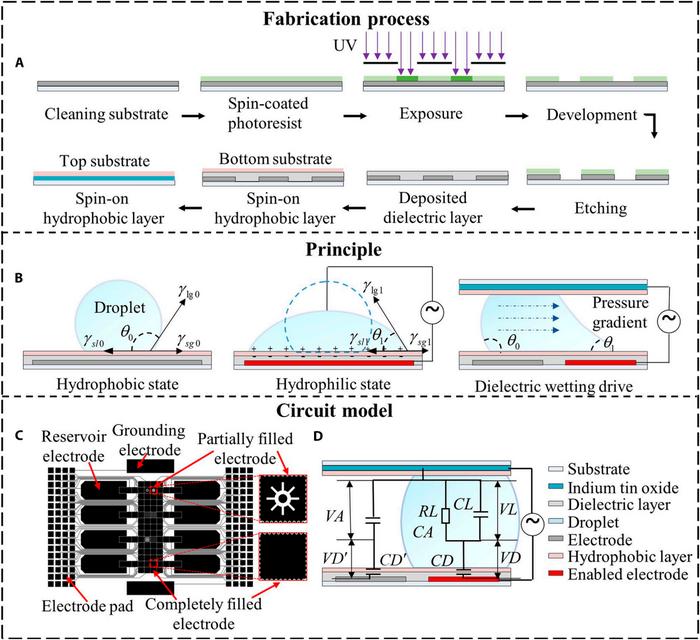
A newly published research study from the Beijing Institute of Technology and City University of Hong Kong has unveiled a groundbreaking approach to optimizing digital microfluidic chips, with significant implications for biochemical analysis and droplet manipulation technologies. The research, which employs innovative electrodynamics simulation modeling, addresses the vital understanding of driving forces that act upon droplets in partially filled electrodes, a key element in enhancing the efficiency of digital microfluidic systems.
Digital microfluidic chips are emerging as a powerful platform for a range of biochemical applications due to their unparalleled ability to handle tiny volumes of fluid with precision. Recent advancements in this field have demonstrated that the manipulation of droplets on these chips can lead to more efficient biochemical reactions, ailment diagnostics, and other innovative applications. The effectiveness of these systems largely depends on the driving force behind droplet movement, making it essential to accurately evaluate and optimize these forces within the chips.
Publishing in the esteemed journal Cyborg and Bionic Systems, the authors present a detailed investigation into the electrodynamics of digital microfluidic devices. Utilizing finite element analysis (FEA), the research meticulously calculates the voltage distribution within microfluidic chips, enabling a deeper understanding of how various structural parameters influence droplet behavior. This work not only enhances the theoretical framework surrounding droplet manipulation but also proposes practical solutions to pressing challenges in chip design.
A significant innovation arising from this study is the integration of electromechanical models into the simulation process. This powerful combination allows for more precise calculations of the driving forces acting on droplets, which are critical for their movement across surfaces. By considering parameters such as the dielectric constant and thickness of the dielectric layer, as well as droplet properties like conductivity, the researchers have created a robust model that significantly outperforms traditional approaches.
One of the pivotal findings of the research involves the systematic evaluation of how various key parameters affect the driving force on droplets within the microfluidic chips. These parameters include not only physical attributes of the electrodes and the properties of the liquid droplets but also the spatial configuration of the chips themselves. By manipulating these factors, the authors were able to uncover new insights into droplet dynamics, providing a comprehensive understanding that can facilitate future designs of microfluidic devices.
The validation of this electrodynamic simulation model was conducted through experimental measurements of droplet acceleration. By correlating empirical data with simulated results, the research team confirmed the accuracy of their model. This critical step highlights the reliability of the simulation method and serves as a foundation for future research applications, paving the way for innovations in droplet-based technologies.
Their method holds significant promise for practical applications in biochemical experiments, demonstrating effective droplet manipulation and enhanced capabilities for microscopic imaging. With a focus on real-world applications, the researchers applied their optimized electrodynamic model to various experimental setups, showcasing not only the model’s accuracy but also its potential to transform existing methodologies in the field.
The significance of these findings extends beyond theoretical contributions; it poses questions about the future of digital microfluidic technology and its potential impact across various sectors, including healthcare and diagnostics. By providing a clearer understanding of the driving forces involved, this research allows for more strategic designs of microfluidic systems, potentially leading to faster and more accurate laboratory assays.
In a reflective statement, Yanfeng Zhao, a key author of the study and researcher at the Beijing Institute of Technology, expressed optimism regarding the new capabilities this electrodynamic simulation model introduces. He emphasized its potential for future innovations in the field, particularly as it relates to intricate designs within complex digital microfluidic systems.
The research team comprised notable scholars and experts in the field, including Yanfeng Zhao, Zhiqiang Zheng, Jiaxin Liu, Xinyi Dong, Haotian Yang, Anping Wu, Qing Shi, and Huaping Wang. Their collective expertise has ultimately culminated in a study that not only expands the horizons of fluid manipulation technology but also signifies a pivotal moment in integrating theoretical modeling with practical applications in microfluidics.
This compelling research was made possible through generous funding from several key programs, including the National Key Research and Development Program of China, National Natural Science Foundation of China, Beijing Natural Science Foundation, and the Postdoctoral Fellowship Program of CPSF. Each of these programs plays a fundamental role in advancing scientific exploration and innovation in China, highlighting the collaborative nature of modern research.
As the results of this study gain widespread attention, it will likely foster a new wave of research initiatives aimed at further understanding and enhancing microfluidic technologies. The implications of optimizing droplet manipulation through better electrodynamic models cannot be understated, and this research marks an important chapter in the ongoing evolution of microfluidics.
The potential for breakthroughs in droplet-based applications in biochemical analysis and diagnostics hinges on the advancement of technologies like digital microfluidic chips. As the field continues to evolve, studies such as this one will undoubtedly play a critical role in shaping the future direction of microfluidic research and its practical applications, further bridging the gap between theoretical study and tangible results in real-world settings.
Keywords
Microfluidics, Electrodes, Biomolecular structure, Electrodynamics simulation, Finite element analysis, Digital microfluidic chips.
Cite Scienmag News
Denise Maddox. (April 14, 2025). Enhancing Droplet Manipulation and Observation: Structural Optimization of Microfluidic Chips Through Electrodynamic Simulation. Scienmag. https://scienmag.com/enhancing-droplet-manipulation-and-observation-structural-optimization-of-microfluidic-chips-through-electrodynamic-simulation/
Denise Maddox. "Enhancing Droplet Manipulation and Observation: Structural Optimization of Microfluidic Chips Through Electrodynamic Simulation." Scienmag, 14 April 2025, https://scienmag.com/enhancing-droplet-manipulation-and-observation-structural-optimization-of-microfluidic-chips-through-electrodynamic-simulation/. Accessed 5 September 2026.
Denise Maddox. "Enhancing Droplet Manipulation and Observation: Structural Optimization of Microfluidic Chips Through Electrodynamic Simulation." Scienmag. April 14, 2025. https://scienmag.com/enhancing-droplet-manipulation-and-observation-structural-optimization-of-microfluidic-chips-through-electrodynamic-simulation/


