


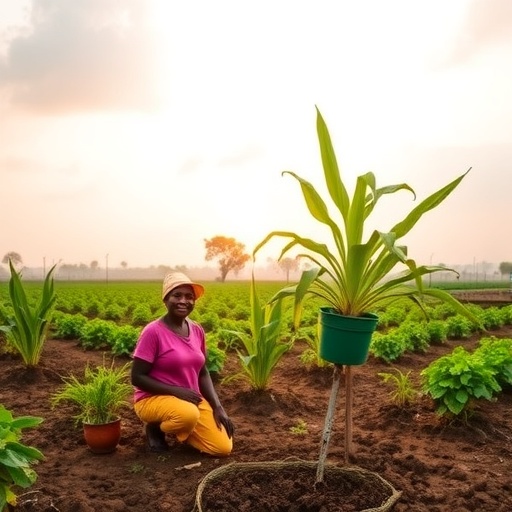
In recent years, the significance of climate resilience in agrifood systems has taken center stage, particularly within the context of Sub-Saharan Africa. With agricultural practices increasingly threatened by climate change, the need for adaptive strategies has never been more pressing. A groundbreaking study conducted by Chirombo and Pangapanga-Phiri highlights innovative governance structures and adaptive practices that can bolster value chains in agrifood systems across this vulnerable region. Their research, published in the journal Discover Sustainability, brings to light the critical intersection of governance, adaptive practices and climate resilience.
Sub-Saharan Africa is uniquely susceptible to climatic fluctuations, making it imperative for stakeholders—ranging from farmers to policymakers—to adopt flexible and resilient agrifood systems. The study emphasizes that conventional farming methods are no longer sufficient to withstand the adverse impacts of climate change, which can lead to decreased yields, food insecurity, and economic instability. By exploring adaptive practices, Chirombo and Pangapanga-Phiri underscore the potential for mitigating these impacts through informed governance.
The authors delineate specific adaptive practices that increase resilience, such as climate-smart agriculture and crop diversification. Climate-smart agriculture not only seeks to increase productivity but also aims to reduce greenhouse gas emissions and enhance the resilience of farming systems to climate change. Crop diversification, on the other hand, provides farmers with a safety net; by growing a variety of crops, they can buffer themselves against the failure of any single crop due to climatic stress.
Equally important, the governance structures that surround these adaptive practices play a crucial role in their effectiveness. Chirombo and Pangapanga-Phiri argue that local governance frameworks should be empowered to tailor these practices to their specific environmental and socio-economic contexts. This localized approach ensures that the strategies adopted reflect the unique challenges faced by each community, thereby increasing the likelihood of success.
Moreover, the study identifies the role of technology as a facilitator of both adaptation and governance. For instance, mobile technology can provide farmers with real-time weather updates and market information, enabling them to make better-informed decisions. In this way, the integration of technology into governance frameworks can significantly enhance the adaptability of agrifood systems to changing climatic conditions.
The research also highlights the importance of stakeholder engagement. Community involvement is essential in creating governance structures that are inclusive and representative of the diverse interests within agrifood systems. Chirombo and Pangapanga-Phiri advocate for participatory approaches, where local farmers, government officials, and NGOs collaborate to design and implement adaptive practices. This cooperation can mitigate opposition to change and promote shared ownership of the strategies developed.
The authors also note that financial mechanisms are pivotal for fostering climate-resilient agrifood systems. Access to credit and insurance can enable farmers to invest in adaptive technologies and practices. However, it is not enough to merely provide financial resources; the study suggests that capacity-building initiatives are necessary to ensure that farmers can effectively utilize these financial tools. Education on financial literacy can empower farmers to make informed choices and enhance their resilience.
Additionally, the policy landscape needs to evolve to support the proposed adaptive practices and governance structures. Chirombo and Pangapanga-Phiri suggest that national policies should be aligned with local needs and realities. Policymakers should take note of local climatic data and agronomic practices to design frameworks that provide supportive environments for adaptation. Long-term investments in infrastructure, such as irrigation systems, can fortify agrifood systems against the challenges posed by climate change.
The study does not shy away from the challenges that lie ahead. Chirombo and Pangapanga-Phiri acknowledge that while adaptive practices and effective governance can pave the way for resilience, systemic obstacles such as poverty and lack of access to resources remain significant hurdles. These socioeconomic factors can impede the implementation of adaptive practices, resulting in unequal access to the benefits of climate resilience.
Furthermore, the authors call for interdisciplinary approaches in research to tackle the complexities surrounding climate adaptation in agrifood systems. Collaboration between climatologists, agronomists, economists, and social scientists can yield more holistic solutions to the challenges posed by climate change. This interconnected approach will ensure that all facets of the issue are addressed, increasing the chances of achieving resilience.
The implications of this research extend beyond Sub-Saharan Africa; the insights gained could inform global discussions on climate resilience in agrifood systems. As climate change continues to pose a threat to food security worldwide, the findings of Chirombo and Pangapanga-Phiri’s work may inspire similar strategies in other vulnerable regions. The call for adaptive practices and enhanced governance structures resonates with global efforts to combat climate change and promote sustainable development.
In conclusion, the study presents an urgent plea for action. It underscores that building climate-resilient agrifood systems in Sub-Saharan Africa is not a choice but a necessity. As the impacts of climate change become increasingly pronounced, efforts must be intensified to adapt agricultural practices and governance structures. By empowering local communities and integrating technology and finance into adaptive strategies, stakeholders can work together to create a sustainable and resilient future for agrifood systems.
The findings of Chirombo and Pangapanga-Phiri are an invitation to rethink how we face the climate crisis, urging us to embrace innovative solutions that prioritize resilience and sustainability within agricultural systems.
Chirombo, B.F., Pangapanga-Phiri, I. Adaptive practices and governance structures for building climate resilient agrifood systems value chains in Sub-Saharan Africa. Discov Sustain 6, 879 (2025). https://doi.org/10.1007/s43621-025-01837-y
Cite Scienmag News
Sloane Callahan. (August 26, 2025). Enhancing Climate Resilience in Sub-Saharan Agrifood Systems. Scienmag. https://scienmag.com/enhancing-climate-resilience-in-sub-saharan-agrifood-systems/
Sloane Callahan. "Enhancing Climate Resilience in Sub-Saharan Agrifood Systems." Scienmag, 26 August 2025, https://scienmag.com/enhancing-climate-resilience-in-sub-saharan-agrifood-systems/. Accessed 3 September 2026.
Sloane Callahan. "Enhancing Climate Resilience in Sub-Saharan Agrifood Systems." Scienmag. August 26, 2025. https://scienmag.com/enhancing-climate-resilience-in-sub-saharan-agrifood-systems/


