


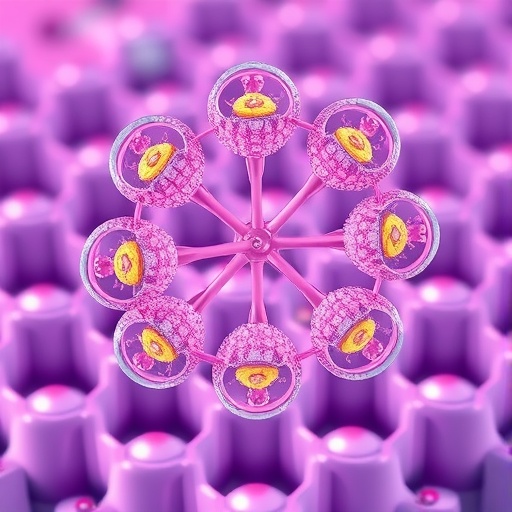
In the ongoing quest for advanced energy storage solutions, researchers have turned their attention towards nanomaterials that offer enhanced performance and efficiency. Among these promising candidates, the Eu-doped NiCo₂O₄ nanoflower electrode materials have captured significant interest due to their unique properties and potential applications in supercapacitors. The recent research conducted by Pu and Ma delves into the design and construction of these materials, shedding light on their capacitive performance and paving the way for future innovations in energy technology.
At the heart of this research lies the synthesis of Eu-doped NiCo₂O₄ nanoflowers, which involves a meticulous approach to material fabrication. The distinct structural characteristics of these nanoflowers significantly influence their electrochemical behavior. By incorporating europium (Eu), a rare earth element, the researchers aimed to enhance the electronic and ionic conductivity within the NiCo₂O₄ structure. This modification not only alters the chemical environment but also improves the material’s overall electrochemical performance, making it a contender for high-efficiency energy storage applications.
The process of creating these nanoflower structures is intricate and demands precision. Utilizing techniques such as hydrothermal synthesis, the researchers are able to construct hierarchical nanostructures that maximize surface area. Larger surface areas lead to greater interaction with electrolytes, a critical factor in energy storage devices like supercapacitors. The unique morphology of the nanoflowers provides multiple pathways for ion transport, facilitating rapid charge-discharge cycles that are essential for efficient energy storage.
Furthermore, the doping of Eu into the NiCo₂O₄ crystal lattice modifies the electronic structure of the material. This modification is crucial, as it can result in improved charge storage capabilities. The presence of Eu ions creates localized states within the band structure, allowing for enhanced charge transfer and reduced energy barriers during the electrochemical processes. Consequently, the doped materials exhibit superior specific capacitance compared to their undoped counterparts, marking a significant advancement in the field of material science.
Experimental evaluations reveal that the Eu-doped NiCo₂O₄ nanoflower electrodes exhibit a remarkable increase in specific capacitance measurements. In laboratory conditions, these electrodes have demonstrated capacitance values that far exceed those of traditional electrode materials. This achievement not only demonstrates the potential of these nanoflowers in supercapacitor applications but also sets a benchmark for future research into novel electrode materials.
Moreover, the stability and longevity of these electrode materials are paramount for practical applications. The study by Pu and Ma emphasizes the cycle stability of the Eu-doped NiCo₂O₄ nanoflowers under continuous charging and discharging conditions. Remarkably, the materials maintained their high capacitance over extended cycles, indicating that they are not only effective energy storage solutions but also durable enough for real-world applications. This aspect is particularly essential as researchers seek to develop supercapacitors that are not only efficient but also reliable and long-lasting.
In addition to electrochemical performance, the researchers conducted thorough analysis on the thermal properties of Eu-doped NiCo₂O₄ nanoflowers. Understanding how these materials behave under different thermal conditions is critical, given that supercapacitors often operate in various environments. The findings indicate that the doped materials exhibit enhanced thermal stability, further reinforcing their suitability for energy storage applications under diverse operational conditions.
The implications of this research extend beyond immediate applications in supercapacitors. The methodology established for synthesizing Eu-doped NiCo₂O₄ nanoflowers can serve as a template for developing other advanced materials with tailored properties for various applications in electronics and energy storage systems. This adaptability is crucial as the demand for innovative energy solutions continues to grow, especially as we transition towards renewable energy sources.
Furthermore, the broader impact of this research could influence the future of energy storage devices significantly. With the potential to develop more efficient and compact energy storage systems, this technological advancement aligns with the world’s pressing needs for sustainable energy solutions. As industries strive to reduce their carbon footprints and enhance energy efficiency, innovations such as Eu-doped nanoflowers may play an integral role in achieving these goals.
The collaboration between material scientists and researchers from other disciplines is vital in pushing the boundaries of what is possible in energy storage. The cross-disciplinary nature of this research reflects a shift in how we approach material development, emphasizing the importance of integrating multiple fields of science to drive innovation. This fusion not only broadens the scope of investigation but also enhances the potential for groundbreaking discoveries that can revolutionize energy technology.
As this research continues to evolve, the importance of disseminating findings through scientific publications cannot be overstated. Sharing knowledge and advancements within the global scientific community fosters collaboration and accelerates the pace of innovation. The publication by Pu and Ma will undoubtedly contribute to the growing body of knowledge surrounding nanomaterials and their applications in energy storage.
In conclusion, the investigation into the design and construction of Eu-doped NiCo₂O₄ nanoflower electrode materials presents a significant breakthrough in the field of electrochemistry and energy storage. With their enhanced capacitive performance and robust stability, these materials symbolize a promising direction for the development of next-generation supercapacitors. As researchers continue to explore and refine these innovations, the potential for more efficient and sustainable energy storage solutions becomes increasingly attainable.
This study underscores the importance of interdisciplinary research and the need for continued investment in advanced materials science. As we move forward, it is evident that strategies like doping and nanostructuring will play critical roles in the relentless pursuit of efficient energy solutions that can meet the demands of an ever-changing world.
Pu, H., Ma, J. Research on the design and construction of Eu-doped NiCo2O4 nanoflower electrode materials and the enhancement of capacitive performance.
Ionics (2025). https://doi.org/10.1007/s11581-025-06788-y
Cite Scienmag News
Denise Maddox. (October 28, 2025). Enhancing Capacitive Performance of Eu-Doped NiCo2O4 Nanoflowers. Scienmag. https://scienmag.com/enhancing-capacitive-performance-of-eu-doped-nico2o4-nanoflowers/
Denise Maddox. "Enhancing Capacitive Performance of Eu-Doped NiCo2O4 Nanoflowers." Scienmag, 28 October 2025, https://scienmag.com/enhancing-capacitive-performance-of-eu-doped-nico2o4-nanoflowers/. Accessed 3 September 2026.
Denise Maddox. "Enhancing Capacitive Performance of Eu-Doped NiCo2O4 Nanoflowers." Scienmag. October 28, 2025. https://scienmag.com/enhancing-capacitive-performance-of-eu-doped-nico2o4-nanoflowers/


