

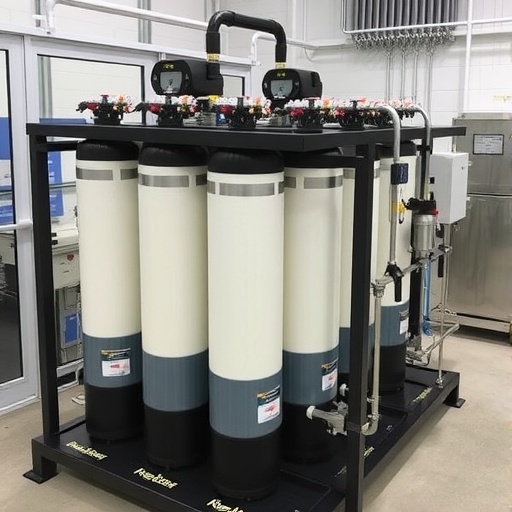
Researchers around the globe are constantly exploring innovative approaches to improve wastewater treatment technologies. In this quest, a new study led by Y.O. Demiral and his colleagues focuses on a pioneering method that integrates forward osmosis (FO) with granular anaerobic membrane bioreactors (AnMBRs). This potentially transformative approach aims to enhance filterability and significantly reduce mass transfer limitations, addressing key challenges faced in conventional wastewater treatment processes.
Forward osmosis is an intriguing technique that leverages osmotic pressure differentials to draw water through a semi-permeable membrane. Unlike traditional reverse osmosis, which requires significant energy consumption to push water against osmotic pressure, forward osmosis operates more efficiently by allowing water to naturally flow from a low-solute concentration side to a higher solute concentration side. This process not only reduces energy inputs but also mitigates fouling, a persistent issue in membrane technologies that can curb their effectiveness.
The integration of forward osmosis with granular anaerobic membrane bioreactors offers a dual benefit: enhancing filtration efficiency while allowing for superior nutrient recovery. By utilizing granular sludge, in contrast to traditional suspended sludge, the bioreactor achieves better settling characteristics. This evolution in design not only streamlines the separation of treated water from solid waste but also creates opportunities for reusing a nutrient-rich effluent that can be repurposed for agricultural or industrial applications.
One of the most significant advantages of this hybrid system is its ability to support higher organic loading rates without compromising operational stability. In centralized wastewater treatment facilities, often plagued by fluctuations in flow rates and compositions, such resilience is invaluable. The study indicates that by harnessing both the osmotic potential of forward osmosis and the metabolic capabilities of granular anaerobic digestion, operators can maintain more stable treatment conditions even under a wide range of influent characteristics.
Moreover, the granular nature of the anaerobic bioreactor facilitates the retention of active microbial communities that are proficient at breaking down organic matter. This is not just advantageous in terms of treatment rates; it also enhances biogas production, a critical component of energy recovery in wastewater treatment. Captured biogas can be harnessed for heat and electricity, further offsetting operational costs and improving the carbon footprint of wastewater treatment facilities.
The research team conducted a series of laboratory-scale experiments that showcased the viability of their forward osmosis-integrated AnMBR setup. The results revealed promising trends, with an observed increase in filterability—a reduction in membrane fouling—compared to conventional AnMBR configurations. By strategically positioning the forward osmosis process upstream of the membrane bioreactor, the team demonstrated the potential for improved water permeability and lower transmembrane pressure, creating a more favorable treatment environment.
In addition to operational enhancements, this innovative integration also addresses the pressing issue of nutrient pollution. With increasing concerns about nitrogen and phosphorus loads entering water bodies, mechanisms that can recover and recycle these nutrients are crucial. Integrated systems like the one proposed by Demiral and his team can serve as a model for circular economy principles, where treated wastewater not only meets regulatory standards but also feeds back into the agricultural cycle, reducing the need for synthetic fertilizers.
The implications of this research extend well beyond the laboratory. With urban areas facing unprecedented challenges in managing wastewater due to growing populations and climate variability, scalable solutions are essential. The findings suggest that wider implementations of FO-integrated AnMBR technology could transform the landscape of urban wastewater treatment, making it more sustainable and resilient.
Despite the promise shown by this new technology, there remain hurdles to overcome before it can transition from experimental to widespread application. Researchers highlight the need for systematic scalability studies, cost-benefit analyses, and in-field trials to establish economic viability. They also stress the importance of stakeholder engagement to ensure that any new systems are compatible with existing infrastructure and regulatory frameworks, streamlining adoption in real-world scenarios.
As more municipalities look to mitigate the impacts of climate change and overhaul outdated treatment systems, innovations like this could play a vital role. By emphasizing resilience and resource recovery, forward osmosis-integrated granular anaerobic MBR technology stands at the forefront of the next generation of wastewater management solutions. The hope is that as these technologies mature, they will provide cities with not just a method of treating wastewater, but a transformational approach to handling one of their most challenging environmental issues.
The world is watching as researchers like Demiral, Ayol, and Lesage pioneer advanced methodologies that could redefine wastewater treatment. With continued research and collaboration, the future of clean water management could be more sustainable, efficient, and adaptable—ensuring that urban centers continue to thrive even in the face of environmental challenges.
The findings of this study are sure to stir interest across academic and industrial sectors alike, as the balance between resource recovery and operational efficiency becomes crucial for sustainable practices. The marriage of forward osmosis and anaerobic processes reflects a broader trend of integrating innovative technologies to create comprehensive solutions to complex environmental problems. As industry leaders and policy makers digest these findings, the potential for a paradigm shift in wastewater management practices may be within reach.
This advancement is not merely an academic exercise; it has real-world implications. Wastewater treatment facilities can become hubs of innovation, energy production, and sustainability by adopting integrated technologies like the FO-AnMBR system. Ultimately, continued research and advocacy are needed to promote the adoption of such technologies worldwide, paving the way for a future where wastewater is no longer viewed as a burden, but as a valuable resource.
Subject of Research: Forward osmosis-integrated granular anaerobic membrane bioreactor technology for wastewater treatment enhancement.
Article Title: Forward osmosis-integrated granular anaerobic MBR: enhancing filterability and reducing mass transfer limitations.
Article References:
Demiral, Y.O., Ayol, A., Lesage, G. et al. Forward osmosis-integrated granular anaerobic MBR: enhancing filterability and reducing mass transfer limitations.
Environ Sci Pollut Res (2025). https://doi.org/10.1007/s11356-025-37324-0
Image Credits: AI Generated
DOI: https://doi.org/10.1007/s11356-025-37324-0
Keywords: wastewater treatment, forward osmosis, anaerobic membrane bioreactor, filterability, mass transfer limitations, sustainability, nutrient recovery, biogas production.


