

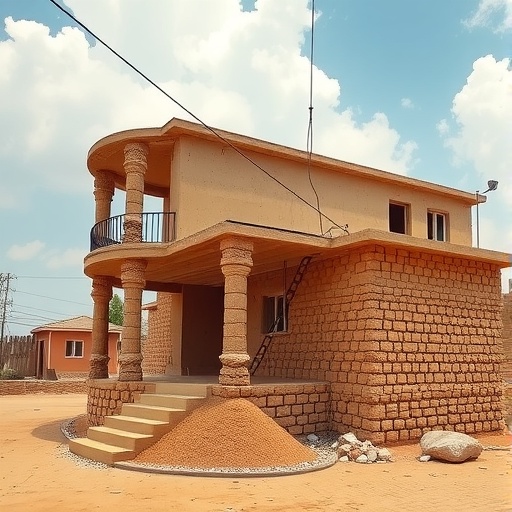
In a groundbreaking study poised to transform the landscape of sustainable construction materials, researchers have delved into the potential of enhancing Agbani clay, a commonly found natural resource, by incorporating granite. This innovative approach not only seeks to improve the mechanical properties of the clay but also aims to evaluate its environmental impact and potential toxicity for broader applications in building services. The implications of this research are significant, considering the ongoing global push toward eco-friendly construction practices.
Agbani clay, known for its plasticity and availability, has been widely used in traditional building practices. However, its mechanical performance—particularly in terms of strength and durability—has generally been viewed as a limitation in its application for modern construction standards. The introduction of granite, a hard and versatile igneous rock, may offer a solution to this challenge. By integrating granite into Agbani clay, the researchers hope to elevate the material’s structural integrity, thereby enhancing its performance in various building applications.
The synergy between Agbani clay and granite raises intriguing possibilities. Granite’s well-documented hardness and resistance to weathering could complement the inherent properties of Agbani clay, resulting in a composite material that possesses not only enhanced strength properties but also improved longevity in construction applications. The study meticulously characterizes the mechanical properties of this composite, aiming to establish a new benchmark for sustainable building materials.
In addition to physical properties, understanding the toxicity of construction materials is of paramount importance in today’s building industry. The researchers have systematically analyzed the leachates from the Agbani clay-granite composite, assessing their chemical composition and potential environmental hazards. By evaluating these leachates, the team is addressing a critical component of environmental sustainability: the potential for contaminants to seep into soil and water systems, impacting ecosystems and human health.
As the construction industry continues to evolve with heightened awareness of environmental challenges, innovative approaches to material science become even more crucial. Strengthening Agbani clay with granite not only leverages local resources but also aligns with global sustainability goals. This research exemplifies how traditional materials can be reinvigorated through modern scientific techniques and technologies.
Moreover, the study highlights the importance of local material utilization in promoting sustainability. By enhancing Agbani clay for construction, the researchers advocate for a reduced carbon footprint associated with transporting building materials over long distances. Consequently, this approach supports local economies while addressing the larger concerns of resource depletion and environmental degradation often linked to conventional construction practices.
The research also emphasizes the balance between material performance and environmental safety. Through precise characterization of both the mechanical and toxicological properties of the Agbani clay-granite mixture, the team offers a well-rounded perspective on material viability for construction. This dual focus is critical as the industry grapples with the complexities of regulatory requirements and consumer demand for eco-conscious building solutions.
In exploring long-termed effects, the implications of using a granite-clay composite extend into future maintenance and lifecycle assessments of buildings. By selecting materials that demonstrate durability and reduced environmental risks, the construction industry can shift towards more resilient structures. This research contributes valuable data to guide architects, engineers, and policymakers in making informed choices about sustainable materials.
The authors also reflect on potential challenges in scaling up the production and application of this composite material. While laboratory results are promising, ensuring consistent quality and performance in field applications will require further investigation. Additionally, addressing community perceptions and gaining acceptance for new materials is a vital component of integrating innovations into mainstream construction practice.
As the study progresses, collaborative efforts involving stakeholders from academia, industry, and government will be essential. Engaging with construction professionals, environmental scientists, and local communities could facilitate broader adoption of the reinforced Agbani clay. Workshops, seminars, and outreach initiatives can play a pivotal role in raising awareness about the benefits and practical applications of this innovative material.
Furthermore, the success of this research could pave the way for similar studies in other regions, where local materials can be enhanced using locally available natural resources. This paradigm shift towards localized, sustainable building materials can contribute to reduced environmental impacts while fostering community resilience and self-sufficiency.
In conclusion, the findings from this research provide a hopeful outlook towards developing an innovative and sustainable building material. The integration of granite into Agbani clay not only enhances the material properties but also aligns with the growing need for environmentally friendly solutions in construction. As the construction industry increasingly prioritizes sustainability, this study could serve as a critical benchmark for future developments in eco-conscious building practices.
Ultimately, as documented in this groundbreaking research, the combination of Agbani clay and granite represents a significant step towards reimagining construction materials in an age defined by sustainability, local resource utilization, and environmental stewardship. The road ahead may hold many challenges, but it is clear that innovative solutions like this could shape the future of building services, driving the industry toward a greener, more responsible tomorrow.
Subject of Research: Strengthening of Agbani clay with granite for building services applications.
Article Title: Strengthening of Agbani clay with granite and characterization of its properties and toxicity for applications in building services.
Article References:
Egole, C.P., Chinonso, O.U., Onuoha, C. et al. Strengthening of Agbani clay with granite and characterization of its properties and toxicity for applications in building services.
Environ Sci Pollut Res (2026). https://doi.org/10.1007/s11356-025-37372-6
Image Credits: AI Generated
DOI: https://doi.org/10.1007/s11356-025-37372-6
Keywords: Sustainable construction, Agbani clay, granite, mechanical properties, toxicity assessment, building materials.


