


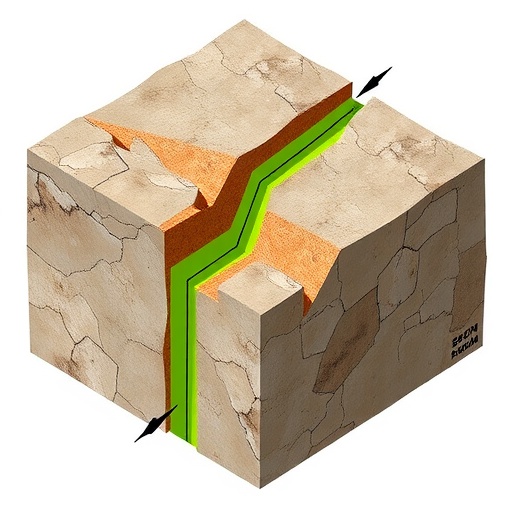
A groundbreaking advancement in the field of rock mechanics has emerged with the introduction of a modified Barton-Bandis normal closure model designed explicitly for infilled rock joints, as presented by Li, Zhu, and Xiao in their recent 2025 publication in Environmental Earth Sciences. This novel approach offers a more accurate and realistic representation of the mechanical behavior of rock joints that are partially or fully filled with infill materials, a scenario commonly encountered in natural and engineered rock masses. Such progress is poised to reshape how geotechnical engineers, mining professionals, and earth scientists predict and manage the stability and deformation of rock structures.
Rock joints—natural fractures or separations in rock masses—play a crucial role in the mechanical behavior of rock formations. Their presence dictates pathways for fluid flow, influences overall rock strength, and triggers deformation processes under stress. Infilled rock joints, where the voids between rock surfaces have been partially or fully filled with softer materials such as clay, silt, or mineral precipitates, present an added layer of complexity. Historically, modeling the mechanical response to loading in these systems has lagged behind due to the challenging interplay between stiff rock surfaces and compliant infill.
The Barton-Bandis model, established decades ago, has long served as a foundation for describing the normal closure behavior of rock joints under increasing stress. However, its traditional form is best suited for clean, unfilled joints and tends to oversimplify or misrepresent the behavior when infill materials modify the joint’s response. Li and colleagues’ modification of this classic model addresses these shortcomings head-on, improving the predictive capabilities for scenarios where joints are filled with distinct materials of varying stiffness and thickness.
At the core of their methodology is a comprehensive integration of experimental data and theoretical recalibration. Through extensive laboratory testing, including direct loading and closure experiments on rock samples with artificially introduced infill layers, the researchers gathered critical insights into how these infill materials compress and deform under normal stresses. These empirical observations informed the refinement of the Barton-Bandis parameters, enabling the model to account directly for the mechanical properties and thickness of the infill materials as integral components of the closure behavior.
One transformative feature of the modified model lies in its ability to separate the contributions of rock asperities — the microscopic irregularities on rock joint surfaces — and infill layers in governing normal displacement. Traditional models often conflated these effects due to a lack of experimental isolation. By introducing parameters specific to infill compressibility and thickness, the revised model encapsulates the layered nature of joint behavior, where rock asperity deformation and infill layer compaction respond differently to stress increments.
This nuanced distinction has immediate practical implications. In engineering projects such as tunneling, slope stabilization, and foundation design, the presence and condition of infilled joints directly influence predictions concerning deformation regimes and strength reduction. The modified Barton-Bandis model enables engineers to better estimate the normal closure and thus the potential permeability or shear strength reduction arising from joint compression, factors critical to design safety margins and long-term performance assessments.
Moreover, this research carries substantial relevance for hydrogeological modeling and environmental assessments. Fluid migration pathways are often controlled by the aperture and closure of rock joints, which are themselves functions of the mechanical interaction between rock surfaces and infill. Accurately predicting joint closure under varying stress states allows for improved groundwater flow simulations and contaminant transport predictions, especially in fractured rock aquifers or waste repository sites.
In terms of methodological innovation, the authors applied a deterministic approach blending mechanical testing results with advanced curve-fitting algorithms to calibrate the model parameters effectively. Unlike prior heuristic or semi-empirical methods, this calibrated procedure enhances repeatability and reliability across different rock types and infill compositions, ranging from soft clay to cemented minerals.
The paper also discusses limitations of previous modeling efforts where infill layers were simplistically treated as homogeneous entities or where their shear behavior was underestimated. The modified model explicitly links normal closure behavior to infill mechanical characteristics, such as elasticity and plasticity, allowing for more accurate coupling with shear behavior models in subsequent analyses.
Beyond theoretical refinement, the study demonstrates the model’s application in case studies involving sandstone and shale joint systems with diverse infill materials sampled from natural outcrops and tunnel boring sites. The comparisons reveal that the modified Barton-Bandis model reduces prediction errors of normal displacement by over 30% when compared to classical formulations, a significant leap in model fidelity.
Li, Zhu, and Xiao also acknowledge future directions that include extending the model to three-dimensional joint network simulations, thereby capturing the scale effects and spatial variability inherent in natural rock masses. Such advancements would augment the current model’s capacity to serve as a fundamental subroutine within numerical geomechanical software packages, enhancing large-scale stability analyses.
The scientific community has lauded the study for its meticulous blend of experimental rigor and theoretical insight. Its publication in Environmental Earth Sciences underlines the multidisciplinary implications of the work, joining the domains of rock mechanics, hydrogeology, and environmental engineering through improved understanding of rock joint behavior under load.
In conclusion, this modified Barton-Bandis normal closure model for infilled rock joints stands as a critical development in rock mechanics modeling. Its capacity to incorporate the mechanical effects of diverse infill materials into normal closure predictions promises to advance the precision of engineering designs and geological assessments alike. As infrastructure projects push into increasingly complex geological settings, having reliable and experimentally backed models such as this is indispensable.
The innovation by Li and colleagues is certain to spark further research into coupled mechanical-hydraulic processes in fractured rock systems, with potential extrapolations into earthquake engineering and resource extraction sectors. Its publication marks a seminal moment in the continuous quest to bridge the gap between laboratory insight and field-scale applications in earth sciences.
Li, X., Zhu, B. & Xiao, W. A modified Barton-Bandis normal closure model for infilled rock joint. Environ Earth Sci 84, 403 (2025). https://doi.org/10.1007/s12665-025-12405-y
Cite Scienmag News
Violet Maxwell. (July 5, 2025). Enhanced Barton-Bandis Model for Infilled Rock Joints. Scienmag. https://scienmag.com/enhanced-barton-bandis-model-for-infilled-rock-joints/
Violet Maxwell. "Enhanced Barton-Bandis Model for Infilled Rock Joints." Scienmag, 5 July 2025, https://scienmag.com/enhanced-barton-bandis-model-for-infilled-rock-joints/. Accessed 4 September 2026.
Violet Maxwell. "Enhanced Barton-Bandis Model for Infilled Rock Joints." Scienmag. July 5, 2025. https://scienmag.com/enhanced-barton-bandis-model-for-infilled-rock-joints/


