


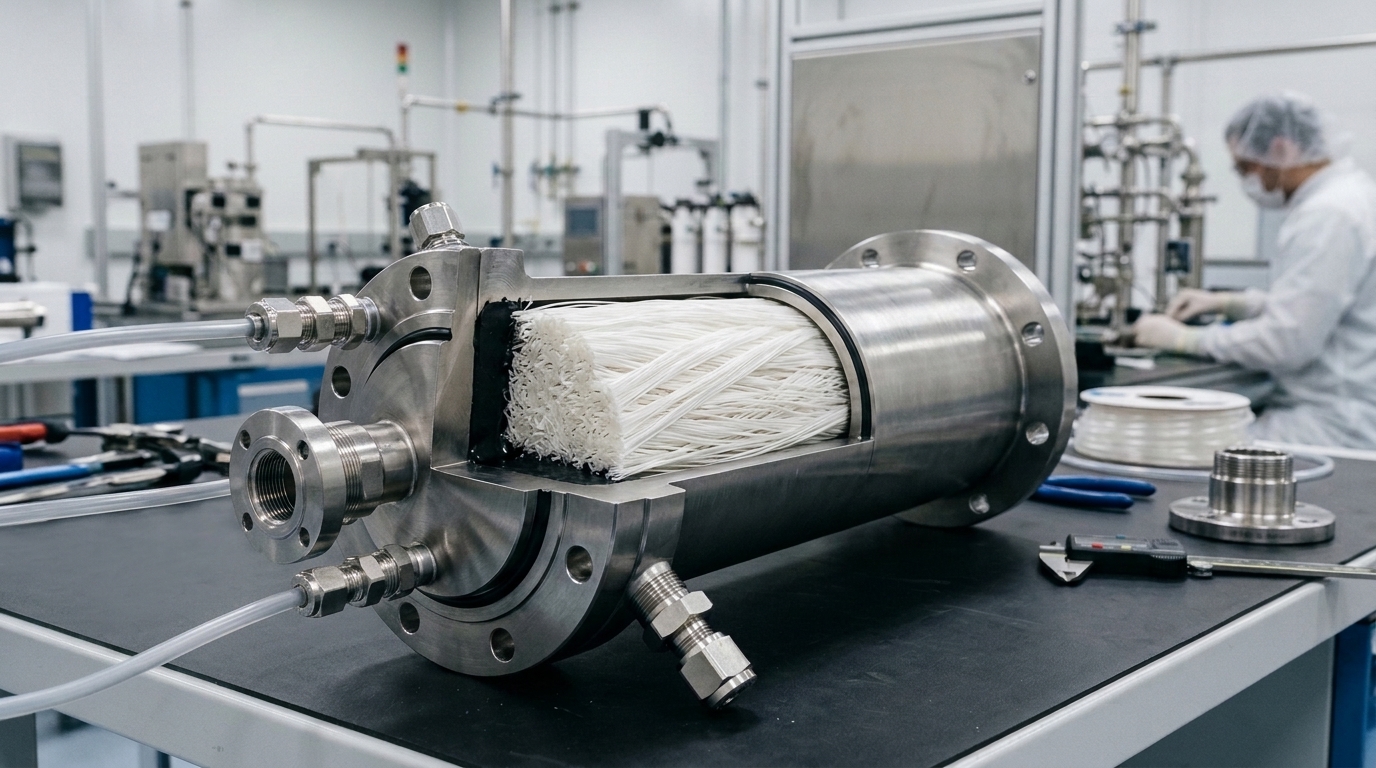
A critical engineering review evaluating polymer-blend and metal-organic framework mixed-matrix membranes indicates that simply maximizing porous filler concentration fails to deliver superior hydrogen and carbon dioxide separation. Conducted by chemical engineering researchers Ahmed Salah Al-Shati, Thamer J. Mohammed, and Ammar Abdulkadhim, the investigation demonstrates that genuine performance gains in pre-combustion hydrogen purification depend fundamentally on microstructural interface control, ultrathin selective layers, rigorous mixed-gas benchmarking, and operational durability under elevated pressures and temperatures. Unlike descriptive literature surveys that conflate separation metrics across unrelated gas pairs, this comprehensive analysis isolates direct hydrogen and carbon dioxide experimental data from legacy gas pairings. The findings emphasize that while mixed-matrix architectures integrate polymer processability with the precise sorption and molecular sieving capabilities of crystalline fillers, unengineered filler addition triggers particle agglomeration, interphase voids, and selective pathway deterioration. Consequently, advancing membrane systems toward viable deployment requires aligning nanoscale transport phenomena with pilot-scale module hydrodynamics and rigorous economic realities.
Industrial hydrogen production relies heavily on steam methane reforming, coal gasification, and biomass conversion, streams in which hydrogen and carbon dioxide are routinely generated together. Purifying this hydrogen feed is essential for fuel cell operation to prevent catalyst poisoning, as well as for downstream petroleum hydroprocessing and ammonia manufacturing. Existing commercial separation relies on three conventional approaches, each constrained by notable operational trade-offs. Pressure swing adsorption selectively captures contaminants including carbon dioxide, methane, carbon monoxide, and nitrogen at elevated operating pressures and desorbs them upon pressure reduction; although producing high-purity hydrogen, it demands complex equipment and high capital expenditure. Cryogenic distillation exploits thermodynamic boiling point differentials between hydrogen at minus 252.8 degrees Celsius and carbon dioxide at minus 78.5 degrees Celsius to liquefy carbon dioxide, yet demands extensive refrigeration energy. Chemical absorption utilizing regenerable amine solvents efficiently strips carbon dioxide but incurs severe thermal regeneration penalties alongside equipment corrosion risks. Membrane separation has emerged as an attractive alternative, offering significant energy efficiency, simplified operation, and lower capital requirements.
Separating hydrogen from carbon dioxide remains an extraordinary transport challenge because both molecular species possess remarkably comparable kinetic dimensions. Hydrogen features a kinetic diameter of 2.9 angstroms, whereas carbon dioxide measures 3.3 angstroms. Hydrogen molecules diffuse through polymer matrices rapidly due to their compact size, enabling kinetic-driven size discrimination. Conversely, carbon dioxide displays pronounced condensability, higher solubility, and strong electrostatic affinity toward polar functional groups within polymer backbones and metal-organic frameworks. This physical divergence determines whether a membrane operates as hydrogen-selective via diffusivity dominance or carbon dioxide-selective via solubility dominance. Furthermore, the review clarifies that established Robeson upper bounds governing the permeability-selectivity trade-off are strictly gas-pair-specific and temperature-dependent. Data obtained from carbon dioxide and methane or carbon dioxide and nitrogen mixtures cannot validate hydrogen and carbon dioxide performance claims, as competitive sorption dynamics, kinetic diameter ratios, and operating envelopes differ fundamentally among these feeds.
Gas transport across dense polymeric films obeys the classical solution-diffusion mechanism, wherein permeability equals the mathematical product of diffusivity and solubility. Ideal permselectivity decomposes into diffusivity selectivity and solubility selectivity. However, evaluating membranes exclusively with idealized single gases severely misrepresents real-world syngas separation. Under realistic mixed feeds, elevated carbon dioxide partial pressures introduce competitive sorption within free-volume elements and framework cavities, which directly suppresses hydrogen transport. Simultaneously, high carbon dioxide activity induces matrix swelling and plasticization, increasing polymer segmental mobility and degrading size-sieving selectivity. The researchers stress that intrinsic material permeability represents merely a single resistance within complete transport pathways. In thin-film composite and hollow-fiber architectures, porous support resistances, boundary-layer concentration polarization, localized structural defects, and feed hydrodynamics dictate observed permeance, necessitating rigorous testing under high-temperature, high-pressure mixed feeds over extended durations.
When pure molecular sieving materials are employed, gas exclusion operates entirely through defined microporous channels narrower than two nanometers, where gas passage is governed directionally by geometric aperture constraints rather than random chain motion. Conventional dense polymers struggle with the inverse permeability-selectivity relationship; rubbery polyether-block-amide matrices exhibit high carbon dioxide solubility through polar ether segments for facilitated transport, whereas glassy polyimides and polymers of intrinsic microporosity provide rigid size-sieving selectivity. Carbon dioxide pressures exceeding 35 bar trigger destructive plasticization, while real syngas contaminants such as moisture, sulfur oxides, nitrogen oxides, and particulates induce accelerated aging. Furthermore, manufacturing polysulfone presents severe environmental hurdles, including toxic solvents like n-methyl pyrrolidone, non-biodegradability, and microplastic disposal concerns.
Polyetherimide offers an exceptional alternative matrix for high-temperature syngas processing and pre-combustion capture owing to its rigid aromatic architecture and elevated glass transition temperature. The molecular backbone of polyetherimide incorporates phthalimide oxygen bonds, a spiro-isopropylidenedianiline moiety, and bridging dianiline rings. The non-coplanar spiro center permits rotational freedom up to 90 degrees, disrupting tight polymer chain packing, reducing crystallinity, and expanding the fractional free volume without forfeiting structural rigidity. Commercial polyetherimide formulations, including Matrimid and Ultem, exhibit reliable processing repeatability and thermal resistance. Multilayer tubular polyetherimide membranes prepared via precision dip-coating and multilayer deposition demonstrate exceptional permeance to hydrogen and carbon dioxide alongside dependable permselectivity between 20 and 80 for secondary gas pairs. Composite membrane configurations minimize selective layer thickness over porous polysulfone or polyethersulfone substrates, maximizing trans-membrane gas flux. Nevertheless, precision fabrication techniques such as spin-coating and interfacial polymerization are mandatory to avoid pinholes, compaction under operational pressure, and non-selective interfacial voids.
Mixed-matrix membranes incorporate porous inorganic or metal-organic framework fillers into continuous polymeric matrices to surpass conventional upper bounds by pairing polymeric ductility with molecular-sieving precision. Frameworks such as the zeolitic imidazolate framework family, particularly zeolitic imidazolate framework-8, provide targeted aperture windows and thermal endurance; Universitetet i Oslo frameworks supply high chemical stability; and Materials of Institute Lavoisier structures deliver tunable pore chemistry. Quantitative assessments compiled in the review confirm that interfacial engineering is far more decisive than filler loading alone. For example, hollow fibers blending zeolitic imidazolate framework-8 with polybenzimidazole demonstrated a hydrogen permeance increase from 65 to 107 gas permeation units at 150 degrees Celsius and 7 bar while preserving an ideal hydrogen-to-carbon-dioxide selectivity of approximately 18. Nevertheless, this permeance advantage diminished under elevated mixed-gas pressures due to competitive carbon dioxide adsorption, proving that pure-gas assessments routinely overestimate separation efficiency under industrial conditions.
Additional quantitative benchmarks demonstrate the efficacy of nanoscale interfacial engineering over raw loading volume. Thermally annealed Matrimid membranes incorporating 30 weight percent high-aspect-ratio zeolitic imidazolate framework-8 nanoplates achieved a notable hydrogen permeability of 330.1 Barrer with a hydrogen-to-carbon-dioxide selectivity of 10.3, proving that high filler loadings remain viable only when particle morphology and interfacial contact are tightly managed. Similarly, crosslinking ten weight percent zeolitic imidazolate framework-8 within polybenzimidazole using phosphoric acid treatment at 150 degrees Celsius elevated hydrogen permeability from 39.97 to 98.36 Barrer, simultaneously boosting mixed-gas selectivity from 4.6 to 8.9. Extended operational trials over approximately 51 days on zeolitic imidazolate framework-8 and polybenzimidazole hollow fibers at 200 degrees Celsius sustained hydrogen permeance between 22 and 47 gas permeation units and selectivity between 22 and 32. These datasets illustrate that surface functionalization, polymer chain crosslinking, and controlled crystal aspect ratios prevent the interfacial dewetting, non-selective voiding, and particle agglomeration that plague unoptimized composites.
To interpret transport behavior, effective-medium models are frequently applied to estimate permeability trends across mixed-matrix systems. The classic Maxwell formulation models dilute, non-interacting spherical particles dispersed evenly within an ideal, defect-free continuous matrix, but fails when filler loadings increase. The Bruggeman model refines this approach for higher concentrations by incorporating particle connectivity and tortuous diffusion pathways, yet remains idealized regarding interfacial wetting. The Lewis-Nielsen model improves prediction accuracy for irregular MOF morphologies by integrating filler geometry and a maximum packing fraction parameter commonly assigned a value of 0.64. The Pal model captures particle-particle interactions at moderate-to-high filler loadings. The authors emphasize that systematic deviations between model predictions and experimental measurements serve as diagnostic indicators of real-world structural non-idealities, including particle clustering, polymer rigidification, pore blockage, and interfacial void formation, rather than invalidating the physical principles of effective-medium theory.
Translating laboratory membranes into industrial pre-combustion hardware requires computational fluid dynamics linked with rigorous techno-economic assessments. Computational fluid dynamics bridges material-level permeability with module-scale hydrodynamics by coupling generalized mass conservation and Navier-Stokes momentum equations with species-permeance boundary conditions. This modeling resolves critical macroscopic transport phenomena, including axial pressure drop, shell-and-tube flow maldistribution, feed depletion, thermal gradients, and concentration polarization across flat-sheet and hollow-fiber modules. As a result, hybrid membrane-adsorption or membrane-solvent systems represent the most viable near-term deployment configurations. Future research must prioritize standardized mixed-gas benchmarking, long-term plasticization testing over multiple months, scalable hollow-fiber spinning, and computational fluid dynamics validated against pilot-scale operational data.
Subject of Research: Mixed-matrix membrane technologies and interfacial transport mechanisms for hydrogen and carbon dioxide separation
Article Title: Recent advances in polymer blend and metal-organic framework-based mixed matrix membranes for H2/CO2 separation
Article References: Al-Shati, A. S., Mohammed, T. J., & Abdulkadhim, A. (2026). Recent advances in polymer blend and metal-organic framework-based mixed matrix membranes for H2/CO2 separation. Frontiers in Chemical Engineering, 8, Article 1955594. https://doi.org/10.3389/fceng.2026.1955594
Image Credits: AI Generated
DOI: 10.3389/fceng.2026.1955594
Keywords: mixed-matrix membranes, hydrogen purification, gas separation, metal-organic frameworks, carbon capture, polymeric membranes, computational fluid dynamics, permeability modeling, Recent, advances, polymer, blend
Cite Scienmag News
Audrey Campbell. (November 6, 2026). Engineered Interfaces and Module Design Drive Advanced Mixed-Matrix Hydrogen Separation. Scienmag. https://scienmag.com/engineered-interfaces-and-module-design-drive-advanced-mixed-matrix-hydrogen-separation/
Audrey Campbell. "Engineered Interfaces and Module Design Drive Advanced Mixed-Matrix Hydrogen Separation." Scienmag, 6 November 2026, https://scienmag.com/engineered-interfaces-and-module-design-drive-advanced-mixed-matrix-hydrogen-separation/. Accessed 6 November 2026.
Audrey Campbell. "Engineered Interfaces and Module Design Drive Advanced Mixed-Matrix Hydrogen Separation." Scienmag. November 6, 2026. https://scienmag.com/engineered-interfaces-and-module-design-drive-advanced-mixed-matrix-hydrogen-separation/




