


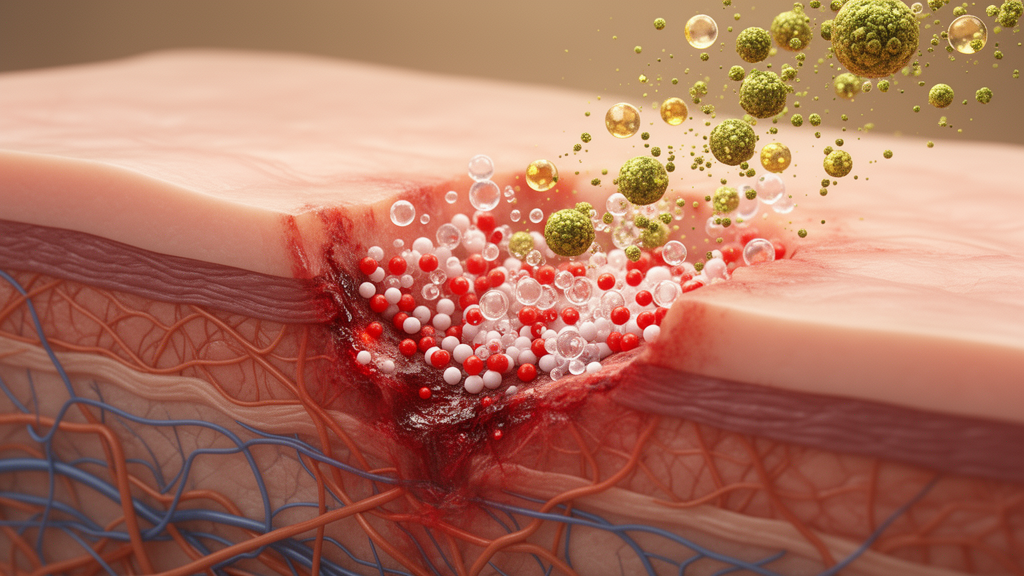
Engineered delivery systems for Chinese herbal medicine-derived therapeutics can improve wound closure in diabetic animal models, but the evidence that they specifically enhance nuclear factor kappa B (NF-κB) modulation remains uneven. A review of published studies found that most formulations improved formulation performance and repair outcomes, while fewer experiments directly measured activation of the core IκB kinase (IKK)–IκBα–p65 signaling cascade or the therapeutic’s exposure inside wounded tissue. The authors say the evidence currently supports engineered delivery as a promising way to modify local therapies, but it does not yet establish a complete causal chain from material properties to sustained NF-κB regulation and diabetic wound repair.
Diabetic wounds fail to progress normally through overlapping phases of hemostasis, inflammation, proliferation, and remodeling. Persistent hyperglycemia, oxidative stress, vascular and neural injury, infection, and immune dysregulation can keep wounds in an inflammatory state. NF-κB is central to this transition because it regulates cytokines, chemokines, extracellular-matrix remodeling, and other processes needed for early immune defense and repair. Its activity normally rises after injury and then declines as pathogens and damaged tissue are cleared. In diabetic wounds, repeated metabolic and inflammatory signals can prevent that decline, sustaining expression of mediators such as TNF-α, IL-1β, and IL-6 while disrupting keratinocytes, fibroblasts, endothelial cells, and tissue reconstruction.
The distinction between pathway activation and related measurements is crucial. At rest, IκBα inhibits the RelA/p65–p50 complex in the cytoplasm. Receptor signals activate the IKK complex, which phosphorylates IκBα and promotes its degradation, allowing p65 to enter the nucleus and activate inflammatory and repair-related genes. Changes in NF-κB messenger RNA, total p65 protein, reactive oxygen species, or cytokine concentrations may indicate that the inflammatory environment has shifted, but they do not by themselves establish inhibition of the core cascade. More direct evidence comes from measurements of IκBα phosphorylation or degradation, p65 phosphorylation, nuclear translocation, DNA binding, or transcriptional activity. The review therefore separated studies with such readouts from those reporting only expression, pathway-associated proteins, or downstream inflammation.
Engineered systems have addressed several barriers that limit direct topical use of herbal-derived compounds. Berberine, an isoquinoline alkaloid with antibacterial, anti-inflammatory, antioxidant, and metabolic-regulatory activities, has been encapsulated in lecithin–chitosan nanoparticles measuring 168.4 nanometres on average, dispersed in calcium-crosslinked hydrogels, and incorporated into radially aligned fibers designed to guide fibroblast migration. These studies reported reduced inflammatory-cell infiltration or macrophage cytokines, along with faster closure, angiogenesis, collagen deposition, or tissue remodeling in diabetic wound models. Their evidence differed, however: one measured total NF-κB expression, while others primarily reported antioxidant or inflammatory outcomes. None directly quantified berberine exposure within wound tissue.
Polyphenols have been engineered for similar purposes, with poor water solubility and chemical stability presenting major formulation constraints. Curcumin loaded into chitosan nanoparticles showed slower in vitro release and increased macrophage uptake, while curcumin in heparin-grafted aligned PLGA fibers produced sustained release, supported cell migration, and retained endogenous growth factors at the wound interface. Quercetin nanoparticles embedded in a gelatin methacryloyl hydrogel released the compound for about 48 hours, compared with complete release of free quercetin within 8 hours. The composite reduced RAGE, total NF-κB protein, reactive oxygen species, and inflammatory mediators while favoring a reparative macrophage state. Taxifolin incorporated into alginate/PVA electrospun fibers was associated with lower TLR4/NF-κB/NLRP3-associated proteins and improved repair. Yet these studies did not measure IκBα degradation or p65 nuclear movement, leaving their pathway evidence at the expression or associated-protein level.
Some herbal compounds serve as active cargoes and structural components at once. Glycyrrhizic acid can form supramolecular networks with zinc ions, while oxidized Ganoderma lucidum polysaccharides can crosslink with carboxymethyl chitosan through Schiff-base bonds to create a stable double-network hydrogel. Such systems promoted shifts from inflammatory toward reparative macrophage states, reduced reactive oxygen species or TNF-α, and improved re-epithelialization, angiogenesis, collagen deposition, and restoration of skin architecture. Rhein from rhubarb was assembled into fibers and placed in a ferrocene–β-cyclodextrin hydrogel that weakened under oxidative conditions, triggering release while preserving the assembled therapeutic. More complex formulations combined responsive release, antibacterial particles, peptides, or additional vesicles. When component-specific controls were missing, the review attributed biological effects to the complete formulation rather than to the herbal ingredient alone.
Chinese herbal polysaccharides, multi-component extracts, and plant-derived nanovesicles have expanded the range of available delivery architectures. An Astragalus membranaceus polysaccharide and baicalein carrier carrying berberine was incorporated into dissolving microneedles for biofilm-covered diabetic wounds. The needles penetrated the wound surface, dissolved, and released cargo in response to high reactive oxygen species. Treatment reduced p65 phosphorylation, TNF-α, IL-6, and reactive oxygen species while improving closure, angiogenesis, and collagen deposition. Houttuynia cordata extracellular vesicles released from a glucose- and reactive-oxygen-responsive collagen hydrogel produced more direct evidence: investigators detected reduced IκBα and p65 phosphorylation, restored total IκBα, lower inflammatory mediators, and increased angiogenesis and collagen deposition. A Ginkgo biloba vesicle system and a bitter melon vesicle–mesenchymal stromal cell vesicle hydrogel likewise improved repair, although their broader effects were evaluated mainly through inflammation, oxidative stress, macrophage state, or associated pathways.
These findings are encouraging, but two linked gaps prevent a firm conclusion that engineering specifically strengthens NF-κB modulation. First, slow release in a buffer does not demonstrate prolonged residence in a wound, and a persistent carrier or fluorescent signal cannot substitute for measuring the therapeutic itself. Most studies characterize particle size, encapsulation, release, or cellular uptake, but relatively few quantify local therapeutic concentrations, tissue distribution, and intracellular exposure in the same experiment. Second, most biological findings concern upstream signals such as TLR4/MyD88, antioxidant pathways, reactive oxygen species, or downstream cytokines. These endpoints are compatible with improved NF-κB control but do not prove that the core cascade mediates healing. The review’s conclusion is that current evidence more consistently supports better formulation performance and wound repair than a proven delivery-dependent enhancement of NF-κB activity.
Timing and cellular context add another layer of uncertainty. Moderate NF-κB activation during the early phase of injury contributes to macrophage recruitment, bacterial clearance, and the initiation of repair, so the therapeutic aim should be to limit persistent pathological activation rather than suppress the pathway continuously. A lower p65 signal measured at one late endpoint cannot reveal whether a formulation has selectively dampened prolonged activation or also blocked useful early responses. Whole-wound measurements likewise cannot distinguish altered signaling within a cell type from changes in the wound’s cellular composition. The authors argue that future studies should measure local exposure and NF-κB activity together across healing phases and relevant cell populations, while using blank-carrier, free-therapeutic, and component-specific controls to separate the effects of engineering, carrier, and added bioactive ingredients.
Translation also requires stronger quality control and safety testing of complete products. Extracts, polysaccharides, and biological nanoparticles can vary in composition, molecular weight, structure, stability, and preparation method, and those differences can alter encapsulation, crosslinking, release, and biological activity. Sterilization, storage, and scale-up may further change particle states and material networks. Final formulations also require biocompatibility assessment because zinc oxide, copper ions, photoinitiators, crosslinking reactions, and degradation products can introduce effects absent from testing individual components. Animal models remain another boundary: conventional diabetic skin-defect models do not reproduce the combined neuropathy, ischemia, infection, and mechanical loading of a human diabetic foot. Faster closure therefore shows efficacy within a selected model, not clinical effectiveness. The review’s proposed next step is not simply longer release, but experimentally aligned systems that demonstrate where a therapeutic is present, how it changes NF-κB activity over time, which cells are affected, and whether those changes causally contribute to repair.
Subject of Research: Review of engineered Chinese herbal medicine delivery for modulating NF-κB in diabetic wound models
Article Title: Engineered delivery of Chinese herbal medicine-derived therapeutics for diabetic wound healing: a focus on NF-κB cascade modulation
Article References: Chen, B., Wang, Q., Zhang, J., Li, X., Wang, N., Zou, M., Huang, Z., Feng, J., Zhang, G., & Ju, S. (2026). Engineered delivery of Chinese herbal medicine-derived therapeutics for diabetic wound healing: a focus on NF-κB cascade modulation. Frontiers in Bioengineering and Biotechnology, 14, 1977317. https://doi.org/10.3389/fbioe.2026.1977317
Image Credits: AI Generated
DOI: 10.3389/fbioe.2026.1977317
Keywords: diabetic wounds, NF-κB signaling, engineered delivery, Chinese herbal medicine, hydrogels, nanoparticles, microneedles, nanovesicles, wound healing, tissue repair, Engineered, delivery
Cite Scienmag News
Denise Maddox. (October 22, 2026). Engineered Herbal Therapies Target Persistent Inflammation in Diabetic Wounds. Scienmag. https://scienmag.com/engineered-herbal-therapies-target-persistent-inflammation-in-diabetic-wounds/
Denise Maddox. "Engineered Herbal Therapies Target Persistent Inflammation in Diabetic Wounds." Scienmag, 22 October 2026, https://scienmag.com/engineered-herbal-therapies-target-persistent-inflammation-in-diabetic-wounds/. Accessed 22 October 2026.
Denise Maddox. "Engineered Herbal Therapies Target Persistent Inflammation in Diabetic Wounds." Scienmag. October 22, 2026. https://scienmag.com/engineered-herbal-therapies-target-persistent-inflammation-in-diabetic-wounds/


