


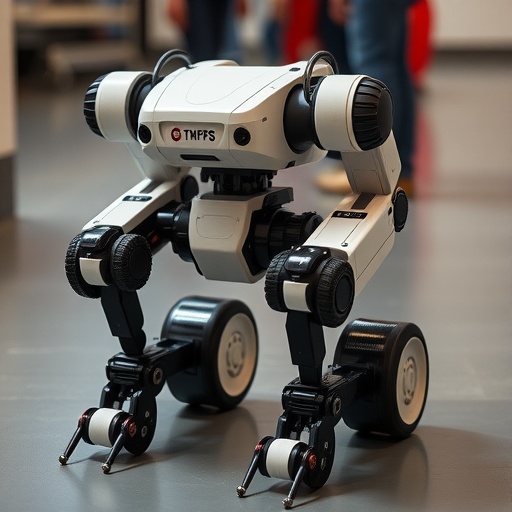
Quadruped robots are beginning to move beyond laboratories, taking on inspection, transportation, logistics and search-and-rescue missions in environments too uneven or dangerous for wheeled machines. Yet their ability to walk comes with a major energy penalty. Every step requires motors to repeatedly lift and reposition the legs, absorb the impact of landing and stabilize the body. A new study from Seoul National University of Science and Technology in South Korea suggests that one of the simplest parts of a walking robot—its feet—could play a surprisingly important role in reducing that energy demand.
Researchers Dr. Keun Park and Dr. Jung-Yup Kim have developed lightweight, porous robot footpads based on triply periodic minimal surface, or TPMS, structures. These intricate three-dimensional architectures consist of repeating curved networks that combine low weight with controlled stiffness and strong energy-absorption properties. When a robot’s foot strikes the ground, the structure deforms and stores part of the impact energy. During the subsequent phase of the step, it can release some of that energy, reducing the mechanical work required from the robot’s motors.
The idea resembles the function of elastic components used in animal movement and in engineered systems such as springs, shock absorbers and composite running blades. However, conventional springs mounted in a robot’s legs can create problems, particularly when the machine is moving slowly. At low walking speeds, stored elastic energy may not be returned at the right moment or in the right direction. Instead, it can be dissipated as heat or cause unwanted motion, forcing the robot’s controller to make additional corrections. The SeoulTECH team sought to place the energy-storage function directly at the point of contact with the ground, where it could be coordinated more precisely with each step.
To identify the most effective design, the researchers manufactured three hemispherical TPMS footpads using additive manufacturing. The structures were based on three well-known minimal-surface geometries: primitive, gyroid and diamond. Although all three designs were porous, their internal surfaces distributed stress and deformation differently. The team subjected the footpads to compression tests, measuring how much energy each could absorb during loading and how efficiently it could return that energy during unloading.
The diamond-shaped structure emerged as the most promising candidate. With a relative density of 60 percent, it provided a combination of flexibility, impact-energy absorption and limited energy loss. Relative density describes how much solid material is present compared with a fully dense version of the same material. By adjusting this parameter, engineers can tune a metastructure’s stiffness and deformation behavior without simply making the entire component larger or heavier. In this case, the optimized diamond design was compliant enough to deform under impact while remaining stable enough to support the robot during locomotion.
The researchers then addressed a more difficult question: how could the robot learn to use the footpads rather than fight against them? They integrated the compliant feet with a deep reinforcement learning controller, an artificial-intelligence system that improves its behavior by evaluating the consequences of different actions. During training, the controller tested alternative gait strategies and received feedback based on energy consumption and walking performance. Its learning process also incorporated the compression and rebound of the TPMS structures, allowing it to coordinate leg motion with the passive behavior of the feet.
This coordination is essential because the footpads do not generate energy. They only store and return energy that would otherwise be lost during ground contact. To benefit from them, the robot must place its feet, regulate its leg trajectories and time its push-off phase so that the released elastic energy contributes to forward motion. The learning-based controller effectively searches for these combinations while also maintaining balance. It can therefore adapt the robot’s movement to the changing mechanical response of the compliant footpads instead of treating them as rigid, conventional soles.
The team tested the trained system on a commercially available quadruped robot fitted with the optimized TPMS feet. Across walking speeds from 0.4 to 1.0 meters per second, the robot used between 1.4 and 6.2 percent less battery power than the same platform equipped with solid feet. The largest improvement reached 6.2 percent, while the robot continued to walk stably. The results indicate that even modest changes to the foot-ground interaction can reduce the electrical work demanded from the motors when the robot’s controller is designed to exploit those changes.
The findings highlight a broader direction in robotic engineering: improving efficiency may depend as much on intelligent mechanical design as on more powerful batteries or motors. A carefully engineered metastructure can shape how forces move through a machine, absorbing shocks, reducing vibration and returning useful energy at the appropriate moment. Combining such passive mechanical behavior with deep reinforcement learning could allow future robots to operate for longer periods between charges, carry out quieter movements and require less intensive motor control. The approach may be particularly valuable for indoor service robots, inspection machines and autonomous systems working far from charging stations.
The researchers describe the TPMS footpads as energy-shaping components rather than simple shock absorbers. Their work demonstrates that a robot’s controller and its physical structure can be designed as a single system, with the robot learning how to take advantage of material behavior that would otherwise be wasted. The study was published online on May 5, 2026, in the International Journal of Precision Engineering and Manufacturing-Green Technology. While the reported savings are not yet a complete solution to the energy challenges of legged locomotion, the result offers a practical route toward more efficient quadruped robots—one step, and one carefully engineered foot, at a time.
News Publication Date: 5-May-2026
Web References: https://doi.org/10.1007/s40684-026-00895-5
References: International Journal of Precision Engineering and Manufacturing-Green Technology; DOI: 10.1007/s40684-026-00895-5
Cite Scienmag News
Denise Maddox. (August 1, 2026). Energy-saving TPMS feet boost quadruped robots, researchers report. Scienmag. https://scienmag.com/energy-saving-tpms-feet-boost-quadruped-robots-researchers-report/
Denise Maddox. "Energy-saving TPMS feet boost quadruped robots, researchers report." Scienmag, 1 August 2026, https://scienmag.com/energy-saving-tpms-feet-boost-quadruped-robots-researchers-report/. Accessed 3 September 2026.
Denise Maddox. "Energy-saving TPMS feet boost quadruped robots, researchers report." Scienmag. August 1, 2026. https://scienmag.com/energy-saving-tpms-feet-boost-quadruped-robots-researchers-report/


