

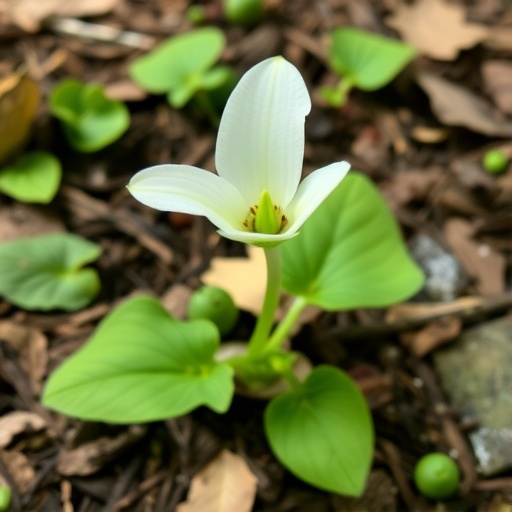
In a world where biodiversity is increasingly under threat, significant attention has been directed towards the conservation of endangered species, particularly those that are endemic to specific regions. Among those species is Trillium govanianum, a plant known for its unique characteristics and restricted geographical distribution. Recent research by Gillani et al. sheds light on the geographic distribution patterns, population dynamics, and habitat vulnerability of this fascinating species, providing insights that may prove vital for its conservation.
Trillium govanianum is a perennial herbaceous plant belonging to the family Melanthiaceae. This species is characterized by its distinct three-petaled flowers and three broad leaves that emerge from a single stem. Known commonly as the Himalayan trillium, it thrives in the temperate forests of the Himalayan region, primarily in Pakistan, India, and parts of Nepal. The stunning appearance of its flowers makes it not only ecologically significant but also appealing commercially, as it has attracted the interest of horticulturists and collectors.
The study conducted by Gillani et al. involved a meticulous examination of the environmental preferences and population status of Trillium govanianum. The researchers utilized a combination of field surveys, spatial analysis, and ecological modeling to understand how various factors influence the distribution of this species in its native habitat. They identified critical habitats and assessed how human activities, such as urban development and deforestation, pose threats to its survival.
One significant finding of the study is the impact of climate change on Trillium govanianum. The researchers discovered that rising temperatures and shifting precipitation patterns could alter the plant’s habitat suitability. By employing niche modeling techniques, they projected potential future distributions of the species under different climate scenarios. These projections indicate a potential contraction in its range, with some areas becoming unsuitable for growth, leading to increased vulnerability and possible local extinctions.
Population dynamics of Trillium govanianum were also a central focus of this study. The researchers gathered data on the size and density of various populations to establish baseline information. A surprising discovery was the existence of small, isolated populations that are particularly vulnerable to extinction due to their limited genetic diversity. The findings suggest that these populations are less resilient to environmental changes, highlighting the need for comprehensive conservation strategies aimed at protecting genetic diversity.
Moreover, the study addresses the effects of human encroachment on Trillium govanianum. Land-use changes associated with agricultural expansion, urbanization, and infrastructure development have led to habitat fragmentation. This fragmentation not only limits the mobility of the species but also increases the potential for genetic isolation among populations. With these challenges in mind, the researchers advocate for habitat restoration initiatives that focus on reclaiming and revitalizing native forest ecosystems.
Another critical aspect of the research is the identification of conservation priorities based on the current threats faced by Trillium govanianum. The researchers suggest implementing protected areas that encompass the natural habitats of the species to mitigate the adverse effects of habitat loss. By establishing conservation zones, it is possible to provide a refuge for not only Trillium govanianum but also other species that share its environment, thereby fostering biodiversity.
The implications of this research extend beyond the immediate conservation of Trillium govanianum. It highlights the intricate relationships between species and their habitats, emphasizing how human activities and environmental changes can dramatically influence those relationships. As more species face increased risks due to climate change and other anthropogenic pressures, studies like this one provide critical evidence needed to influence policy and conservation strategies.
Furthermore, the research team has urged policymakers and conservation organizations to collaborate on comprehensive biodiversity action plans that incorporate scientific findings. These plans should consider ecological, socioeconomic, and cultural aspects of the regions where Trillium govanianum is found. Engaging local communities in conservation efforts can promote sustainable practices that enhance the resilience of both ecosystems and human populations.
Ultimately, the study by Gillani et al. serves as a call to action, emphasizing the urgency of conserving Trillium govanianum and many other endemic species at risk of extinction. By shedding light on the species’ geographic distribution, population dynamics, and habitat vulnerabilities, the researchers have provided a crucial resource for conservationists seeking to reverse the tide of biodiversity loss. The survival of Trillium govanianum is interlinked with the health of its ecosystem, and preserving it may well be a reflection of the broader struggle to sustain our planet’s rich natural heritage.
Preserving Trillium govanianum requires a multidimensional approach that integrates ecological understanding with effective management strategies. As awareness grows regarding the threats faced by this species, there is hope that collaborative efforts can not only protect Trillium govanianum but also contribute to a more sustainable coexistence between human populations and the natural world. The intriguing complexities of life on Earth continue to remind us of our responsibility to safeguard the delicate balance of our ecosystems for future generations.
In conclusion, the research highlights the importance of studies like that conducted by Gillani et al. as we navigate the challenges posed by rapid environmental changes. By combining scientific inquiry with actionable conservation strategies, there is potential to foster a more resilient planet where species like Trillium govanianum can thrive amidst the pressures of modern life. It is imperative for researchers, policymakers, and the public to work together to ensure that this and other endangered species are not relegated to the annals of history, but rather celebrated and preserved for their intrinsic value and the roles they play within their ecosystems.
Subject of Research: Trillium govanianum (Himalayan trillium)
Article Title: Geographic distribution patterns, population dynamics, and habitat vulnerability of endangered and endemic Trillium govanianum.
Article References:
Gillani, S.W., Ahmad, M., Manzoor, M. et al. Geographic distribution patterns, population dynamics, and habitat vulnerability of endangered and endemic Trillium govanianum.
Environ Monit Assess 198, 162 (2026). https://doi.org/10.1007/s10661-026-15013-w
Image Credits: AI Generated
DOI: https://doi.org/10.1007/s10661-026-15013-w
Keywords: conservation, biodiversity, Trillium govanianum, habitat vulnerability, climate change, population dynamics, endemic species, ecosystems


