


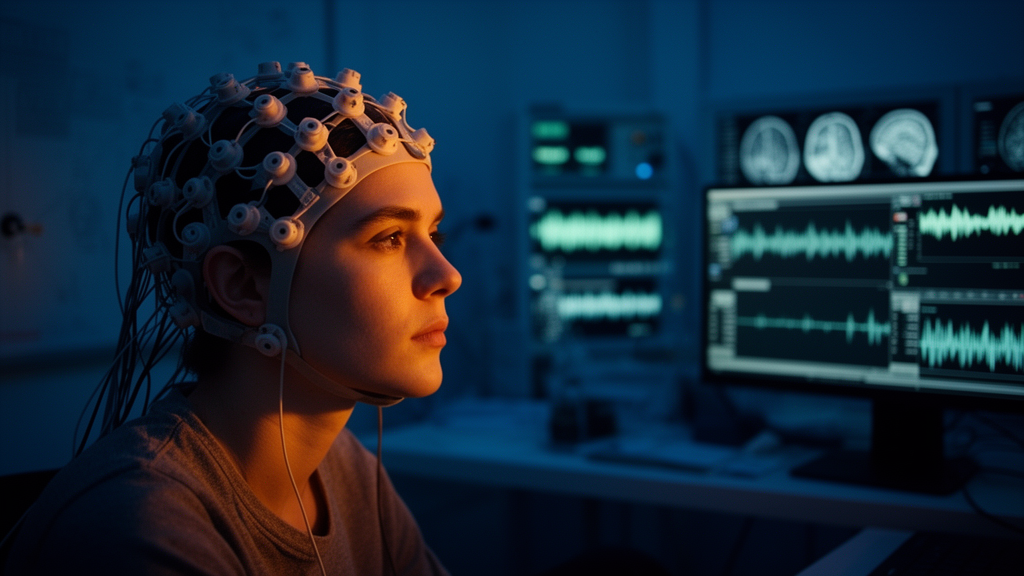
Neuroticism—the tendency to experience anxiety, worry, and negative emotions—has long been recognized as one of the most consequential dimensions of human personality. People who score high on this trait face a substantially elevated risk of developing anxiety disorders, mood disorders, and substance use problems, which makes understanding its biological roots a central goal of neuroscience. Yet decades of brain-imaging research have produced a frustratingly inconsistent picture, with studies reporting conflicting findings about which brain regions and functions underlie the trait. A new study published in Communications Psychology offers a fresh explanation for that inconsistency and, in doing so, delivers a striking result: the brain signatures of neuroticism become dramatically easier to detect when people watch emotionally charged movie scenes that resonate with the trait itself.
The research, led by Johanna L. Popp and Kirsten Hilger of the University of Würzburg together with Joshua Faskowitz of Indiana University, took advantage of the Human Connectome Project, one of the largest open-access neuroimaging datasets in existence. The team analyzed ultra-high-field 7-Tesla fMRI data from 174 young adults who had watched four short films—roughly fifteen minutes each—while lying in the scanner. Crucially, the participants had also completed the NEO-Five-Factor Inventory, a standard questionnaire measuring the Big Five personality traits, allowing the researchers to link each person’s neuroticism score to the way their brain responded to the films.
Rather than asking whether particular brain regions light up more strongly in neurotic individuals, the team employed a technique called inter-subject representational similarity analysis, or IS-RSA. The logic is elegant. First, the researchers measured how similarly each pair of participants’ brains responded to the movies, region by region, using inter-subject correlations of activity time courses across 200 functionally defined brain areas. They then compared this matrix of neural similarity to a matrix of similarity in neuroticism scores. If people with similar personalities show similar brain responses, the two matrices should align—and the precise form of that alignment can reveal something deeper about how the trait is organized in the brain.
To test competing hypotheses about that form, the researchers constructed three mathematical models of trait similarity. The Nearest Neighbors model assumes that people with similar neuroticism scores, whether high or low, show similar brain activity. The Anna Karenina model—named after Tolstoy’s famous opening line about happy and unhappy families—assumes that high scorers resemble one another while low scorers diverge. The Gaussian model predicts that people in the middle of the distribution are the most alike. When the team compared these models against the actual neural data, a clear winner emerged, but with an unexpected twist: it was the inverse of the Anna Karenina model that best described reality. In other words, people with low neuroticism responded to the films in highly similar ways, while people with high neuroticism diverged from one another—and from everyone else—in their patterns of brain activity.
This finding of increasing neural heterogeneity with increasing neuroticism is more than a statistical curiosity. The researchers speculate that it may reflect a well-documented feature of the trait: a propensity for worry and rumination. According to Attentional Control Theory and the Dual Mechanisms of Control framework, highly neurotic individuals rely on reactive, bottom-up attentional systems that are vulnerable to disruption by internally generated thoughts. While watching a film, a person high in neuroticism may drift inward, activating autobiographical memories and personal concerns that are unique to their life history. Such idiosyncratic internal processing would naturally produce brain activity that differs from person to person, whereas low scorers, attending more uniformly to the screen, would generate closely matched responses. The authors also note that distinct subtypes of neuroticism, such as the so-called healthy neuroticism profile combining high neuroticism with high conscientiousness, could contribute to this diversity of neural responses.
The study’s second major contribution came from a clever two-stage design. Before analyzing any brain data, the researchers ran an online pilot study in which 86 independent participants rated 88 thirty-second scenes from the same four movies on how strongly each scene evoked emotions related to the six facets of neuroticism: anxiety, angry hostility, self-consciousness, depression, impulsiveness, and vulnerability. Scenes falling in the top quartile of these ratings were classified as trait-relevant, while those in the bottom quartile were classified as trait-irrelevant. This allowed the team to ask whether the link between neuroticism and brain activity depends on what is happening on screen—a direct test of interactionist personality theories, such as Cybernetic Big Five Theory and Trait Activation Theory, which hold that traits reveal themselves most clearly in situations that engage them.
The answer was emphatic. When the researchers restricted their analysis to trait-relevant scenes, the association between neuroticism and neural response heterogeneity was roughly twice as strong as during trait-irrelevant scenes. At the whole-brain level, the effect size grew from a Cohen’s d of about 0.64 to about 1.43, and the difference between the two scene types was itself highly significant. The amplification was visible across multiple large-scale functional networks, including the default mode network, the ventral attention and salience network, the dorsal attention network, and the somatomotor network, with the default mode network—a system closely tied to self-referential thought and autobiographical memory—showing one of the most robust enhancements. The pattern replicated almost entirely in an independent sample of 85 participants drawn from the same dataset but analyzed separately.
The authors interpret this amplification as a kind of neural stress test. Just as a cardiac stress test exposes hidden weaknesses in the heart that are invisible at rest, emotionally demanding scenes appear to engage the neural machinery of neuroticism more fully, making each individual’s trait-related response patterns more pronounced and therefore more detectable. This idea converges with earlier work showing that brain-trait associations in general become stronger when neural activity is constrained by trait-relevant tasks, and it carries a practical message for the field: stimulus selection is not a trivial detail but a powerful lever for improving the sensitivity of neuroimaging studies of individual differences, an area of research that has struggled with small effect sizes and replication failures.
The findings also resonate with a growing literature on clinical populations. Reduced similarity of brain responses during naturalistic viewing has been reported in patients with melancholic depression, first-episode psychosis, and in children and adolescents with elevated social anxiety or depressive symptoms. The new results extend this picture to neuroticism in healthy adults, lending support to dimensional models of psychopathology, such as the Hierarchical Taxonomy of Psychopathology, which view mental disorders as extreme ends of continuous trait distributions rather than categorically distinct illnesses. If heightened neural heterogeneity during emotional stimulation marks a vulnerability that precedes clinical onset, naturalistic neuroimaging could eventually help identify at-risk individuals before illness strikes, opening a window for personalized prevention.
The study is not without limitations, which the authors acknowledge candidly. The sample, though larger than most brain-wide association studies, is modest by the standards now considered necessary for robust individual-differences research, and no fully independent external dataset with comparable movie fMRI and personality data currently exists. Trait-relevance was rated after viewing rather than measured during scanning, no direct measure of attention such as eye-tracking was collected, and demographic covariates cannot yet be formally controlled within the IS-RSA framework. Even so, the work stands as a compelling demonstration that who we are shapes how our brains respond to the world—and that the right moments in a film can bring those hidden differences into sharp focus.
Subject of Research: Neural correlates of neuroticism during naturalistic movie-watching fMRI
Article Title: Trait-relevant movies amplify neuroticism-associated brain responses
Article References: Popp, J. L., Weiß, M., Faskowitz, J., & Hilger, K. (2026). Trait-relevant movies amplify neuroticism-associated brain responses. Communications Psychology, 4(1), Article 134. https://doi.org/10.1038/s44271-026-00541-5
Image Credits: AI Generated
DOI: 10.1038/s44271-026-00541-5
Keywords: neuroticism, personality neuroscience, fMRI, naturalistic stimuli, inter-subject correlation, IS-RSA, Human Connectome Project, mental health risk, default mode network, attentional control, psychopathology, movie watching
Cite Scienmag News
Cassandra Pierce. (October 9, 2026). Emotional Movie Scenes Reveal Hidden Brain Signatures of Neuroticism. Scienmag. https://scienmag.com/emotional-movie-scenes-reveal-hidden-brain-signatures-of-neuroticism/
Cassandra Pierce. "Emotional Movie Scenes Reveal Hidden Brain Signatures of Neuroticism." Scienmag, 9 October 2026, https://scienmag.com/emotional-movie-scenes-reveal-hidden-brain-signatures-of-neuroticism/. Accessed 9 October 2026.
Cassandra Pierce. "Emotional Movie Scenes Reveal Hidden Brain Signatures of Neuroticism." Scienmag. October 9, 2026. https://scienmag.com/emotional-movie-scenes-reveal-hidden-brain-signatures-of-neuroticism/


