


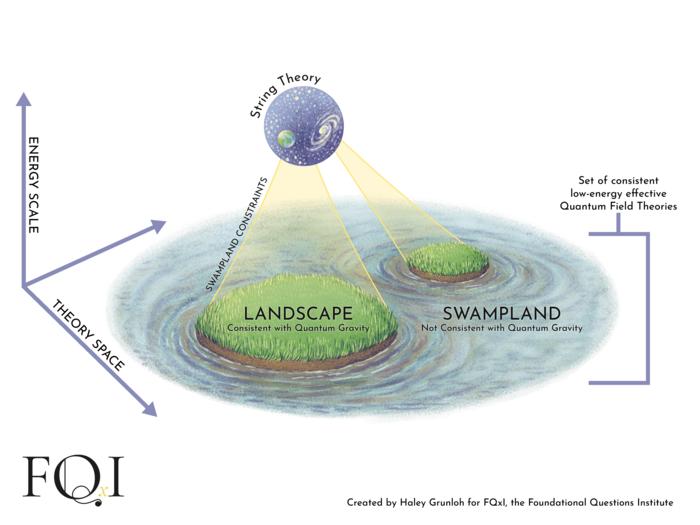
String theory has long held the promise of unifying the fundamental forces of nature, providing a framework that elegantly describes elementary particles and their interactions as manifestations of tiny, vibrating strings. Since its inception, it has represented one of the most ambitious attempts in theoretical physics to capture the underpinnings of the universe. However, despite its allure, string theory has encountered formidable conceptual challenges, particularly in reconciling its vast landscape of possible universes with our observed reality. Recent developments have exposed a troubling discrepancy: most solutions generated by string theory’s equations appear to be incompatible with the key features of our universe, especially the phenomenon of dark energy and workable models of quantum gravity. This emerging crisis, famously termed the “string theory swampland,” has cast doubt on string theory’s ability to fully describe cosmological evolution.
At the heart of this swampland problem lies a perplexing paradox. Early in the 21st century, physicists discovered that string theory’s equations do not specify a unique universe but instead open a Pandora’s box of approximately 10^500 possible vacua—different candidate universes each with its own distinctive particles, forces, and constants. This staggering multiplicity gave rise to the concept of the "string theory landscape," a metaphorical terrain teeming with potential universes. Yet, this landscape is bordered by a vast “swampland” of mathematically consistent yet physically inconsistent scenarios that defy integration with quantum gravity principles. Among the most pressing issues is the inability of conventional string theory models to naturally incorporate dark energy—the mysterious force driving the accelerated expansion of our cosmos—and to support standard cosmological mechanisms such as inflation.
This profound challenge has motivated researchers to rethink and extend the assumptions underlying string theory. A compelling new breakthrough has emerged from the work of Eduardo Guendelman, a physicist affiliated with the Foundational Questions Institute (FQxI) and Ben-Gurion University of the Negev in Israel. Guendelman’s recent analysis proposes a novel class of string models that could potentially circumvent the constraints imposed by the swampland. Unlike traditional models where the string tension—a fundamental parameter characterizing a string’s energy and resistance to stretching—is fixed a priori, these exotic strings generate their tension dynamically through internal mechanisms. This subtle shift in perspective enables new theoretical landscapes with properties that better align with observed cosmological realities.
The notion of dynamically generated string tension is revolutionary because it acknowledges the tension as an emergent quantity subject to the internal dynamics of the string rather than a static external input. In conventional string theory, the string tension is a fixed constant that directly influences the Planck scale, the fundamental length scale below which quantum gravitational effects dominate. Guendelman’s innovation lies in demonstrating that if the tension itself fluctuates and interacts with other fields dynamically, the associated Planck scale likewise becomes a variable quantity. This dynamism in the Planck scale has profound implications for the swampland criteria, which are predicated on fixed scales and constants.
When the string tension and the Planck scale become dynamical, the swampland constraints weaken substantially. These constraints had previously stood as nearly insurmountable barriers, forbidding realistic cosmological scenarios such as slow-roll inflation—a brief, explosive expansion phase hypothesized to explain the smoothness and flatness of the universe—and consistent incorporation of dark energy, often modeled by a de Sitter vacuum state. Guendelman’s theoretical framework suggests that in regions where the dynamical tension grows large, the swampland constraints lose their restrictive power, opening the door to viable models capable of describing our actual universe. This revelation challenges the entrenched pessimism that conventional string theory was incompatible with established cosmological phenomena.
Moreover, this approach brings fresh conceptual insights into the mechanism of spontaneous symmetry breaking and the associated restoration phenomena in the target space of string theories. By imposing scale invariance in the target space alongside symmetry breaking, these dynamical tension theories establish a more flexible and adaptive framework that resonates better with the complexities of quantum gravity. Guendelman’s work meticulously formulates this theory, providing mathematical rigor to support the possibility of escape routes from the swampland quagmire. This not only rejuvenates string theory’s relevance but also strengthens its position as a foundational candidate for explaining reality.
The implications of dynamically generated tension extend beyond purely academic interest, as they directly influence cosmological model building. Inflationary models within this framework could accommodate slow-roll dynamics without clashing with swampland conditions, thereby making the early universe’s rapid expansion phase more natural to realize. Similarly, the framework promises improved consistency in embedding the elusive dark energy into string-theoretic descriptions. This development potentially harmonizes quantum gravity with cosmology in unprecedented ways, allowing a cohesive narrative of the universe’s birth, evolution, and accelerated expansion.
Guendelman’s groundbreaking findings, published in The European Physical Journal C in March 2025, underscore the importance of revisiting and broadening the foundational assumptions of string theory. His paper meticulously details the mathematical underpinnings of dynamical string tension theories while elucidating their cosmological relevance. By infusing scale invariance and breaking established norms around fixed string tension, the research transcends previous limitations and invigorates ongoing quests to unify particle physics with gravitation and cosmology. It encourages theorists to explore the fertile swathes of the landscape with new tools, potentially charting a path towards empirical predictions and testable hypotheses.
The challenged status quo in string theory signaled by the swampland problem also serves as a poignant reminder of the complexities inherent in uniting general relativity and quantum mechanics. Guendelman’s innovative approach presents a rare instance where theoretical elegance and empirical compatibility might converge. If dynamically generated tension models continue to withstand scrutiny and expand understanding, they could catalyze a paradigm shift in fundamental physics, offering a refined understanding of the quantum structure of spacetime, and resolving some of the most confounding cosmological puzzles.
In broader context, this work exemplifies the vital role of foundational questions in driving physics forward. Organizations such as the Foundational Questions Institute, by supporting explorations at the edges of knowledge, facilitate breakthroughs that challenge established dogma and offer fresh perspectives. The dynamical tension string models enrich the tapestry of string theory research, inviting renewed engagement with one of physics’ grandest challenges. As theoretical neuroscience and cosmology converge on deep questions, such novel frameworks underscore the ever-evolving nature of scientific inquiry.
Ultimately, the dynamical tension string theories do more than address technical constraints; they articulate a philosophical shift. A universe in which fundamental constants and scales are not immutable but dynamically emergent reflects a subtler, more flexible conception of reality. This shift resonates with a growing trend in physics, moving toward relational and emergent understandings of space, time, and matter. Guendelman’s work thus presents not only a solution to an immediate theoretical impasse but also a profound conceptual advance that could redefine the future trajectory of fundamental physics.
News Publication Date: 12-Mar-2025
Web References:
References:
Guendelman, E. “Dynamical string tension theories with target space scale invariance SSB and restoration.” The European Physical Journal C (2025). DOI: 10.1140/epjc/s10052-025-13966-9
Keywords
String theory, swampland, dynamical string tension, quantum gravity, dark energy, inflation, Planck scale, cosmology, FQxI, scale invariance, spontaneous symmetry breaking, theoretical physics
Cite Scienmag News
Katie Riggs. (June 9, 2025). Emerging from the String Theory Swampland: A Breakthrough Discovery. Scienmag. https://scienmag.com/emerging-from-the-string-theory-swampland-a-breakthrough-discovery/
Katie Riggs. "Emerging from the String Theory Swampland: A Breakthrough Discovery." Scienmag, 9 June 2025, https://scienmag.com/emerging-from-the-string-theory-swampland-a-breakthrough-discovery/. Accessed 5 September 2026.
Katie Riggs. "Emerging from the String Theory Swampland: A Breakthrough Discovery." Scienmag. June 9, 2025. https://scienmag.com/emerging-from-the-string-theory-swampland-a-breakthrough-discovery/


