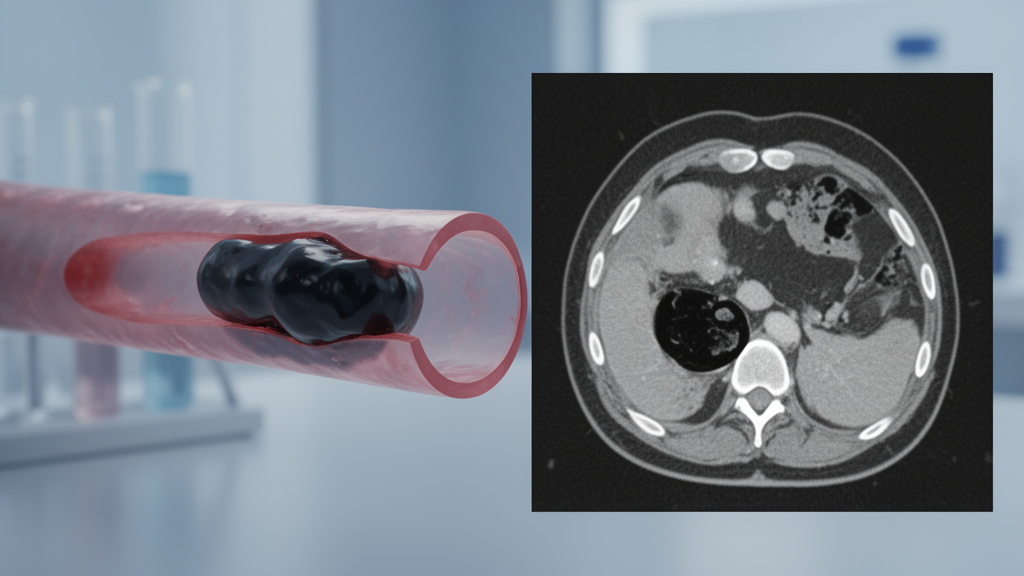
When interventional radiologists plug a bleeding artery with a soft, tantalum-laced hydrogel called Obsidio Conformable Embolic, the plug does not simply sit still inside the vessel. A new retrospective study reports that the embolic cast measurably shrinks over the months after delivery while its CT attenuation drifts upward, all without any radiologic sign that the occluded vessel has reopened. The work, published in CVIR Endovascular, offers one of the first quantitative, longitudinal portraits of how this relatively new embolic agent evolves inside human patients, and it gives clinicians a reference frame for telling expected material remodeling apart from genuine complications on follow-up scans.
The investigation was a single-center cohort study conducted between October 2023 and April 2026. The researchers enrolled 21 consecutive adult patients, with a mean age of 59 years, who had undergone transarterial embolization with Obsidio for active non-neurovascular hemorrhage or hypervascular tumor and who had at least two post-procedural CT scans available for review. Across the cohort, 30 vessels were treated: 15 patients had a single artery embolized, three patients had two arteries, and three patients had three arteries. The treated vessels included visceral branches such as gastroduodenal, gastric, adrenal and renal arteries in 13 cases, intercostal arteries in 11 cases, and inferior epigastric or internal mammary arteries in 6 cases. The indication was active hemorrhage in 25 vessels, or 83.3 percent, and a peripheral artery aneurysm or pseudoaneurysm in the remaining 5 vessels.
Every embolization in the series was technically successful, with immediate cessation of bleeding reported in all 30 treated vessels, including several trauma patients who arrived with coagulopathy. The operators injected a mean of 0.257 milliliters of Obsidio per vessel, using a superselective microcatheter technique and continuing injection under fluoroscopy until antegrade flow stasis was achieved. The patients were notably coagulopathic as a group: preprocedural INR values ranged from 1 to 4.7 with a mean of 1.52, hemoglobin ranged from 5.3 to 9.8 with a mean of 7, and platelet counts ranged from 53 to 314 with a mean of 191. These baseline characteristics underscore that the cohort reflects a real-world acute bleeding population rather than a curated elective one.
To track what happened to the embolic material afterward, the team relied on CT scans that were already part of standard clinical care. A baseline non-contrast scan, typically obtained within one to three days of the procedure, established the initial cast volume and radiodensity. Follow-up scans were then acquired according to clinical indication rather than a fixed research schedule. For the quantitative analysis, the researchers used the volumetric segmentation tool in a Picture Archiving and Communication System, manually outlining the radiopaque tantalum signal of the cast on non-contrast series. Two independent readers segmented each vessel, and disagreements were resolved by joint review and consensus. Recanalization was assessed on contrast-enhanced and angiographic phase images when available, defined as contrast opacification within or around the cast.
The volumetric results describe a steady, decelerating contraction of the embolic cast. At the first follow-up CT, obtained at a median of 12 days, the mean cast volume was 89.33 percent of the original post-procedural volume, a statistically significant reduction of 10.67 percent. By the second follow-up at a median of 36 days, available for 15 patients and 18 vessels, the volume had fallen to 79.51 percent of baseline, a net reduction of 20.49 percent. The third follow-up, at a median of 76 days and covering 7 patients and 9 vessels, showed a mean volume of 85.20 percent of baseline, a non-monotonic result the authors flag as the most variable time point in the series. At the fourth follow-up, at a median of 252 days, volume dropped to 66.79 percent of baseline, and at the fifth follow-up, at a median of 356 days, it reached 60.15 percent, a net reduction of 39.85 percent.
The pace of that shrinkage was not constant. The mean per-vessel rate of volume reduction measured 0.99 percent per day between the initial and first follow-up scans, slowed to 0.71 percent per day by the second follow-up, dropped sharply to 0.17 percent per day by the third, and then stabilized at roughly 0.2 percent per day through the later intervals. A representative case illustrated the pattern concretely: a single cast shrank from 290.1 cubic millimeters immediately after the procedure to 280.1 cubic millimeters at 10 days and 235.2 cubic millimeters at 32 days, a net loss of 18.9 percent, while retaining a cohesive morphology throughout. The authors interpret the decelerating rate as consistent with gradually slowing gelatin hydrolysis and water diffusion, eventually giving way to a stable scaffold dominated by the non-resorbable tantalum component.
Radiodensity told a subtler story. Mean Hounsfield unit attenuation within the cast showed a non-significant upward trend of 2.2 percent at the first follow-up, equivalent to an average rate of 0.55 percent per day, and a larger but still non-significant increase of 4.85 percent at the second follow-up, corresponding to a slower rate of 0.11 percent per day. At the third follow-up the increase was 4.47 percent, and by the fourth and fifth follow-ups the trend reversed into small, non-significant decreases of 3.65 percent and 2.12 percent respectively. The authors suggest this pattern fits a simple physical explanation: as the lower-attenuation gelatin matrix resorbs, the higher-attenuation tantalum becomes relatively concentrated within the persisting cast, briefly raising measured density before later measurement variability and small sample sizes blur the signal.
Perhaps the most clinically reassuring finding was what the scans did not show. Across every follow-up CT angiogram, the researchers observed no evidence of recanalization, distal embolization, or cast fragmentation, and the embolic material remained smooth and contiguous on all multiplanar reconstructions. This matters because a shrinking cast on a follow-up scan could otherwise be mistaken for treatment failure. The authors argue that the combination of volume loss, a transient attenuation rise and preserved occlusion instead points to a predictable remodeling process, distinct from the failure modes of other agents such as coil compaction or the recanalization that often follows gelatin sponge embolization.
That interpretation is anchored in preclinical work. A Good Laboratory Practice study in a porcine model previously showed that Obsidio provokes a localized inflammatory response involving macrophages and multinucleated giant cells, which break down the gelatin and silicate components by 90 days and leave only tantalum aggregates integrated into a remodeled, permanently occluded lumen by 180 days. Obsidio itself is a pre-formed, shear-thinning hydrogel composed of bioresorbable gelatin, synthetic silicate nanoplatelets, tantalum and water, designed to be cohesive and non-adhesive for controlled delivery and conformable vessel filling. The human imaging findings, while limited to a shorter observation window than the animal time course, are consistent with that bioresorption mechanism playing out in patients.
The study’s limitations are substantial and the authors are candid about them. The retrospective design and reliance on clinically indicated imaging produced heterogeneous follow-up intervals, and CT acquisition parameters were not standardized for research purposes, introducing potential variability in Hounsfield unit measurements. Formal inter-observer reproducibility metrics were not calculated, the sample of 21 patients and 30 vessels precludes meaningful subgroup analysis, and the cohort mixed high-flow traumatic hemorrhage with aneurysm cases. CT volumetry cannot definitively distinguish active bioresorption from passive compression, no histopathological correlation was available, and some follow-up scans included only non-contrast acquisitions, which may have limited sensitivity for detecting partial recanalization. Whether late recanalization or further cast evolution occurs beyond the available scans remains unknown. The authors call for prospective studies with standardized imaging time points and direct comparisons against established embolic agents to determine whether this distinctive remodeling behavior translates into differences in re-bleeding rates, post-embolization syndrome or long-term vessel patency.
Subject of Research: Longitudinal CT volumetry and radiodensity changes of Obsidio Conformable Embolic casts after transarterial embolization in humans
Article Title: Post-embolization dynamic changes in Obsidio Conformable Embolic: volume and radiodensity analysis
Article References: Harraka, M., Amin, R., Pourmorteza, A., Cohen, E. I., Afsari, B., Sabri, S. S., Banovac, F., Bomberger, H., Jones, J., Habibollahi, P., & Nezami, N. (2026). Post-embolization dynamic changes in Obsidio Conformable Embolic: volume and radiodensity analysis. CVIR Endovascular, 9(1), Article 136. https://doi.org/10.1186/s42155-026-00792-7
Image Credits: AI Generated
DOI: 10.1186/s42155-026-00792-7
Keywords: Obsidio Conformable Embolic, transarterial embolization, embolic cast remodeling, CT volumetry, Hounsfield unit attenuation, bioresorption, tantalum hydrogel, hemorrhage, recanalization, interventional radiology, gelatin matrix, follow-up imaging
Cite Scienmag News
Ophelia Keating. (October 27, 2026). Embolism-cast CT tracking shows Obsidio gel shrinking as radiodensity rises. Scienmag. https://scienmag.com/embolism-cast-ct-tracking-shows-obsidio-gel-shrinking-as-radiodensity-rises/
Ophelia Keating. "Embolism-cast CT tracking shows Obsidio gel shrinking as radiodensity rises." Scienmag, 27 October 2026, https://scienmag.com/embolism-cast-ct-tracking-shows-obsidio-gel-shrinking-as-radiodensity-rises/. Accessed 28 October 2026.
Ophelia Keating. "Embolism-cast CT tracking shows Obsidio gel shrinking as radiodensity rises." Scienmag. October 27, 2026. https://scienmag.com/embolism-cast-ct-tracking-shows-obsidio-gel-shrinking-as-radiodensity-rises/